
For restaurants, food brands, and culinary businesses. We earn editorial backlinks on food publications that build authority the big recipe sites cannot block.
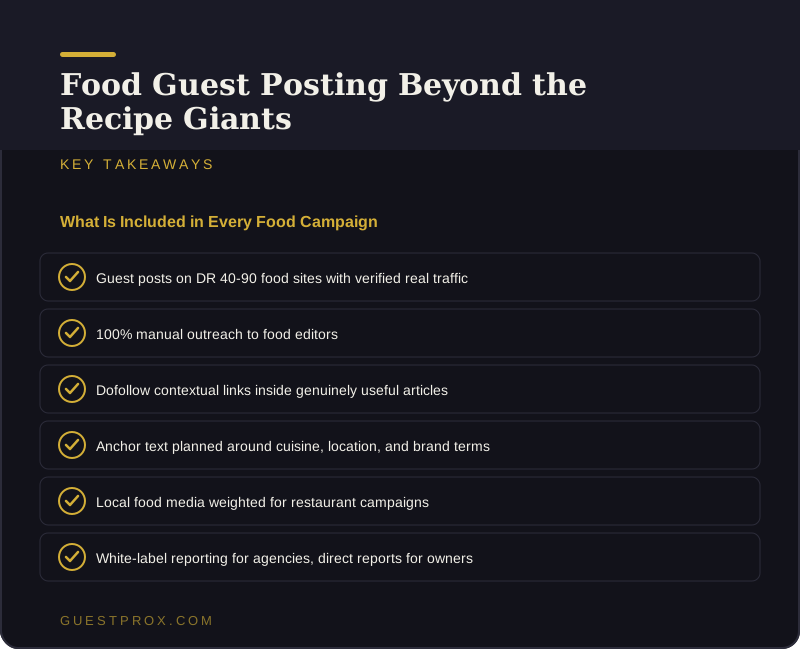
Food guest posting means publishing expert culinary content on real food publications, with a contextual backlink to your restaurant or food brand. The content must genuinely serve food lovers; this audience detects sponsored fluff instantly.
Food search has a structural quirk: recipe keywords are dominated by a handful of giants with perfect schema, massive libraries, and years of authority. A restaurant or food brand does not beat them at recipes. It wins with what they cannot publish: local food culture, chef expertise, and ingredient stories with real provenance.
The publisher economics matter here. Food bloggers and mid-size publications run on tight margins and get pitched constantly. What cuts through is content that serves their readers and fills a gap: technique explainers, ingredient deep-dives, local food guides with genuine reporting.
Nutrition and health claims need care. Anything touching diets, allergens, or health benefits gets extra scrutiny from editors who know the liability. We write with proper qualifiers and never promise outcomes. Our publisher standards verify every target has real traffic and a real editorial process before we pitch.
In food, the links that matter are around the recipe, not for the recipe.
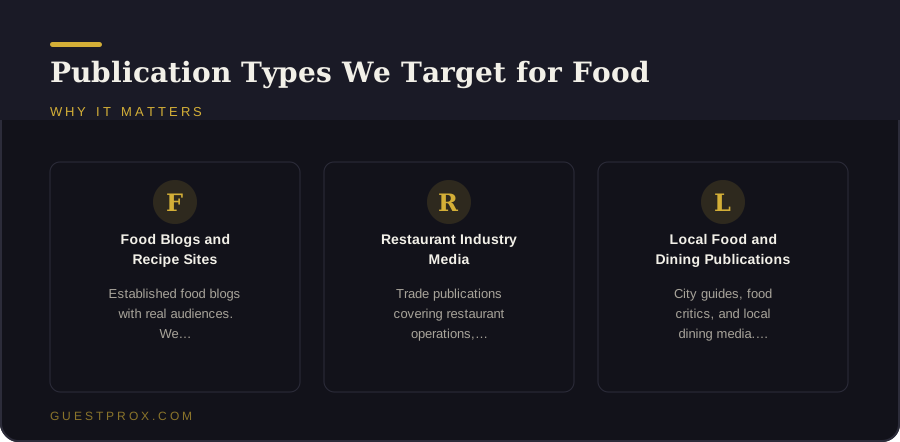
We pitch food publications where culinary expertise earns editorial space.
Established food blogs with real audiences. We contribute technique guides and ingredient deep-dives that complement rather than compete with their recipes.
Trade publications covering restaurant operations, trends, and business strategy. Operator-perspective content earns links with serious topical weight.
City guides, food critics, and local dining media. For restaurants, these placements drive both authority and actual reservations.
Wellness publications covering food as nutrition. Dietitian-reviewed angles and honest ingredient content fit their editorial standards.
Culinary-credible deliverables, reported in full.
Five steps shaped for a niche pitched to exhaustion.
We map your food category, local or national scope, and which publications link to competitors. For restaurants, we layer in local search dynamics from the start.
We target food publications with real traffic and editorial standards, filtering out the recipe-scraper sites and sponsored-post farms common in this niche.
Food editors are the most pitched in existence, so our outreach leads with genuinely fresh angles: sourcing stories, technique science, industry data. Personalized and brief.
Our writers produce food content with real knowledge: accurate technique, honest ingredient guidance, and industry insight. It reads like it came from a kitchen, not a content mill.
Every link is verified live, dofollow, and contextual before reporting with full metrics. Agencies receive white-labeled reports.
Food publications run lean. Independent food blogs and mid-size sites survive on ads, affiliates, and sponsored content, which means editors say yes to pitches that serve readers and no to anything that smells like a free ad.
Restaurants hold an unfair advantage most never use: real kitchens, real chefs, real local knowledge. A chef explaining why a specific technique works, or a restaurant documenting its sourcing relationships, produces content no content farm can replicate. That authenticity is the currency editors trade in.
Local food guides compound beautifully. A genuine guide to a city's food scene, written by someone who actually eats there, earns links from local media, tourism sites, and other food publications. These placements build neighborhood-level relevance that national recipe giants cannot touch, and a competitor link-gap analysis shows exactly where local rivals are vulnerable.
Technique content from working chefs is food media's scarcest resource. Why dough behaves differently in humid climates, what actually happens during fermentation, how professionals taste for seasoning: editors need this and cannot write it themselves.
Ingredient stories with provenance earn links because they cannot be faked. Where your produce comes from, why you chose a specific supplier, what changed when you switched: this is narrative content with built-in authenticity.
For packaged food brands, the angle is education without the sales pitch. An honest guide to reading labels, or what certifications actually mean, serves readers and earns citations. We keep product mentions minimal and honest, and pair editorial placements with digital PR when a brand has a genuine story worth wider coverage.
Food link sellers exploit the niche's visual appeal. Gorgeous recipe blogs with no traffic, selling placements to restaurants and food brands who never check analytics. Beauty without readership is decoration, not authority.
Recipe-schema farms are the technical trap. Sites mass-producing recipe content with perfect markup but no real audience, built to look authoritative to buyers who only check surface signals. Real food publications have real comment sections, real social shares, real returning readers.
Health claims in paid placements are a double risk: the link is worthless and the claim is a liability. Any vendor willing to publish unsubstantiated nutrition claims for a fee will cut every other corner too. Verify with our backlink quality checklist before you pay anyone.
Restaurant owners should be especially wary of directory-style link packages. Hundreds of low-quality directory listings do nothing for rankings and can actively dilute your profile. What moves the needle is a smaller number of genuine editorial citations from food publications with real readers. Ten real links beat a thousand directory listings every single time. Quality over quantity, verified before you pay. Real readers, real traffic, real results. Every placement should earn its place.
Tell us about your restaurant or food brand. We will map editorial placements on food publications worth reading.
Chat on WhatsApp →Food overlaps with travel, hospitality, and local search.
Authoritative sources if you want to go deeper on this topic.
It should not try to. Recipe keywords belong to the giants, but restaurant websites win on local and intent-driven searches: best Italian restaurant in a city, private dining options, catering services. Editorial links from local food media build exactly the authority those searches reward, while also driving direct reservations.
By not pitching what everyone else pitches. Most outreach offers generic recipe roundups or product placements. We lead with fresh editorial angles: sourcing stories, technique explainers, industry data. Brief, personalized, and genuinely interesting is rare in food editors' inboxes, which is why it works.
Paid blogger posts are advertising: often nofollowed, labeled sponsored, and forgotten in a week. Our placements are earned editorial content on real publications secured through manual outreach. They carry dofollow contextual links that keep building authority long after publication.
We don't publish prices. Every campaign is scoped to your targets and competition, so message us on WhatsApp at +1 (213) 582-6001 and we will price your exact placement plan.
Yes, white-label fulfillment is a core service. Since 2018 we have delivered 1259+ guest posts, many for agencies. Your clients see your brand on every report; GuestProx never appears in deliverables.
We treat nutrition content as trust-sensitive. Claims stay factual and conservative, we cite real sources, and anything near medical advice gets dietitian review before an editor sees it. This slows some placements down but earns links from publications readers actually trust, which is the entire point.
Tell us about your restaurant or food brand. We will map the editorial placements that drive both rankings and reservations.
Global Service Delivery