
For SEOs and site owners planning link campaigns. Learn to distribute anchors naturally, avoid over-optimization, and make every placement work harder.
Anchor text is the visible, clickable wording of a hyperlink. When another site links to your page using the phrase emergency plumber Austin, Google reads that as a signal about what your page covers. This anchor text guide exists because anchors are one of the few ranking signals you can fully control, and mismanaging them is one of the fastest ways to attract a manual review.
A natural backlink profile contains a mix of anchor types. Some links use your brand name, some use the raw URL, some use generic phrases like click here, and a smaller share uses keyword-rich wording. When every link points at your site with the identical keyword phrase, the pattern looks engineered. That engineered look is exactly what over-optimization reviews punish.
The goal is not to avoid keyword anchors altogether. It is to earn them at the rate a genuinely popular site would, which means planning your anchor text strategy before outreach begins and applying it consistently across every placement. The sections below give you the full framework: the five anchor types, how to distribute them, and how to fix a profile that already looks skewed.
Anchor text is the clickable text of a hyperlink, and it tells Google what the linked page is about.

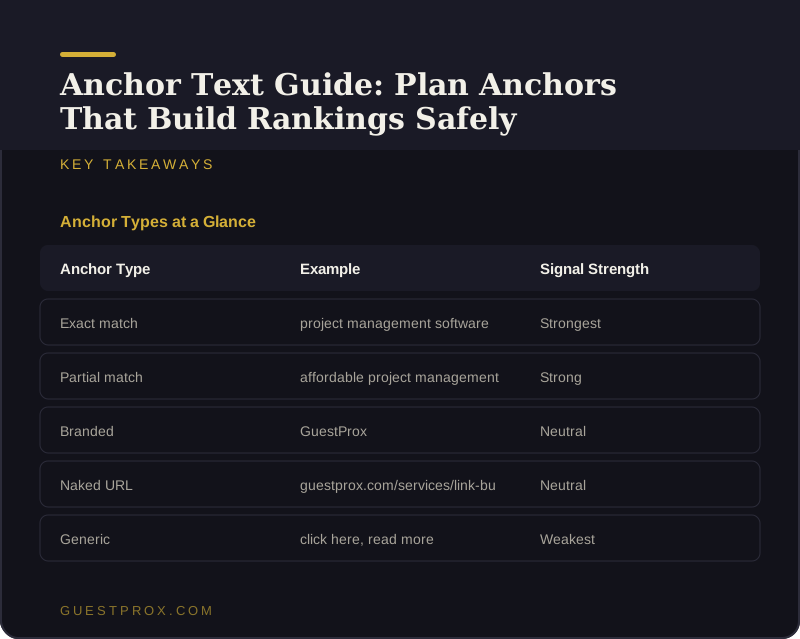
Every anchor falls into one of five buckets. Knowing which bucket each link belongs in keeps your planning precise and stops you from accidentally stacking too many keyword-rich anchors on a single page. Tag every anchor in your profile once, and the skews become obvious before they become expensive.
Exact match anchors carry the strongest topical signal of any type. That strength is also why they draw scrutiny. Reserve them for your most important pages, vary the phrasing between placements, and keep them the smallest slice of your profile.
Partial match anchors mention your keyword inside natural phrasing, which reads the way real writers link. They pass clear topical relevance without the mechanical repetition of exact match. Most content-led campaigns lean on partial match more than any other keyword-bearing type.
Real brands get linked by name constantly, so branded anchors should form the largest share of a healthy profile. They are also the safest anchor type you can build at scale. If your branded share looks thin next to competitors, that is usually the first gap to close.
Nobody writing naturally links with optimized keywords every time. People paste raw URLs and write click here constantly, so a profile without them looks curated. These anchors dilute keyword density across your profile and make the keyword-rich links you do build look earned rather than placed.
A distribution plan is a decision, made in advance, about what share of anchors each type gets. Without one, every writer defaults to keyword-rich anchors and the profile drifts toward over-optimization by itself. That is why this anchor text guide treats the distribution plan as the foundation of the whole campaign: each placement gets an assigned anchor before anyone contacts a publisher.
Pull your backlink data and sort anchors into the five buckets before building anything new. Most site owners are surprised twice: first by how many exact match anchors they already have, then by how few branded anchors show up. The audit tells you whether your next campaign should chase keywords or rebalance toward brand.
Your anchor text distribution should differ by page type. Homepage links can carry more branded anchors because people naturally reference brands by name. Commercial pages can carry more partial and exact match, but only inside a profile whose branded base is already solid. Blog content sits in the middle, favoring partial match that mirrors what the post actually covers.
The most common failure in anchor planning is treating it as a reporting step. Decide the anchor for each target URL when you plan the campaign, write it into the brief, and instruct writers on natural placement. Changing anchors after publication means renegotiating with editors, which rarely works and always costs time.
Google's Penguin system now runs continuously and mostly devalues manipulative links instead of punishing whole sites the way it did in 2012. That sounds forgiving, but the practical effect is the same: a skewed anchor profile stops helping and can drag down the pages it was meant to lift. Manual actions for unnatural links still exist for the worst cases. Prevention is cheaper than cleanup by an order of magnitude, which is why the distribution plan comes before the first pitch.
Reviewers and algorithms both look for repetition. Dozens of links with identical commercial anchors arriving in a short window, anchors that never vary while competitors show variety, and keyword-rich anchors pointing at thin pages are the classic tells.
There is no shortcut around a skewed profile. You stop building keyword-rich anchors, you accelerate branded and naked link acquisition to dilute the ratio, and in genuine manual-action cases you disavow the worst offenders through Search Console. Recovery is measured in months, which is why prevention through planning costs less than any cleanup. The prevention-first approach this anchor text guide recommends is simple: plan first, build second, and report the mix honestly.
Every GuestProx campaign starts with an anchor map: target URLs, assigned anchor types, and variation rules written before outreach begins. Placements go on DR 40-90 real-traffic sites through 100% manual outreach, and monthly reports show the anchor mix so you can watch the distribution hold. With 1259+ guest posts delivered since 2018, that discipline is baked into the process, not added as an upsell.
Theory gets vague fast, so here is a worked example. Imagine a personal injury law firm building twenty links to its car accident page. The anchor map below shows how a practitioner distributes those twenty anchors so the page gains relevance without tripping over-optimization filters.
Notice what the map does. The two exact matches go on the highest-quality sites, where scrutiny is lowest and value is highest. The partial matches carry the topical weight across mid-tier placements. The branded base is thick enough that no reviewer sees a keyword campaign.
Write the map before outreach, then hand each prospect a row. The writer placing the link knows exactly which anchor to use, and the campaign finishes with the distribution you planned instead of the one that happened by accident. Anchor planning is built into our guest posting campaigns: targets, anchors, and variation rules agreed before a single pitch goes out. The deeper anchor text strategy framework extends this example to multi-page campaigns.
Your competitors' anchor profiles are the closest thing to a published answer key. Pull the top three sites outranking your target page, export their anchors, and sort them into the five buckets. You are not copying their links. You are reading their ratios.
First, the branded share. Winners in competitive niches almost always have a thick branded base, often forty percent or more. If yours is ten percent and theirs is fifty, that gap is your first campaign, not more keyword anchors.
Second, where the exact matches cluster. Competitors concentrate keyword anchors on their strongest links, not evenly across everything. A competitor link gap analysis shows which placements carry their keyword anchors, so you can aim your own exact matches at comparable-quality sites instead of wasting them on weak ones.
Copy the distribution, never the domains, and never the exact phrasing. If a competitor's exact anchors read 'Austin personal injury lawyer' across six sites, yours should vary: 'injury attorney in Austin', 'Austin accident lawyer'. Same intent, different fingerprints.
Re-run the comparison quarterly. Competitor profiles drift, and the gap you closed in January may reopen by July. The breakdown of branded versus exact match anchors explains why the branded base is usually the safest gap to close first. For law firms specifically, link building for legal sites carries its own anchor constraints worth knowing before you plan.
Not every link type tolerates the same anchors. The anchor you can safely use depends on who controls the placement and how editorial the link looks. Match the anchor to the link type and the whole profile reads more naturally.
Guest posts give you the most control, which makes them the riskiest place to over-optimize. Editors expect natural anchors, and a guest post with three exact-match links reads like a paid placement. Use one keyword-bearing anchor per article, keep the rest branded or generic, and never link twice to the same page with the same anchor.
Niche edits insert your link into an article that already ranks, so the anchor must fit the existing sentence. Partial match anchors work best here because they read like the author's own wording. Forcing an exact match into a sentence that was not written for it is the classic niche edit mistake, and editors notice it immediately.
Earned coverage almost always uses your brand name or a naked URL, and you cannot change that. This is a feature, not a limitation: PR links naturally thicken your branded base, which buys headroom for keyword anchors elsewhere. Plan PR and guest posting together so the branded and keyword shares stay balanced across the whole campaign.
Use this table when assigning anchors to target pages.
| Anchor Type | Example | Signal Strength | When to Use It |
|---|---|---|---|
| Exact match | project management software | Strongest | Sparingly, on priority commercial pages |
| Partial match | affordable project management software for teams | Strong | Regularly, matched to the page topic |
| Branded | GuestProx | Neutral | As the backbone of the whole profile |
| Naked URL | guestprox.com/services/link-building/ | Neutral | To mimic how real people share links |
| Generic | click here, read more | Weakest | As filler that keeps the profile natural |
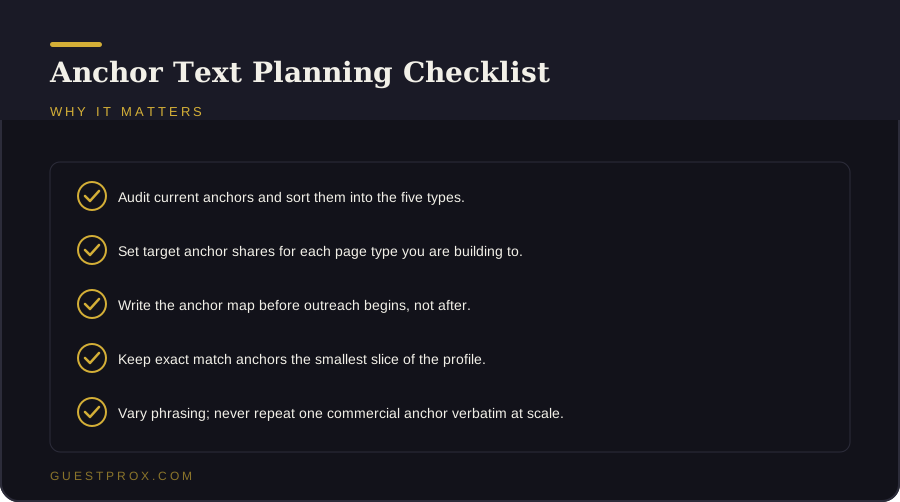
Run through this list before your next link campaign starts.
Go deeper on the link building topics connected to anchor strategy.
Authoritative sources if you want to go deeper on this topic.
There is no fixed number, because safety depends on your total profile size and niche. A useful rule: if exact match anchors are growing faster than branded and naked anchors, you are drifting toward risk. Keep keyword-rich anchors the minority and let branded links lead, and the question mostly answers itself.
Rarely on its own. Penalties and devaluation usually combine skewed anchors with other signals like low-quality linking domains or thin target pages. That said, anchors are the easiest signal for reviewers to read, so a profile where every link uses the same commercial phrase invites the closer look that finds everything else.
No. Every GuestProx campaign includes an anchor map as part of planning: target URLs, assigned anchor types, and variation rules are set before outreach starts. It is part of how we keep client profiles natural, and it is reflected in the monthly reports you receive.
Buying links usually means paying for placements with keyword-stuffed anchors on sites that sell to anyone, which is exactly the pattern Google targets. Anchor planning inside manual outreach means real editors on real DR 40-90 sites choose natural phrasing around an assigned anchor type. The control is in the planning, not in forcing unnatural wording into articles.
Expect weeks to months, not days. Google needs to recrawl the linking pages and reassess the profile as a whole. New anchors on fresh placements typically show influence within one to two crawl cycles of the linking page, while rebalancing an old profile takes longer because the ratio has to move meaningfully.
Yes. Your homepage should attract mostly branded and naked anchors, since that is how people reference brands. Commercial pages can carry more partial and exact match anchors, but only when the site-wide branded base is strong enough to make them look earned.
Usually nothing. Editors adjust wording to fit their article's voice, and that variation actually helps your profile look natural. Only push back if the change breaks the link's relevance entirely, such as pointing a commercial anchor at an unrelated page. Good outreach relationships make these small fixes easy.
Our link building service plans anchor text for every placement before outreach starts. Share your site and goals, and we will map a natural distribution for your profile.
Global Service Delivery