
Two anchor styles, opposite risk profiles. Here is when each earns its place and how to balance them without looking engineered.
Branded anchor text uses your company or site name as the clickable words. Exact match anchor text uses the precise keyword you want to rank for. They sit at opposite ends of the risk spectrum, and most anchor problems come from leaning too hard on one end.
Branded anchors are what the web produces on its own. When someone references a company, they write its name. Exact match anchors are what optimizers produce. Both have legitimate roles, but they do very different jobs: branded anchors build a trustworthy base, while exact match anchors deliver concentrated topical signal to specific pages.
The practical question is never which one is better in the abstract. It is how much of each your profile can carry, pointed at which pages, without the pattern looking deliberate. That is what this post breaks down.
Branded anchor text uses your company or site name as the clickable words; exact match anchor text uses the precise keyword you want to rank for.
If you take one thing from this post, take this: when in doubt, go branded. It is the hardest anchor to get wrong.
A branded link says someone is talking about you specifically, not about a keyword. That is a trust signal first and a ranking signal second. Profiles dominated by branded anchors look like the result of genuine awareness, which is exactly the impression you want.
Campaigns need volume, and volume needs somewhere safe to go. Branded anchors are that place. You can build dozens of branded links to a homepage without creating any meaningful pattern risk, which gives your keyword anchors room to work on deeper pages.
Even branded anchors benefit from variety: the brand alone, brand plus domain, brand plus a descriptor. Real linkers phrase things differently. Mirror that instead of stamping one identical branded phrase everywhere.
Exact match is not poison. It is a concentrated signal that needs careful dosing.
Use it sparingly on the pages where the keyword genuinely matches the content, and where the linking article's context supports the phrase. One exact match link inside a relevant, well-written guest post reads fine. Twenty of them pointed at the same URL does not.
Most of the time, what you actually want is partial match: the keyword plus surrounding words. It delivers most of the topical signal with a fraction of the pattern risk, and editors accept it more readily because it reads like natural writing.
An exact match anchor inside a deeply relevant article on a real site behaves differently from the same anchor on a thin page. Surrounding relevance dilutes risk. This is another reason earning links on genuine, niche-relevant publications matters so much.
Balance is not a fixed ratio. It shifts with your site's age, authority, and what the profile already contains.
A young site with little history has no trust buffer. Early campaigns should be overwhelmingly branded and generic while the site earns its footing. Keyword anchors come later, once the base looks established.
A site with years of natural branded links has room to be more aggressive on commercial pages. The existing base absorbs the signal. Even then, keep keyword anchors a clear minority and keep rotating the phrasing.
Never plan new anchors without looking at the current mix. If the profile already carries heavy exact match from past work, your next campaign should be branded-heavy to rebalance. Anchor strategy is corrective as much as it is constructive, which is why every plan should start with a backlink audit.
Abstract ratios only go so far. Here is how the balance plays out across common site types.
For an established content site, expect branded anchors to form the clear plurality, generic and URL anchors to appear steadily, and keyword anchors to cluster on a handful of commercial pages. No single non-branded phrase should dominate. That shape emerges naturally from real-world linking, so imitate it.
Stores and local businesses earn overwhelmingly branded and URL anchors because customers link business names. If your link building adds keyword anchors on top, keep them modest relative to that branded base, or the commercial intent becomes obvious to anyone reviewing the profile.
Informational content in B2B earns descriptive anchors naturally, since writers reference guides and studies by topic. That gives you more room for partial match. The same rule still holds: variety within the descriptive set, never one phrase repeated across placements.
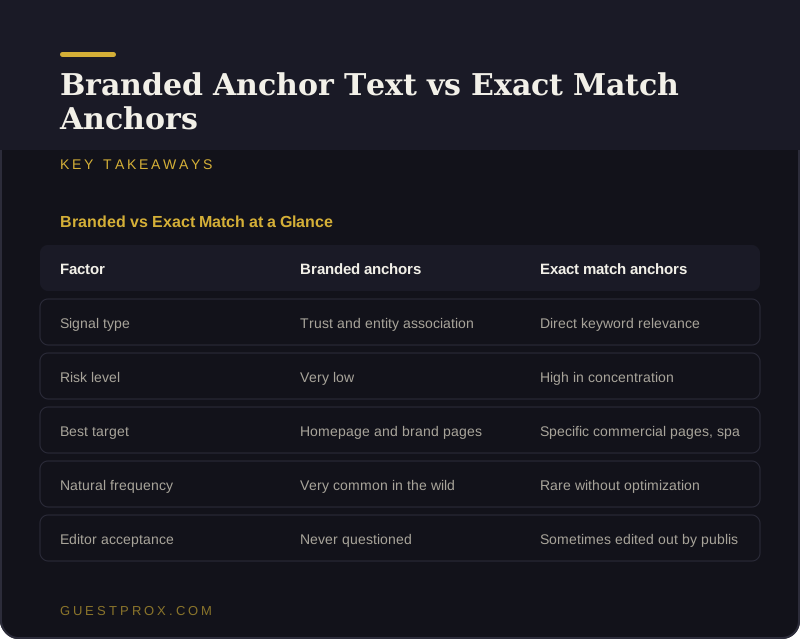
The trade-offs that decide which anchor goes where.
| Factor | Branded anchors | Exact match anchors |
|---|---|---|
| Signal type | Trust and entity association | Direct keyword relevance |
| Risk level | Very low | High in concentration |
| Best target | Homepage and brand pages | Specific commercial pages, sparingly |
| Natural frequency | Very common in the wild | Rare without optimization |
| Editor acceptance | Never questioned | Sometimes edited out by publishers |
More on anchors and campaign planning.
Authoritative sources if you want to go deeper on this topic.
Neither in isolation. Branded anchors are the safe foundation every profile needs, and exact match anchors are a concentrated signal for specific pages. The right mix depends on your site's age, existing profile, and targets. Most healthy profiles are branded-heavy with keyword anchors as a deliberate minority.
On their own, no single anchor causes a penalty. The risk comes from patterns: many exact-match links to one page, built quickly, with identical phrasing. That is the footprint spam detection looks for. Kept sparse, varied, and surrounded by branded anchors, exact match is a normal part of link building.
A partial match anchor is a variation that includes your keyword alongside other words, like best guest posting services for SaaS instead of just guest posting services. It carries topical signal with much less pattern risk, reads naturally in editorial content, and is usually what you want when exact match feels too aggressive.
Rarely. Homepages naturally attract branded and URL anchors, so keyword anchors there look out of place. Point exact and partial match anchors at the deeper commercial or informational pages they actually describe, and let the homepage collect branded links.
Export your backlinks from a tool like Ahrefs or Search Console, group by anchor text, and look at the share per phrase and per target page. Watch for any single keyword phrase dominating, or commercial pages carrying far more keyword anchors than branded ones. That tells you what the next campaign needs to rebalance.
Yes, anchor mapping per target URL is part of every campaign before outreach starts. We do not publish prices, so message us on WhatsApp at +1 (213) 582-6001 for a quote based on your site and goals.
We map anchors per target page before a single pitch goes out. Message us on WhatsApp at +1 (213) 582-6001 or send a message through the form.
Global Service Delivery