
We place attorney bylines on credible legal publications, expert commentary that builds authority without crossing ethical lines.
Legal guest posting means publishing attorney-authored analysis on credible legal publications, with contextual backlinks to your practice area pages. Law is YMYL with an extra layer: state bar advertising rules that treat even educational content with suspicion when it reads as solicitation.
Avvo, FindLaw, and Justia dominate national legal search, and Google holds law content to exacting expertise standards. Firms that break through combine genuine attorney bylines with placements on publications lawyers actually read. Anything less gets rejected by editors and ignored by search engines.
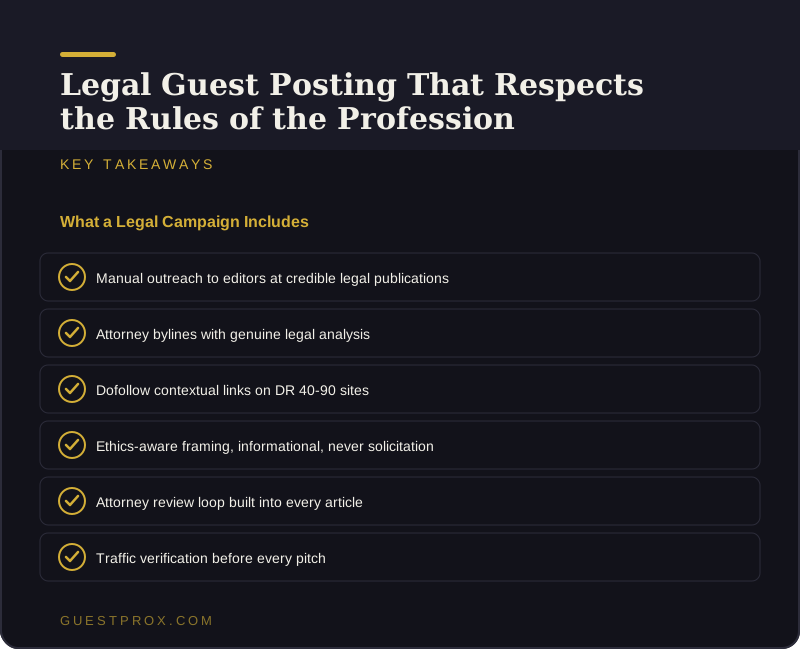
We work within your ethics boundaries from day one: no misleading claims, no guaranteed outcomes, no solicitation framing. Your attorneys review every draft, sites are traffic-verified before outreach, placements are dofollow and contextual. GuestProx has delivered 1,259+ guest posts since 2018, 100% manual outreach, no PBNs, on DR 40-90 sites. Our law firm link building guide details the full framework.
Legal campaigns reward patience. Attorney review cycles and editor vetting run slowly, but the resulting links are among the most durable in SEO, because they rest on expertise competitors can't quickly replicate. We set expectations in quarters, not weeks.
Publishing attorney-authored analysis on credible legal publications, earning contextual backlinks while respecting the profession's advertising and ethics rules.
Every legal campaign starts from the profession's rules and works outward, never the reverse. A pitch that would be aggressive but acceptable in software can be an ethics problem in law. State bar rules, no misleading claims, no guaranteed outcomes, no testimonials framed as promises, apply to guest articles carrying your byline, not just your website.
The practical consequence: attorney involvement isn't optional. Editors expect attorney authorship or documented review, and many jurisdictions effectively require it. We build every campaign from real briefings with your lawyers, on practice areas they actually handle, because borrowed expertise survives neither editorial review nor ethics scrutiny.
Jurisdiction specificity is the underused advantage. Legal rules differ by state, and content addressing one jurisdiction's filing deadlines, damage caps, or procedural quirks faces far less competition than generic national content. We build campaigns around the jurisdictions you practice in, turning a limitation into a targeting edge.
In legal publishing, the byline outweighs the article. A regulatory analysis bylined by a partner with twenty years in the practice area gets published; the same analysis from an anonymous contributor gets deleted. We never manufacture bylines. Every article is built from real briefings, and your lawyers approve the final draft.
Match the lawyer to the topic, too. A family law partner shouldn't byline a tax analysis; editors notice mismatches. We map topics to the attorneys whose credentials support them, which is what earns placement on publications lawyers actually read.
Legal editors accept pitches that serve their professional readership and reject anything resembling a sales pitch. The filter is simple: would a practicing lawyer find this useful? Court-decision explainers, regulatory compliance guides, and practice guides for specific situations all clear it.
Rulings and new legislation create a permanent news cycle, and publications need qualified lawyers to interpret them. We track developments in your practice areas and pitch commentary while the story is current. The analysis must be genuinely expert, how this changes client advice and what remains uncertain, not a news summary with a byline.
Don't overlook business and local media. Business publications constantly need legal perspective for founders and HR teams, and local news outlets need attorney commentary on ordinances and cases. Our editorial process for law firms starts with attorney briefings, not keyword lists, which is why these placements land.
Credible law sites with real readerships, legal blogger outreach done properly.
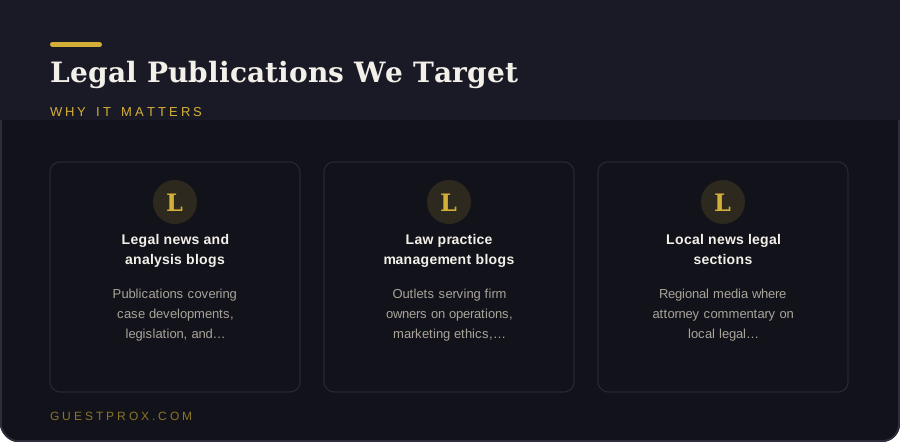
Publications covering case developments, legislation, and legal trends.
Outlets serving firm owners on operations, marketing ethics, and growth.
Regional media where attorney commentary on local legal matters earns links.
B2B outlets covering contracts, compliance, and corporate legal topics.
Ethics-aware, attorney-reviewed, fully reported.
Careful, credentialed, and compliant.
We define your practice areas, the topics your attorneys can authoritatively cover, and your ethics boundaries.
We shortlist legal publications with real traffic and editorial standards, then verify each one.
Editors receive substantive legal analysis proposals, the standard legal editors expect.
We draft from your attorneys' expertise; they review and approve before submission.
Every live link verified as dofollow and indexed, reported with metrics you can audit.
We will map credible legal publications and work inside your ethics boundaries from day one.
Get an Ethics-Safe Plan →Build firm authority on every front.
Authoritative sources if you want to go deeper on this topic.
Educational, informational content authored by attorneys is widely accepted, the risk comes from promotional framing, misleading claims, or guaranteed outcomes. We write strictly informational articles, your attorneys review every draft, and we recommend your ethics counsel reviews the approach for your jurisdiction before we begin.
They need attorney authorship or review. We draft from briefings with your lawyers, they review for accuracy and tone, and the byline carries their name and credentials. Editors in legal publishing expect this, and it is what makes the content rank.
Yes, when the link serves the reader, a personal injury analysis linking to your PI resources page, for example. We plan target pages with you in advance so every link supports a page that matters, framed informationally rather than as a sales pitch.
Legal keywords are among the most competitive in local and national search. Expect 4 to 12 weeks after placements go live for initial movement, longer for major practice-area terms in competitive markets. Editorial links compound, so each campaign builds on the last.
Directories are citations with limited ranking power, and paid link schemes in YMYL niches carry serious penalty risk. A bar complaint is unlikely from a directory, but a Google penalty from manipulative links can erase years of marketing investment. Editorial placements are the safe, durable path.
We write to the strictest applicable standard across the jurisdictions you practice in, and we recommend your ethics counsel reviews our content framework before outreach begins. Most restrictions, no misleading claims, no guaranteed outcomes, informational framing, are consistent across states; where specific states add requirements like disclaimers, we build those into the relevant articles. One review up front prevents problems across the whole campaign.
Tell us your practice areas and ethics boundaries. We will map the publications worth your attorneys' bylines.
Global Service Delivery