
We place bylined articles for SaaS companies on real editorial sites with genuine traffic, built for comparison keywords, review-heavy SERPs, and long buying cycles.
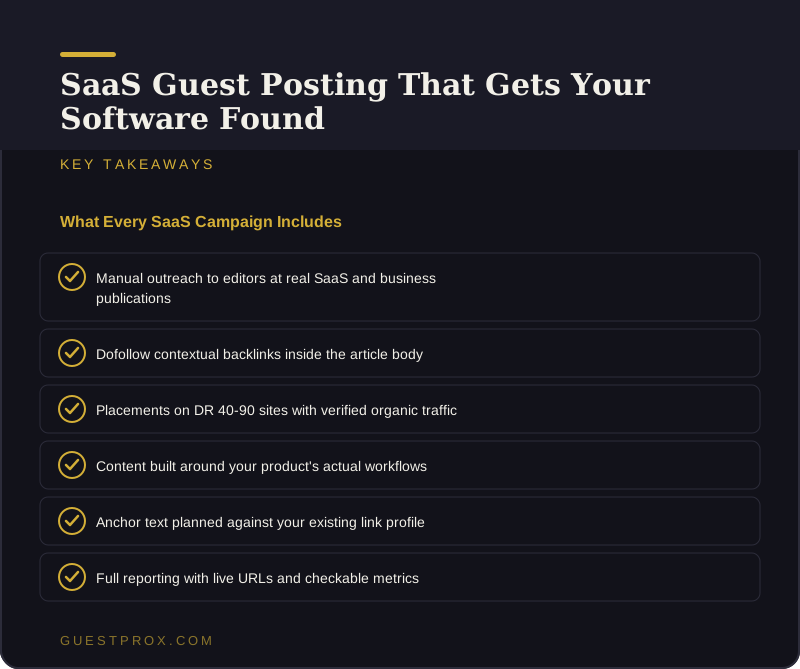
SaaS guest posting means publishing expert articles on established software and business publications, with contextual backlinks pointing to your product, feature, or resource pages. Every placement starts with manual outreach to a real editor, never a database blast or a link farm.
Here is the problem. Your buyers search comparison keywords owned by G2, Capterra, and affiliate publishers with enormous domain authority, then read three to five sources before booking a demo. A SaaS brand with no editorial backlinks looks thin next to competitors quoted across the industry press, and one homepage link does nothing for a committee-led buying cycle.
We fix that by pitching topics tied to real product workflows: implementation guides, integration playbooks, honest methodology breakdowns. Our team verifies traffic on every target site before outreach, negotiates dofollow contextual placement, and reports each live URL with its metrics. Since 2018 we have delivered 1259+ guest posts for 57+ clients through 100% manual outreach, all 100% white hat with no PBNs.

Software buyers do not behave like other buyers, and link building that ignores that fact burns budget. Three structural realities decide whether a SaaS campaign works.
G2 and Capterra dominate best-software terms in nearly every category, and they are not going anywhere. Fighting them head-on is usually a losing allocation for a growing company.
The smarter play is earning links on the publications surrounding those review pages. A bylined implementation guide on a respected martech blog ranks for the long-tail questions buyers ask mid-research, and passes authority to your own comparison pages. That is the core of SaaS link building campaigns that actually move rankings.
A typical B2B evaluation involves several people reading three to five sources. Links need to land on feature pages, integration pages, and comparison content, the pages people actually read mid-evaluation.
We build a target-page map before outreach starts, matching each publication to the destination page with a commercial job to do. Authority pools where it can convert into pipeline, not where it is easiest to earn.
SaaS publications are run by people who use software for a living. Generic pitches about the benefits of automation die in the inbox.
What gets a reply is evidence your team lives inside the workflow: screenshots from real setups, numbers from real usage, opinions formed by real migrations. We run a briefing call with your product people before drafting a single pitch, because the angle has to come from inside the product.
SaaS editors get pitched constantly. The pitches that get replies promise something staff writers cannot produce: proprietary data, a genuine practitioner's workflow, or a defensible opinion.
Aggregate usage patterns, onboarding drop-off points, and feature adoption curves are original research no journalist can replicate. We help you shape the finding into a headline the editor can picture, then write the piece around the data rather than the product.
Every vendor in your stack runs a blog, a partner directory, often a marketplace. We map your integration partners before outreach and pitch cross-tool workflow stories. One integration piece can earn links on two or three ecosystem publications, each pointing at your integration page.
Your comparison and best-tool pages sit closest to revenue, which makes them both the most valuable and the most scrutinized targets. We seed them with branded anchors early, then let editorial pickups add exact matches organically once the page ranks. Forced exact anchors on a new page invite scrutiny, so our anchor text planning stays conservative by design.
This is also where sustained blogger outreach pays off. A single placement is a spike; a steady cadence across the publications your buyers read builds the topical authority Google rewards in software categories. We pace campaigns across quarters because that is the timescale on which SaaS authority actually moves.
Traffic-verified before outreach, real SaaS blogger outreach, not database blasts.
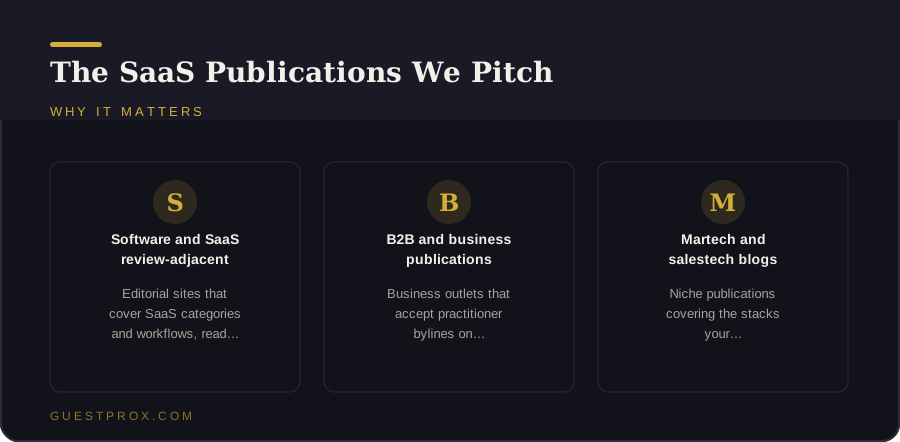
Editorial sites that cover SaaS categories and workflows, read by buyers doing active research.
Business outlets that accept practitioner bylines on operations, growth, and the tooling behind them.
Niche publications covering the stacks your product integrates with, CRM, email, analytics, support.
Founder-focused outlets where product stories and hard-won lessons earn genuine editorial links.
Concrete outputs, reported in full, nothing hidden.
Five stages, all manual, all reported.
We map your category, your competitors' backlink profiles, and the publications your buyers read before signing up.
We build a target list of real-traffic sites in your niche and adjacent verticals, then verify traffic on each one.
Personalized pitches to editors with topic ideas shaped for their audience, never template blasts.
Articles grounded in genuine product insight, checked for accuracy before they go to the editor.
Each live link is verified as dofollow and indexed, then reported with metrics you can verify yourself.
We will show you the actual sites we plan to pitch before you commit to anything.
Get a Placement Plan →Pair SaaS coverage with adjacent placements.
Authoritative sources if you want to go deeper on this topic.
The publications, the pitch angles, and the anchor strategy all change. SaaS campaigns target software and business publications your buyers read during evaluation, pitch workflow-based topics instead of generic listicles, and plan anchors around feature and comparison pages. A generic campaign lands you on general-interest blogs that carry no topical weight for software keywords.
Placements go live over several weeks because real editors work on editorial calendars. Most clients see ranking movement within 4 to 12 weeks as links are indexed and recrawled. SaaS keywords crowded by review sites can take longer, and we set that expectation before you spend anything.
No. Buying links means paying for placement on sites that sell links to anyone, usually with no editorial review. We pitch real editors who can reject the article, write to their standards, and earn the link through publication. That is the difference between a link that holds its value and one that gets devalued in the next update.
You can, manual outreach is a skill, not a secret. Building editor relationships across dozens of publications takes months of full-time work, and our team already holds those relationships from 1259+ placements since 2018. Most SaaS teams find it more efficient to outsource fulfillment while keeping strategy in-house.
Carefully and gradually. Comparison pages attract exact-match anchors naturally in the wild, but a new page with nothing but exact anchors looks engineered. We start with branded and URL anchors to build a natural base, then layer in partial-match anchors as the page earns its own editorial mentions. Every anchor we place is reported, so you can audit the distribution yourself at any point in the campaign.
Sometimes, but treat that as a bonus rather than the goal. The primary job of a guest post is authority: it moves your comparison and feature pages up the rankings, and those pages drive the demos. That said, a strong byline on a publication your buyers read does send qualified referral traffic. Measure the campaign on rankings and pipeline influence over two quarters, not on clicks in week one.
Tell us about your product and target keywords. We will map out the publications we would pitch and the pages we would build links to.
Global Service Delivery