
For SEOs and business owners watching AI Overviews reshape search. A measured look at how backlinks, brand mentions, and consistent business facts relate to visibility in AI-generated answers.
AI search link building is the practice of earning backlinks and brand mentions from authoritative sources so that AI-generated answers reference your brand. When systems like Google AI Overviews or chat assistants answer a question, they draw on sources they treat as trustworthy. Links and mentions from those sources appear to influence which brands get cited and which get ignored.
Honesty first: nobody can promise placement in AI answers, and anyone selling guaranteed AI Overview citations is selling fiction. What is reasonably established is simpler. AI systems cite authoritative sources, they corroborate claims across multiple trusted sites, and brands with strong, consistent web footprints show up more often. Link building supports all three.
This guide explains what AI answers appear to reward, how backlinks and mentions fit together, and what a sensible playbook looks like. Every claim is qualified where the evidence is still emerging, because in this space, certainty is usually a sales tactic.
Earning backlinks and brand mentions from authoritative sources makes AI-generated answers more likely to cite your brand. It is traditional authority building, aimed at a new kind of reader.
AI answer engines do not browse the way humans do: they retrieve candidate sources, weigh their trustworthiness, and synthesize an answer with citations. The exact weighting is proprietary and changes constantly. But the observable pattern is consistent, and the direction is solid enough to act on: answers cite sources that look authoritative, current, and corroborated by other trusted sites.
Across studies and everyday observation, AI answers lean on established publishers, official documentation, and sites with strong link profiles. This is consistent with how search has always worked: authority is largely a function of who links to you. A deep backlink profile from real editorial sites remains the best-understood proxy for the trust these systems need.
AI systems appear to cross-check claims against several sources before stating them confidently. A fact mentioned on one obscure blog carries little weight. The same fact repeated across respected industry publications, news outlets, and official pages is far more likely to surface in an answer. Breadth of quality coverage matters as much as any single link.
AI answers favor current information, especially for time-sensitive topics. They also penalize, in effect, brands whose facts disagree across the web: different founding years, conflicting addresses, contradictory product claims. Consistent factual information across your site and third-party sources makes you easier to cite accurately.
Three signals work together here, and confusing them leads to bad strategy. Backlinks pass authority between pages, while brand mentions build recognition even without a link. Together they shape entity authority: how clearly and consistently the web understands what your brand is and why it deserves trust. Get the three reinforcing each other and the whole becomes stronger than the parts.
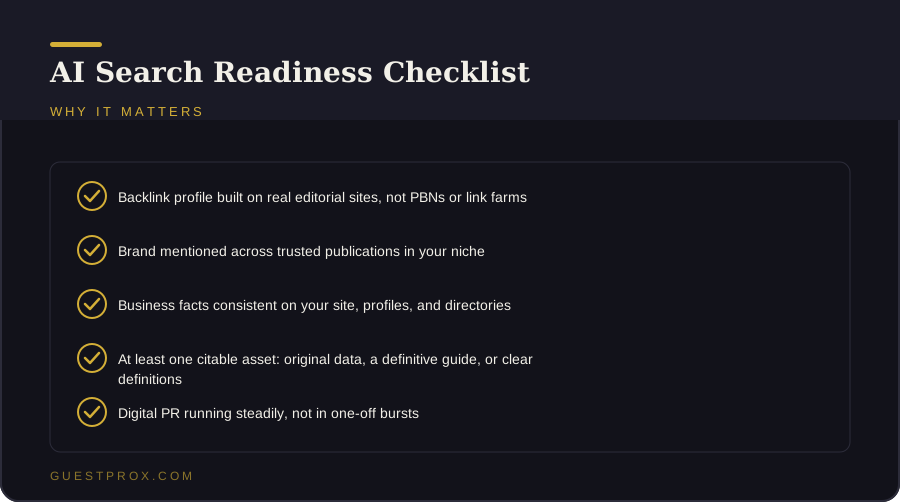
For all the talk of new signals, backlinks remain the most studied authority signal available. Editorial links from respected publications support the domain-level trust that AI systems appear to borrow when choosing sources. If your link profile is thin, that is still the first problem to fix, regardless of AI search.
AI systems read text, not just link graphs, so a brand mentioned favorably across trusted sites builds familiarity even without hyperlinks. Digital PR, expert commentary, and podcast appearances all generate mentions that feed this signal. Pursue mentions and links together rather than treating them as separate campaigns.
An entity is the thing search systems think your brand is: its name, what it does, where it operates. Every consistent mention sharpens that picture, and every contradiction blurs it. Keep business facts identical across your site, profiles, directories, and press coverage. This kind of consistency compounds quietly, then shows up everywhere at once.
Forget AI-specific tricks and do the unglamorous work that feeds every authority signal at once. The playbook below is deliberately boring. It is also the most honest version of AI search link building available: authority work, aimed at AI readers.
Ask AI assistants the questions your customers ask and note which brands get cited. This is directional, not scientific, since answers vary by phrasing and session. Still, it reveals which sources the systems trust in your niche, and those sources become your outreach targets.
If three assistants all cite the same industry publications, those publications are your priority list. Pitch them expert commentary, original data, and genuinely useful resources. Editorial links and mentions from already-trusted sources carry more weight for AI visibility than links from sites the systems ignore.
AI answers cite pages that state facts clearly: original research, definitions, statistics with methodology, step-by-step explanations. Create the definitive resource on questions your customers ask, with clear headings and quotable statements. Citable content earns both links and direct citations.
Audit your business details, leadership bios, founding story, and product claims across the web. Fix contradictions wherever you control the source. Factual consistency is the cheapest AI search optimization available, and most brands have never done it.
Track brand citations in AI answers for a fixed set of questions, sampled the same way each month. Track referral traffic and branded search volume alongside it. Do not mistake a single cited answer for a trend, and do not let anyone sell you certainty about a system that changes monthly. LLM visibility is a lagging indicator of authority work, not a switch you flip.
A small but growing body of research studies what AI answers cite. The honest summary: the studies agree on direction, disagree on magnitude, and all of them measure correlation, not causation. Treat every finding below as a lead, not a law.
The honest limitations: sample sizes are small, the systems change monthly, and nobody outside the labs sees the actual retrieval weights. Any vendor quoting a study as proof their method works for AI search is overselling. The measured overview in what we know about AI search visibility and link building keeps the claims qualified the way this space demands.
The practical takeaway is boring and useful: the same authority work that wins traditional search positions you for AI citations. Deepen the link profile, sharpen the entity, publish citable content. If a tactic only makes sense for AI search and does nothing for regular rankings, skip it. More on making that content citable in how to make your brand more citable in AI search.
An entity is the machine-readable version of your brand: the set of facts systems associate with your name. AI answers can only cite you confidently if they can resolve who you are. Entity building is the unglamorous infrastructure work that makes everything else in this guide possible.
None of this is new SEO. It is the same consistency work good agencies have done for years, now with an additional consumer: answer engines that cross-check facts before citing them. The glossary defines the entity vocabulary if any of these terms are unfamiliar.
Entity work compounds with link building. Each editorial link from a trusted publication both passes authority and sharpens the entity record. That is why off-page SEO done properly covers mentions, links, and factual consistency together instead of treating them as separate services.
AI answers cite pages that make extraction easy: clear statements of fact, organized under descriptive headings, with the key answer near the top. You are not writing for robots. You are writing clearly enough that a synthesis system can quote you without distortion.
Structure matters as much as substance. Descriptive headings, short paragraphs, and tables for comparisons all help retrieval systems find and quote the right passage. This is standard content discipline aimed at a second reader: the answer engine.
One caution: citable content earns citations, but citations are a lagging indicator. Publish the definitive resource, earn the links that prove its authority, and let the answer engines catch up. The fundamentals in the complete link building guide still underpin all of it: authority first, citations follow.
Separate the established from the speculative before you spend.
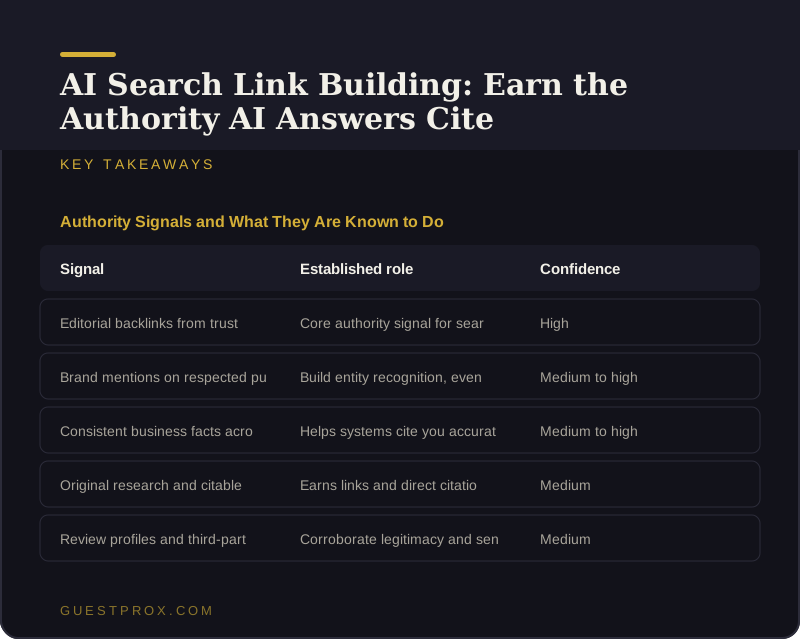
| Signal | Established role | Confidence |
|---|---|---|
| Editorial backlinks from trusted sites | Core authority signal for search for decades | High |
| Brand mentions on respected publications | Build entity recognition, even unlinked | Medium to high |
| Consistent business facts across the web | Helps systems cite you accurately | Medium to high |
| Original research and citable content | Earns links and direct citations | Medium |
| Review profiles and third-party listings | Corroborate legitimacy and sentiment | Medium |
The fundamentals that support visibility in AI answers.
More on authority building and off-page SEO.
Authoritative sources if you want to go deeper on this topic.
No, and treat anyone who promises it as a red flag. AI answer engines are proprietary, constantly changing, and consider many signals beyond links. What an agency can honestly do is strengthen the underlying authority signals: editorial backlinks, brand mentions, and consistent entity information. Those improve your odds across every AI system without promising any specific outcome.
You need both, but backlinks still carry more established weight. Mentions help AI systems recognize and contextualize your brand, especially unlinked ones in trusted publications. Backlinks add the authority layer that decades of search research support. A program that earns both from the same outreach is the efficient path.
Buying links means paying for placements, often on sites built to sell them, which risks penalties from traditional search and earns zero trust from AI systems. This approach means earning editorial coverage and mentions through outreach, PR, and genuinely citable content. AI engines appear to weight source trustworthiness heavily, which makes paid-link schemes even less effective here than in classic SEO.
Typically months, not weeks. AI systems need to crawl new coverage, update their understanding of your entity, and fold it into answer generation. Most brands see gradual improvement over two to four quarters of consistent work. Anyone promising faster results is either guessing or selling something else.
We don't publish prices. Every campaign is scoped to your targets and competition, so the fastest way to get an exact number is to message us on WhatsApp at +1 (213) 582-6001.
Yes, but proportionally. If your customers are starting to use AI assistants for buying decisions, the brands those assistants cite get a head start. The good news is that the work overlaps almost entirely with classic authority building: local press, reviews, consistent facts, and useful content. Small businesses doing solid SEO are already partway there.
More than ever, because AI answers are built on top of the same web. The sources AI systems cite are overwhelmingly pages that rank well and carry strong link profiles. Treating AI-answer visibility as separate from SEO is a category error. Build authority the proven way, and you serve both audiences at once.
Our off-page SEO service earns the editorial links and brand mentions that support visibility in AI answers. Talk to us about an authority plan for your brand.
Global Service Delivery