
For site owners and SEOs deciding where to invest their link budget. A clear-eyed tour of what works, what to avoid, and how to measure it.
A link building guide is a manual for earning backlinks, links from other websites that signal trust to search engines. This one focuses on the part most guides skip: how to tell a link worth earning from one worth ignoring.
Links remain one of the strongest ranking factors because they are hard to fake at scale. Anyone can publish content; not everyone can convince independent editors to vouch for it. That difficulty is the entire point, and it is why shortcuts eventually fail.
GuestProx has delivered 1259+ placements for 57+ clients since 2018, all through manual outreach to real DR 40-90 sites. This link building guide distills that experience into a decision framework you can use with any provider, including us, or instead of us.
Link building is the practice of earning backlinks from independent, relevant websites through outreach, content, and relationships, the off-page signal search engines use to judge authority.
There is no single best link building tactic, only the best tactic for your situation. A new site needs foundational relevance; an established site in a competitive SERP needs authority directed at specific pages. Strategy means matching the tactic to the gap.
Start with a link gap analysis: export your top competitors' backlinks and find the relevant, high-authority domains linking to two or more of them but not you. Those domains have already shown they link to sites like yours. That list is your first campaign.
Guest posting gives you control over the anchor, the surrounding content, and the target page. It is the most predictable way to build relevant, contextual links at scale, which is why it anchors most campaigns we run.
The trade-off is effort. Each placement needs prospecting, pitching, and a genuinely good article. Providers who skip any of those steps are selling something else.
Niche edits place your link inside an existing article that already ranks and already earns traffic. No waiting for a new page to get indexed and build authority, the equity flows immediately.
They work best when a page needs a quick authority injection before a seasonal push or launch. Inventory is limited by what already exists, so they complement guest posts rather than replacing them.
Original data, surveys, and genuinely newsworthy stories can earn links from major publications that no outreach template will ever reach. When it lands, the authority per link is unmatched.
When it does not land, you have spent weeks for zero links. Treat digital PR as a high-variance supplement to a steady outreach base, not the base itself.
Every link opportunity should pass the same four tests: relevance, traffic, editorial standard, and placement quality. Fail any one and the link's value drops sharply; fail two and it is not worth your time. Any backlink building guide worth following will tell you the same. Print the four tests and keep them visible, every shortcut in this industry is a failed test someone decided to ignore.
Relevance means the linking site's audience overlaps yours. Traffic means real humans visit, verified and stable over twelve months. Editorial standard means a human gatekeeper decides what gets published. Placement quality means your link sits inside the article body, dofollow, where readers can click it.
This SEO link building guide boils down to those four tests, everything else is commentary.
A DR 50 link from a site in your niche outperforms a DR 75 link from an unrelated general blog. Search engines read the topical context around links; a relevant neighborhood amplifies the signal.
Check what the site actually ranks for. If its top keywords have nothing to do with its supposed niche, the relevance is cosmetic.
Sites built purely to sell links almost always have inflated metrics and dead traffic. A quick traffic check exposes them in seconds, no visitors, no value, no matter what the DR says.
We verify traffic before pitching anything, and we only target DR 40-90 sites with real, stable visitor numbers. It is the single highest-ROI habit in link building.
Contextual in-content links pass the most value. Author-bio links, footer links, and sidebar links pass far less, and comment or forum links barely register in ranking terms.
Confirm dofollow status and permanence before you invest writing time. A link that goes nofollow after publication, or disappears in three months, was never an asset.
Rankings move last, so measure leading indicators first: placements secured, average DR and traffic of linking domains, anchor distribution, and indexation of new links. If those trend in the right direction, rankings usually follow within one to two quarters. Set the baseline before the first placement lands, or you will argue about what caused the movement six months from now.
Report at the domain level, not just the link level. Ten links from ten relevant domains beats thirty links from three domains. Referring-domain diversity is the metric most correlated with durable ranking improvements.
Every placement reported with the live URL, DR, organic traffic, anchor text, target page, and date published. No vanity screenshots, no vague network claims, each link individually verifiable.
That is how we report at GuestProx, in a white-label friendly format, so agencies can forward it straight to clients.
If three months of steady placements produce zero movement on target keywords, the problem is usually on-page or intent mismatch, not link quantity. Links amplify; they do not fix a page that does not deserve to rank.
Conversely, if rankings climb but traffic does not, check SERP features and intent. Sometimes you win the ranking and lose the click to AI overviews or video carousels.
Amateur link builders chase individual links. Professionals manage a portfolio. The difference matters because no single tactic, anchor type, or domain works forever, algorithms shift, sites change policies, and pages get deleted. A diversified profile survives all of it.
Portfolio thinking means deliberate variety across three axes: tactics, anchors, and referring domains. Each axis hedges a different risk. Tactics hedge against a channel drying up. Anchors hedge against over-optimization filters. Domains hedge against any single site losing value.
A healthy quarterly plan might lean on guest posts for steady relevance, add niche edits for speed on priority pages, and sprinkle in digital PR for authority spikes. No single tactic should carry more than roughly two-thirds of new referring domains.
The mix also depends on the page. New pages need the control guest posts give you over anchors and context; established pages competing on hard keywords benefit from the raw authority of PR links. Match the tool to the job, not the habit to the quarter.
Anchor diversity is the most neglected axis. A profile of exact-match anchors looks engineered because it is engineered; a profile mixing branded, partial-match, natural language, and raw URLs looks like the web linking on its own. Plan the mix before the quarter starts, retrofitting diversity onto a finished campaign never works.
Our rule of thumb: branded and natural anchors in the clear majority, partial-match carrying the commercial intent, exact-match rare and deliberate. The full framework lives in our anchor text strategy guide.
Ten links from ten relevant domains beat thirty from three, every time. Referring-domain diversity is the metric most correlated with durable gains, so cap how many links you take from any single site and keep prospecting new publications.
Track the numbers in your link building metrics dashboard monthly, what gets measured gets diversified.
A link gap analysis finds domains that link to two or more of your competitors but not to you. Those domains have already demonstrated they link to sites like yours, which makes them the warmest prospects in existence. It is the highest-ROI prospecting exercise in link building, and most people do it shallowly.
The shallow version exports the gap and pitches everyone. The proper version filters ruthlessly, prioritizes by expected value, and pitches with an angle that explains why your site deserves the link the competitor got. Here is the full sequence.
Pull referring domains for your site and three to five competitors ranking above you. The gap is domains linking to at least two competitors but not you. Then clean it: remove directories, forums, and obvious junk the same way you would when auditing a backlink profile, a gap list full of spam is worse than no list, because it invites bad decisions.
Score each remaining domain on relevance to your target pages, real traffic, and how likely the linking page's context fits your content. A DR 45 niche site whose audience matches yours outranks a DR 70 generalist for your purposes. Sort the list and work top-down.
Then match each domain to a linkable asset on your site. If you have nothing worth linking to for a given prospect, that prospect waits until you do. The gap analysis often reveals content gaps disguised as link gaps.
Your pitch to a gap prospect has one advantage: proof of concept. The site already links to businesses like yours, so your email can reference the competitor's piece and explain what yours adds. That specificity is what competitor backlink analysis is really for, not copying links, but understanding why each link was earned and earning yours on merit.
For ongoing gap work, our competitor link gap analysis service runs this process quarterly, because gaps refill as competitors keep building.
Three months of steady placements with zero ranking movement is a diagnosis problem, not a volume problem. Adding more links to a broken situation wastes budget. Walk the decision tree in order: each question eliminates a cause, and the fix differs completely depending on where you stop.
Most stalled campaigns fail at exactly one of these nodes. Resist the urge to skip ahead, the tree is ordered by how commonly each cause appears in real campaigns.
Verify before theorizing. Check that recent placements are indexed, dofollow, contextual, and on pages with real traffic. A surprising number of stalled campaigns trace back to links that never got indexed or quietly went nofollow.
If the links fail here, the problem is fulfillment, not strategy, fix the vetting before buying another placement.
If the links are good, look at the target page. Does it match search intent better than what is ranking? Is it thin, slow, or buried three clicks deep? Links amplify a page's existing merit; they do not manufacture it. A page that cannot satisfy the query will not hold a ranking no matter how many links you point at it.
Sometimes the page is fine and the links are fine, but the SERP is not. AI overviews, video carousels, and dominant brands can absorb all the clicks even at position three. Check whether anyone outside the top two gets meaningful traffic, and whether the intent behind the keyword matches what you sell.
If the SERP is unwinnable, the strategic move is sideways: target adjacent keywords with weaker competition, or shift link equity to pages competing in SERPs you can actually win. Links are ammunition; stop firing them at fortresses.
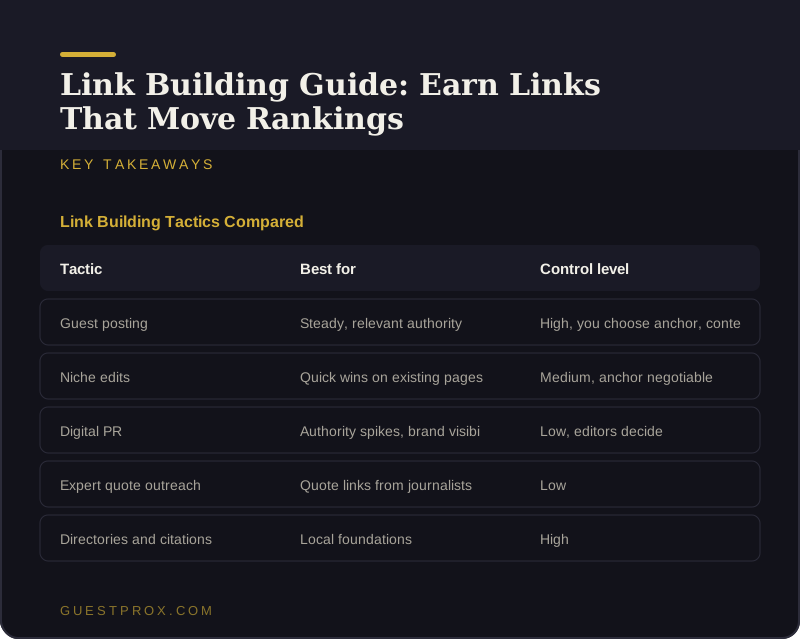
Effort, control, and risk for the tactics that matter.
| Tactic | Best for | Control level | Risk |
|---|---|---|---|
| Guest posting | Steady, relevant authority | High, you choose anchor, content, page | Low when manual |
| Niche edits | Quick wins on existing pages | Medium, anchor negotiable | Low when manual and relevant |
| Digital PR | Authority spikes, brand visibility | Low, editors decide | Low risk, high effort per link |
| Expert quote outreach | Quote links from journalists | Low | Low; very competitive |
| Directories and citations | Local foundations | High | Minimal ranking value beyond local |
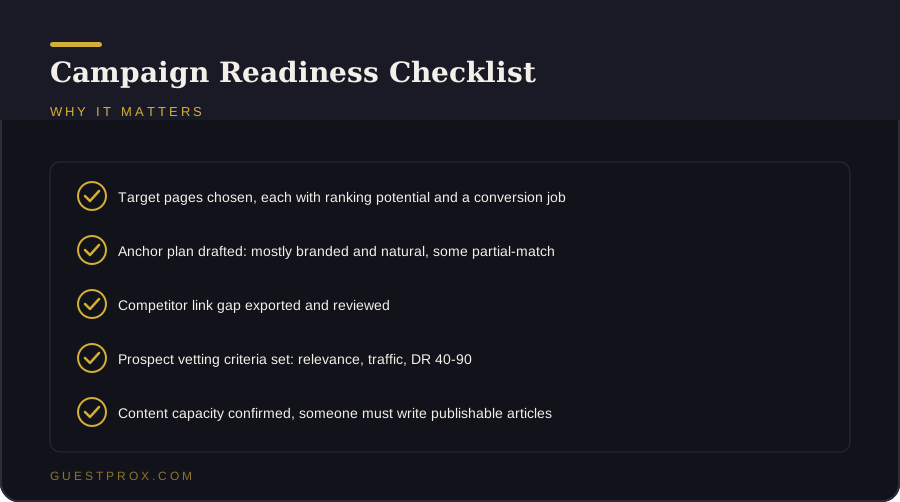
Answer yes to all eight before spending on links.
Keep building your link evaluation toolkit.
Authoritative sources if you want to go deeper on this topic.
Plan on two to four months before new links move your rankings. Crawling, signal processing, and re-evaluation all take time, and competitive keywords take longer. The compounding effect is real: links built in month one keep working in month twelve.
We don't publish prices. Every campaign is scoped to your targets and competition, so the fastest way to get an exact number is to message us on WhatsApp at +1 (213) 582-6001.
Earning links through manual outreach and genuine content is safe and explicitly legitimate. What gets penalized is manipulation: PBNs, paid link networks, spun content, and irrelevant link blasts. We operate 100% white hat with no PBNs, so every link we build is one you can show anyone.
Buying links pays for placement regardless of merit, the site publishes whatever the buyer sends. Outreach earns placement: an editor reviews the content and accepts it for their readers. Bought links leave financial footprints and get devalued; earned links survive algorithm updates because they look like what they are.
There is no magic number, but velocity should look natural for your site's size and history. A small site adding four to eight relevant links from real sites monthly looks organic; the same site adding fifty looks bought. Consistency matters more than spikes, steady beats sporadic every time.
Great content earns some links on its own, but rarely enough and rarely fast enough in competitive niches. Outreach puts your best pages in front of people who can link to them. Think of content as the product and link building as distribution, you need both.
You can absolutely do it yourself, this guide gives you the full process. The honest trade-off is time: prospecting, pitching, and writing at quality takes ten to twenty hours per placement. Most teams outsource once they value their time above the per-link cost, and keep strategy in-house.
GuestProx runs manual outreach campaigns on DR 40-90 sites with monthly reporting. See our link building service for packages and turnaround times.
Global Service Delivery