
The exact quality bar every website must clear before we pitch it your guest post. Published openly, so you can hold us to it.
Guest post publisher standards are the minimum quality criteria a website must meet before we pitch it a single article. Most agencies keep these rules private; we publish ours because a buyer should be able to judge the sites their links will come from.
Every prospect passes checks drawn from our publisher vetting standards: real organic traffic, genuine editorial content, clean ownership, and a natural link profile. Fail any one of them and the site is out, no matter how attractive its DR looks.
If a site fails even one, we do not pitch it.
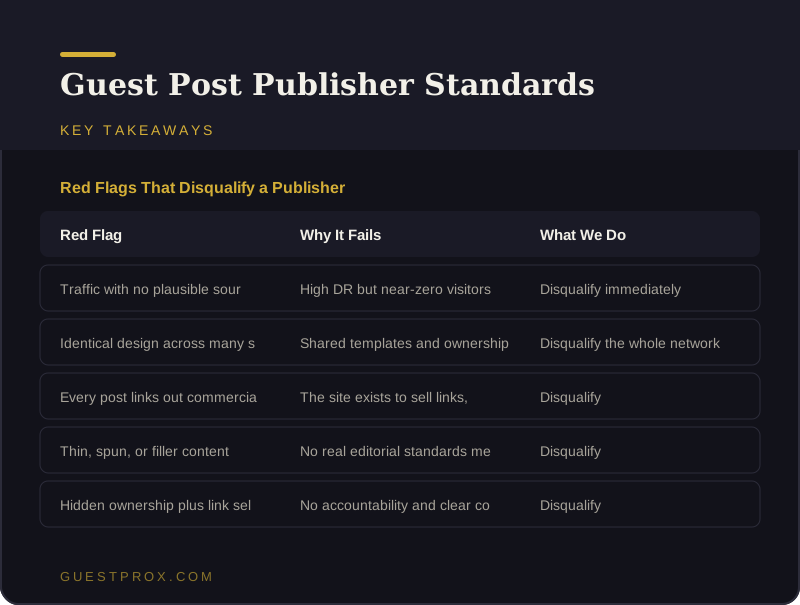
What we look for, and what happens when we find it.
| Red Flag | Why It Fails | What We Do |
|---|---|---|
| Traffic with no plausible source | High DR but near-zero visitors suggests manipulated metrics | Disqualify immediately |
| Identical design across many sites | Shared templates and ownership signal a PBN | Disqualify the whole network |
| Every post links out commercially | The site exists to sell links, not to publish | Disqualify |
| Thin, spun, or filler content | No real editorial standards means no real audience | Disqualify |
| Hidden ownership plus link selling | No accountability and clear commercial intent | Disqualify |
We check organic traffic history across multiple months, not a single snapshot. A healthy publisher shows steady or growing visitors from real keywords; a manipulated one shows spikes, cliffs, or traffic concentrated in irrelevant countries.
We also look at engagement signals: comments, social shares, and content that plausibly earns its audience. Traffic that cannot be explained by the site's content is treated as a red flag, not a selling point.
This is where website quality standards matter most. We read the site's recent articles, check author bios, and confirm a real publishing cadence. Sites with named writers, original reporting or analysis, and clear editorial judgment pass; content mills do not.
We also review how the site handles outbound links. A page that links to genuine resources reads as editorial. A page where every other paragraph links to a commercial anchor reads as inventory for sale.
We look at domain registration, design footprints, and hosting patterns to spot networks pretending to be independent sites. Shared themes, identical layouts, and clustered IP addresses are classic PBN tells.
A legitimate publisher has nothing to hide: a named owner or company, a contact page, and a history you can trace. When ownership is masked and the site sells links, we walk away.
Vetting does not end at pitch time. We re-check publishers before each campaign round, because sites change hands, get sold, or degrade. A publisher that passed last year is not automatically approved this year.
If a site's quality drops after your placement is live, we stop pitching it for future campaigns. Placements already published remain legitimate editorial links; we simply do not send new clients into a declining site.
Clients can review and veto prospect lists before outreach begins. Transparency is the policy here, not a favor.
Start a Campaign →Go deeper on publisher quality and vetting.
Authoritative sources if you want to go deeper on this topic.
DR 40 is our floor, and it must come with real organic traffic to match. A DR 55 site with no visitors fails our standards while a DR 42 site with steady, relevant traffic passes. Authority scores open the conversation; traffic closes it.
No. We have a zero-tolerance policy for private blog networks. Our vetting checks ownership patterns, design footprints, hosting clusters, and traffic plausibility specifically to catch networks pretending to be independent sites. Any site that looks like a PBN node is disqualified along with its network.
We check organic traffic history over multiple months in SEO tools, confirm the traffic comes from plausible keywords, and look for engagement signals like comments and shares. We also read the content itself: traffic that cannot be explained by what the site publishes is treated as suspicious.
We re-verify publishers before each campaign round. If a site's quality drops after your placement is live, we stop pitching it for future campaigns. Your existing placement remains a legitimate editorial link; we simply do not send new clients into a declining site.
Yes. Every client can review the prospect list before we send a single pitch, and veto any site for any reason. Some clients remove competitors' partners; others just prefer certain publications. Your vetoes are final.
Generally no. We need traffic history to verify a site is legitimate, and brand-new sites have none. Exceptions are rare and only for sites with a verifiable team, real launch coverage, and clear editorial standards from day one.
Tell us about your niche. We will show you the caliber of publishers we pitch before you commit to anything.
Global Service Delivery