
For brands, founders, and agencies ready for press-level links. Learn how digital PR campaigns work, which tactics earn coverage, and when this approach is not the right fit.
Digital PR link building is the practice of earning backlinks through media coverage. Instead of pitching a guest post to a blog, you give journalists something worth writing about: original data, expert commentary, or a timely angle on the news. When they publish, your site earns editorial links from publications that rarely accept outreach placements at all. This digital PR link building guide walks through how campaigns run, which tactics earn coverage, and where the approach falls short.
The links digital PR earns look different from placed links. They usually point to your homepage or a data asset rather than a commercial page, they carry your brand name as anchor, and they come from domains with genuine newsroom authority. That makes them powerful for overall domain strength and weaker for pushing one product page, a trade-off worth understanding before you budget.
Digital PR also demands more from you than guest posting does. You need something genuinely newsworthy, a spokesperson willing to comment, and patience while journalists decide. The sections below cover the campaign mechanics, the tactics with the best hit rates, and an honest read on when your money works harder elsewhere.
Digital PR link building means earning backlinks by getting journalists and publications to cover your story, data, or expertise.
A digital PR campaign is a short, intense push with a clear news hook, not an ongoing drip of placements. Most campaigns run four to eight weeks from idea to coverage, and the work splits into three phases: building something worth covering, pitching it to the right journalists, and following up without becoming a nuisance.
Journalists do not care about your link targets. They care about a story their readers will click. Strong hooks come from original survey data, a contrarian expert take, or a local angle on a national story. If you cannot explain why a stranger would read the article, you do not have a campaign yet.
Digital PR outreach targets news desks and beat reporters, and it follows newsroom rules: short pitches, genuine news value, and exclusivity offered to one top-tier outlet first. Response rates run lower than blogger outreach because the bar is higher. But a single national pickup can syndicate across dozens of regional outlets, which is where digital PR SEO earns its reputation: a few placements can move domain-level authority more than months of steady guest posts.
Expect two to three weeks to build the asset and media list, one to two weeks of active pitching, and coverage landing unevenly after that. News moves on its own schedule; a story can sit quiet for ten days, then get picked up because a related event broke. Anyone promising exact coverage dates is selling certainty the news cycle does not offer.
The tactics covered in this digital PR link building guide were chosen for one reason: they give journalists the two things they always need, something new and someone quotable. Each tactic below includes what the journalist gets out of it, because coverage follows value, not asks.
Commission a survey or analyze your own data, then package one surprising finding as the headline. Data stories work because they are exclusive and citable: every outlet that covers the finding links back to your study as the source. Few formats generate digital PR backlinks as reliably as an exclusive dataset with a clean methodology, so publish the full numbers and let journalists verify them.
Newsjacking means offering a qualified expert the moment a story breaks in your field. Speed decides everything: journalists on deadline quote the first credible voice with a take sharper than the obvious one. Keep a roster of spokespeople and pre-approved angles ready so you can respond within hours, not days.
Interactive tools and striking visual assets earn links because they give readers something to use, not just read. A salary calculator, an interactive map, or a well-designed index can keep earning links for years after launch. The upfront build cost runs higher than a survey, but the link tail outlasts any single news story.
Earned and placed links solve different problems, and strong campaigns use both. Understanding what each one gives you stops you from buying the wrong service for your goal. The comparison is practical, not philosophical: different goals, different budgets, different timelines.
Earned links come from editorial decisions you do not control. You cannot choose the anchor text, you usually cannot choose the target page, and the link may be nofollow under the outlet's policy. In exchange you get domains, audiences, and trust signals that money alone cannot buy, plus brand visibility no guest post delivers.
Digital PR is a poor fit when you need links to one commercial page fast, when you have no newsworthy angle and no budget to create one, or when your niche gets almost no press coverage. Local service businesses and brand-new sites with no story usually get more ranking movement per dollar from targeted guest posting. That honest filter is the point of this digital PR link building guide: match the tactic to the goal before you spend.
The two approaches stack well. Digital PR builds homepage authority and brand mentions at the domain level, while guest posting aims controlled, contextual links at the commercial pages that need to rank. Run them in parallel and the earned coverage even makes outreach easier, because editors recognize the brand from the press.
Journalist outreach follows different rules than blogger outreach. A blogger wants good content for their audience. A journalist wants a story their editor will approve, filed before deadline. Every part of your pitch should answer the journalist's real question: why should I write this today?
Subject lines under eight words, stating the finding, not the ask. A subject that leads with the data point beats "guest contribution opportunity" every time. The first two sentences carry the news: what you found, why it matters now, and what you are offering: data, quotes, or graphics.
Keep the whole pitch under 150 words. Journalists triage hundreds of emails daily; anything longer gets skimmed or deleted. Offer the asset as a link, never an attachment. The mechanics overlap with getting editors to say yes, but the bar for news value is higher and the tolerance for fluff is zero.
Offer your top-tier target an exclusive: first publication rights in exchange for near-certain coverage. Exclusives raise response rates because journalists compete on being first. Set an embargo time so other outlets can prepare their versions without spoiling the exclusive.
Time pitches to the news cycle. A data story about holiday spending lands in November, not January. Newsjacking requires same-day response: when a story breaks in your field, your expert quote needs to reach the reporter within hours. Keep pre-approved angles and a willing spokesperson ready, because the window closes fast.
One follow-up, three to five days later, with something new: a second data point, a sharper quote, a different angle. Never forward the original pitch with "just bumping this" at the top. If there is no reply after the second touch, the story did not land. Move on and keep the relationship warm for the next campaign.
Treat every journalist contact as a multi-campaign relationship, not a one-shot transaction. That is how content outreach compounds: the reporter who passes today remembers the useful source next quarter.
Link counts are the weakest measure of a PR campaign. A single national pickup that syndicates to forty regional outlets counts as one relationship but forty links, and the brand effects dwarf the link effects. Measure what the campaign was actually for.
Compare the spend against what the same effort buys in placed links. PR wins on domain authority, brand visibility, and link diversity; it loses on control and predictability. The honest comparison in guest posting versus digital PR helps you decide which deserves the bigger share of the budget.
Report coverage honestly. A campaign that earned three strong pickups and forty syndications is a good campaign; a campaign that earned two blog mentions is not. The authority metrics that predict link value apply to PR links too: check the outlet's real traffic before celebrating the logo.
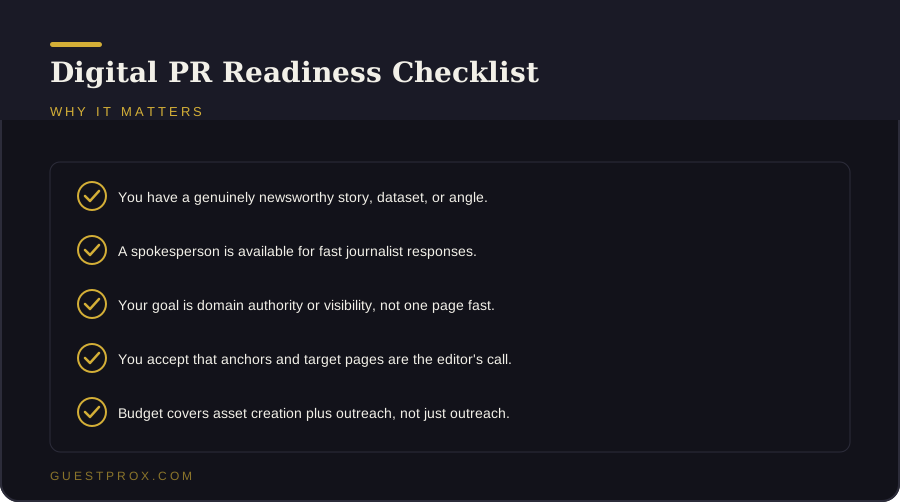
Most failed PR campaigns fail before outreach starts: the story was never newsworthy. Run every campaign idea through these five questions. If it fails two, rebuild the idea or choose a different tactic.
Good example: a survey finding that 41% of a city's renters would move for a shorter commute, pitched to local business reporters during a transit debate. Bad example: a company announcing it "is excited to offer" a service competitors have sold for years. One is news; the other is an advertisement wearing a press release costume.
When the story passes, the campaign deserves professional execution: media list building, embargo management, and disciplined follow-up. That is what our digital PR service handles end to end. And if you want to see how we measure and report results across campaign types, the case studies page explains our reporting framework.
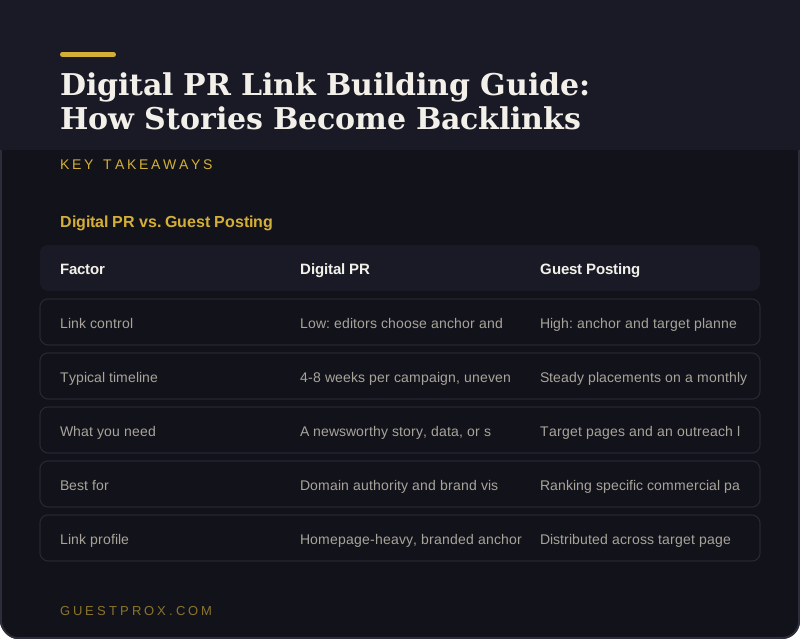
Choose based on your goal, timeline, and budget.
| Factor | Digital PR | Guest Posting |
|---|---|---|
| Link control | Low: editors choose anchor and page | High: anchor and target planned in advance |
| Typical timeline | 4-8 weeks per campaign, uneven results | Steady placements on a monthly cadence |
| What you need | A newsworthy story, data, or spokesperson | Target pages and an outreach list |
| Best for | Domain authority and brand visibility | Ranking specific commercial pages |
| Link profile | Homepage-heavy, branded anchors | Distributed across target pages by plan |
Answer honestly before committing budget to a campaign.
Pair digital PR with the tactics that compound its results.
Authoritative sources if you want to go deeper on this topic.
We don't publish prices. Every campaign is scoped to your targets and competition, so the fastest way to get an exact number is to message us on WhatsApp at +1 (213) 582-6001.
It is among the safest link building methods because the links are genuinely earned through editorial coverage. The real risk is budgetary, not algorithmic: a campaign can consume weeks and produce modest coverage. Working with a team that kills weak angles early, rather than pitching them anyway, controls that risk.
Plan for four to eight weeks from kickoff to coverage, with links arriving unevenly as outlets publish. Unlike guest posting, there is no fixed delivery schedule, because journalists publish on their own timelines. If you need links landing in a specific month, pair digital PR with a steadier tactic.
Buying links means paying a site owner for a placement, which Google explicitly prohibits. Digital PR means creating something newsworthy and earning coverage from journalists who choose to link on editorial merit. No one is paid for the link itself, which is why earned coverage carries the trust that paid placements cannot.
Yes, with the right angle. Local data, community stories, and founder expertise all earn regional press, and regional outlets link generously. What small businesses should skip is the national-campaign playbook; a targeted local push with one strong hook beats a broad campaign with none.
Indirectly. Most earned links point to your homepage or the campaign asset, which lifts domain-level authority that flows to every page. If one product page must rank, combine digital PR with guest posting aimed at that page so you get both the rising tide and the targeted push.
A good team tells you early when an angle is not landing instead of burning the full budget. The asset usually survives: data studies become blog content, tools keep earning links passively, and the media list carries into the next attempt. Ask any provider how they handle a quiet campaign before you sign.
Our digital PR service turns your data and expertise into stories journalists want to cover. Tell us about your brand and we will tell you honestly whether digital PR fits.
Global Service Delivery