
For brands competing across countries and languages. We earn links from publishers in your target markets, not just English-language sites that happen to rank there.
International link building earns backlinks from publishers in the markets you want to rank in. English links rarely move the needle for German, French, or Spanish SERPs, because Google weighs local relevance heavily.
Companies learn this the expensive way. They translate the site, set up hreflang, then wonder why rankings stall. The missing piece is almost always authority in the target market: links from sites that market actually reads and trusts.
We run outreach natively in each market. Local writers, local editors, local publications. Our per-market gap analysis shows exactly where competitors get their local links, so we start with targets proven to work.
The payoff for getting this right is enormous. Most of your competitors never bother with local-market links, which means the ones who do often dominate with surprisingly few placements.
Do not ignore English-language international press. Publications like TechCrunch or The Guardian carry weight across markets, and one strong English placement can support multiple regional campaigns.
Link velocity needs market-specific calibration. A new German site earning links at US pace looks unnatural to local algorithms tuned to local norms. We pace each market to what looks organic there.
International link building earns backlinks from country- and language-specific publishers so each regional version of your site builds authority in its own market.

If you sell or compete in more than one country, your links should too.
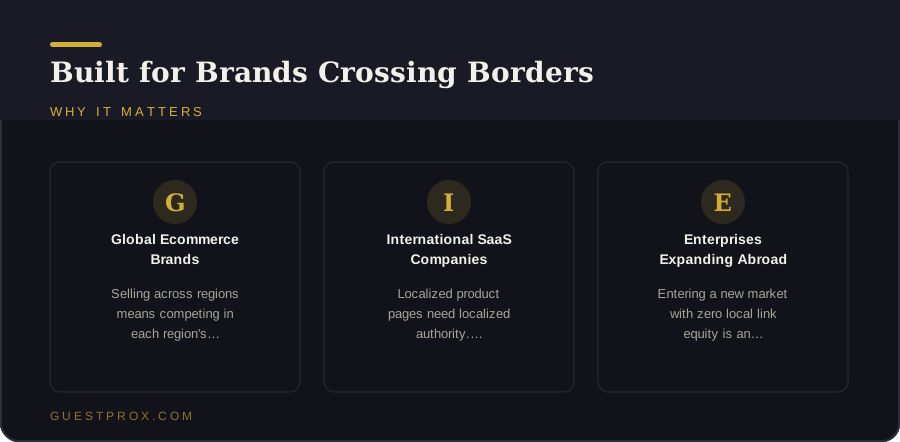
Selling across regions means competing in each region's SERPs. Market-specific links support every regional storefront.
Localized product pages need localized authority. Our multilingual link building covers each language market you target.
Entering a new market with zero local link equity is an uphill climb. We build the local footprint before you need it.
Destination content earns links best from publishers in the traveler's language and the destination's press.
Machine-translated pitches get deleted. Even fluent translations fail when the angle ignores local media culture: what German editors consider newsworthy differs from what Brazilian editors want. Outreach is persuasion, and persuasion is local.
Our teams work in the target language from the first email. They know the publications, the editorial calendars, and the angles that land. Combined with digital PR, this earns the coverage that actually shifts local rankings.
Hreflang and content get you eligible; links get you ranked. We coordinate with your international SEO setup so every placement points at the correct regional URL with the right anchor language. Wrong-region links dilute the exact signals you are building.
We vet publishers per market for the same things everywhere: real traffic, real editorial standards, real relevance. A high DR means nothing if the site has no readers in your target country.
Start where the data points. We will show you the gap per market, the effort per market, and the expected return, then let you choose. Informed bets beat hopeful guesses. The data never lies about where opportunity lives.
Every market needs its own campaign. A link from a Spanish newspaper does little for your French rankings, and outreach that works in the UK often falls flat in Japan. We run parallel market campaigns under one reporting roof.
You get per-market reporting with local context, not a blended spreadsheet. Our link building guide explains how international fits into the broader strategy.
We also handle the content side per market. Outreach needs local-language assets: pitches, articles, and data that connects locally. Our writers produce market-native content, not translations, because editors can taste the difference.
Cultural missteps kill campaigns. We brief every outreach on local norms: how formal to be, what not to claim, which topics are sensitive. Respect opens inboxes that templates cannot.
We also watch for regional algorithm differences. What works for Google.com does not always transfer to markets where local search engines matter. Our per-market playbooks account for these differences.
You do not need to conquer twelve countries at once. Pick the market with the most revenue potential, win it, then replicate. One focused campaign teaches us what works for your brand before we scale.
The first market is also where we build your playbook: which publications respond, which angles land, what content assets earn links. Every market after that moves faster because the learning compounds.
We recommend starting where the gap is biggest. Our per-market gap analysis shows exactly that, so the first campaign starts with proven targets.
Reporting separates markets cleanly. You see per-country placements, per-country movement, and per-country next steps. Global dashboards that blend everything hide exactly the detail you need to make decisions.
Currency and invoicing are handled in your terms. Multi-market billing, VAT handling, and consolidated reporting come standard, because enterprise finance teams have enough headaches.
One coordinated program, executed market by market.
From market prioritization to consolidated reporting.
We agree which countries and languages matter most and sequence the work by opportunity.
For each market, we find publishers with real local traffic and audiences that match your customers.
Outreach goes out in the market's language, written natively, never machine-translated.
Each link targets the right regional URL, respecting your hreflang setup and site structure.
We verify every link: correct page, sensible anchor, dofollow, and live.
One report covering all markets, with per-country link counts, publisher quality, and progress.
International link building is not one tactic repeated, it adapts.
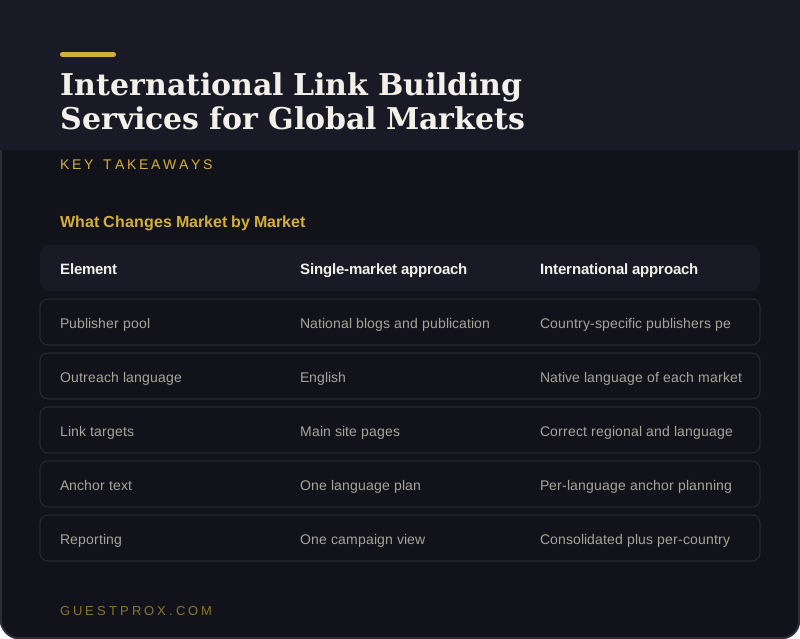
| Element | Single-market approach | International approach |
|---|---|---|
| Publisher pool | National blogs and publications | Country-specific publishers per market |
| Outreach language | English | Native language of each market |
| Link targets | Main site pages | Correct regional and language URLs |
| Anchor text | One language plan | Per-language anchor planning |
| Reporting | One campaign view | Consolidated plus per-country breakdowns |
Tell us which countries you are targeting. We will assess the link scene in each and show you what is winnable.
Assess My Markets →Combine global reach with the right supporting tactics.
Authoritative sources if you want to go deeper on this topic.
You can, and they help domain authority. But regional rankings respond to regional signals. A French site with links from French publications outranks one with only English links for French queries, all else being equal.
Yes. International SEO link building only works when outreach is written natively for each market, we do not machine-translate pitches. Editors can spot translated outreach instantly, and it kills response rates.
Every link targets the correct language or regional version of the page. We map your URL structure before outreach starts so German links point to German pages.
We serve the US, UK, Canada, and Australia directly and coordinate outreach across European and other international markets. Tell us your targets and we will confirm coverage during scoping.
We don't publish prices. Every campaign is scoped to your targets and competition, so the fastest way to get an exact number is to message us on WhatsApp at +1 (213) 582-6001.
Expect the same three-to-six-week lead time for first placements per market, with timelines running in parallel across markets once outreach is underway.
Tell us your target countries and languages. We will map the publications and build a per-market link plan.
Global Service Delivery