
For SEOs auditing a link profile or judging a placement before it goes live. A technical checklist for the link itself: anchors, placement, page signals, and neighborhood.
A backlink quality checklist evaluates the link itself, not the article around it: anchor text, position on the page, authority of the linking page and domain, and the company the link keeps. A strong article on a strong site can still carry a weak link if any of those fail.
Think of each backlink as a vote. This checklist asks whether the vote looks earned: natural anchor, contextual placement, a real page with real traffic, and a domain whose other outbound links are legitimate. Votes that look bought get discounted; votes that look earned compound.
Run it on new placements before they enter the report, and quarterly across the existing profile. The same checks catch a bad purchase on day one and a decaying asset on day ninety: links rot, and audits catch the rot early.
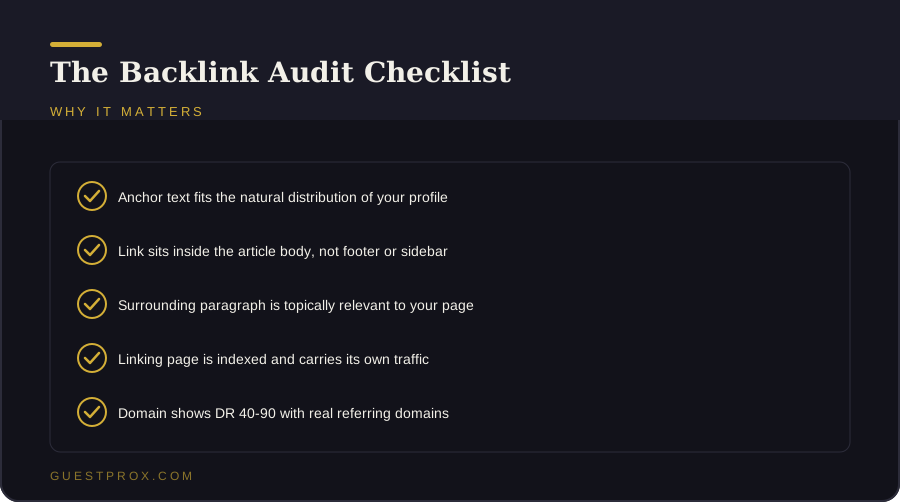
Anchors and placement are the two things search engines read first about any link, and the two things most buyers check last. Get them right and the link looks like a citation; get them wrong and it looks like a transaction. Run the anchor and placement checks before anything else in this backlink quality checklist, because no amount of domain authority rescues a link buried in a footer with a keyword-stuffed anchor.
No single anchor makes or breaks a link; the pattern across your profile does. A natural profile mixes branded anchors, naked URLs, partial phrases, and the occasional exact-match keyword. A profile built on exact-match anchors is the footprint search engines look for. Anchor mix analysis is the foundation of any serious backlink evaluation: it is the signal most directly tied to penalties.
Before approving a placement, check what the anchor adds to your existing mix. If your last ten links all used the same money keyword, the next one should not. Anchor planning is portfolio management: every new link should make the profile look more natural, not less.
An in-content link inside the article body carries the most weight: editorial, contextual, surrounded by relevant text. Sidebar, footer, and author-bio links carry less, because they are structural rather than editorial. Sitewide footer links are the worst: hundreds of identical links that look exactly like what they are.
When reviewing a placement, confirm the link sits in the body copy; if it was promised as contextual and delivered in an author bio, push back before it goes in the report. Position is part of what you paid for.
Search engines read the sentence around your link as a relevance signal. The linking paragraph should discuss the same topic as your linked page: a link to a link building guide inside a paragraph about outreach is a citation; the same link inside a paragraph about gardening is noise.
This is the fastest manual check in the audit: read the paragraph, ignore the link, and ask what it is about. If the answer matches your page's topic, the context is right. If not, the placement is weak regardless of the domain's metrics.
Know what you bought. Dofollow passes ranking equity; nofollow, sponsored, and UGC tell search engines not to count the link as a vote. Nofollow links still have value: traffic, brand exposure, and a natural-looking profile.
The problem is mismatch, not the attribute itself: if you paid for dofollow and received nofollow, that is a fulfillment failure. Check the rel attribute on every placement before reporting, and keep a deliberate mix, since 100% dofollow looks manufactured.
A link is only as strong as the page it lives on and the domain behind it. These checks separate placements that pass real authority from ones that only display impressive metrics. Start with the linking page itself: is it indexed, does it get traffic, and does it rank for anything real? A strong domain with a dead page is a weak placement wearing a good costume.
Check the URL, not just the domain: does the specific page have its own traffic, referring domains, and rankings? A link from a strong page on a medium domain beats a link from a dead page on a strong domain, because authority flows from the page first.
Also confirm the page is indexed: a page search engines have not indexed passes nothing, no matter how authoritative the domain looks. New placements sometimes take weeks to get crawled, so verify before you report and recheck the stragglers.
Look for DR in a believable range backed by real referring domains and steady organic traffic. Our own bar is DR 40-90 on sites with verified traffic. Domain health is the slowest-moving part of this quality backlinks checklist, which is why it matters most for links you keep for years.
Check the domain's traffic trend alongside its authority: strong metrics with collapsing traffic means a decaying asset, whose links erode in value as the domain fades. Prefer domains on a flat or rising line.
A link from a site search engines already associate with your topic carries relevance along with authority: a plumbing business linked from a home improvement publication gets both. The same link from a generic multi-niche blog gets authority without relevance, and relevance is often the difference between a link that ranks and one that decorates a report.
Judge relevance by what the site actually ranks for, not what its about page claims: the top keywords in your SEO tool tell you how search engines categorize the domain.
Zoom out from the single link to how the domain acquires links over time. Natural domains gain referring domains gradually, with occasional spikes around genuinely newsworthy content. Domains gaining thousands of links in a week, repeatedly, are usually buying them.
Apply the same lens to your own profile during quarterly audits: a sudden spike in referring domains you did not earn deserves investigation, whether a scraper, an attack, or a provider cutting corners. Velocity anomalies are early warnings.
The company your link keeps shapes how search engines read it: a link surrounded by legitimate citations looks earned, while one surrounded by casino, pharma, and payday-loan links looks bought. This is the risk pass of the audit. Scan every other outbound link on the page before you approve yours. Five minutes here catches the placements that metric checks miss entirely.
Open the linking page and look at its other outbound links: on a healthy page they point to sources, tools, and related reading, the normal citations of a real article. On a compromised page, your link sits alongside exact-match anchors to unrelated commercial sites.
Count them too: a handful of outbound links passes meaningful equity through each, while a hundred dilutes every link to near zero. Outbound link count is the most underrated metric in link buying.
Individual paid links are hard to spot; patterns are not. Watch for footprints across a domain: dozens of posts with keyword-rich exact-match anchors, sponsored labels without proper disclosure, author bios that exist only to host links. One footprint is a warning; three is a verdict.
Sitewide links deserve special suspicion: a link repeated in the footer or sidebar of every page is advertising inventory, not an editorial citation. Search engines have discounted sitewide links for years, and they can still attract manual scrutiny.
Private blog networks exist to simulate authority, and the simulation usually leaks: thin about pages with no real people, no verifiable contact info, content published in bursts, and design that looks assembled rather than designed.
Our rule is absolute: no PBNs, ever, in our placements or in profiles we audit. A single PBN link is a contained risk; a profile with PBN exposure is a penalty waiting for a reviewer. When you find one, remove it.
Links are not permanent assets; they are rented placements on other people's property. Pages get deleted, sites get sold to owners who strip outbound links, and domains quietly die. A link that graded A last year can be a dead URL today.
This is why the audit repeats quarterly: recrawl your most valuable placements, confirm the link is live and dofollow, and check the domain's health. Catching decay early means replacing the link while the campaign is active, not discovering it during a rankings postmortem.
A placement on a site with traffic is worth more than a placement on a site with a score. But traffic numbers are easy to stage, so the check that matters is the history behind the number: how the graph looks over twelve months, where the visits come from, and what keywords drive them. A steady graph built on topically relevant keywords means a working publication. A spike, a collapse, or traffic from irrelevant queries means the number is decoration.
Start every traffic check with the twelve-month view, not the current month. Real publications show gradual growth, gentle seasonal movement, or a flat line. Expired domains resurrected for link sales show a long flatline, a sudden vertical jump after the domain changed hands, then another flatline. That shape is the clearest tell in the whole audit.
Open the site's top organic keywords and ask whether they match the publication's claimed niche. A marketing blog whose top terms are celebrity names and coupon codes is ranking for junk, and your link sits on a site search engines already distrust. The keywords should read like the site's own content plan.
Check the traffic countries too. A supposed US business publication drawing most of its visits from regions where it publishes nothing is a red flag, not a quirk. These checks take minutes, and the full breakdown of DR, DA, Trust Flow, and organic traffic explains why no single score ever settles the question.
When someone else builds your links, traffic verification should happen before the placement enters your report, not after you ask about it. Ask your provider what the traffic looked like before the pitch went out. A confident answer with a screenshot beats a confident assertion every time.
Build the habit of checking history before scores on every prospect. Learning to run the same sequence yourself starts with evaluating a guest posting site the way a practitioner does: traffic history first, content read second, authority scores last.
Two pages can sit on the same DR 60 domain and pass completely different value. The difference is outbound link hygiene: how many links leave the page, where they point, and whether they look editorial or rented. A page that links to ten legitimate resources is a citation page. A page that links to forty unrelated commercial sites is a billboard.
This check also protects you from guilt by association. Search engines read the set of sites a page links to as a neighborhood signal, and your link inherits some of that context. A placement surrounded by payday loans, casinos, and unrelated pharma links gets judged by its company.
Open the page and count. Fewer than ten outbound links, mostly to established editorial sources, is healthy. More than twenty commercial links with no topical connection to each other suggests the page exists to sell placements. There is no official limit, but working editors link sparingly, and sold placements link promiscuously.
Then classify the destinations. Links to government pages, research, real companies, and recognized publications are editorial. Links to thin affiliate pages, crypto schemes, and essay mills are rented. One bad neighbor does not ruin a page, but a pattern of them means the publication sells to anyone with a budget.
Good: a 1,800-word guide to email marketing on a marketing blog, linking to a deliverability study, two email platforms' documentation, and three relevant industry articles. Your link to a deliverability tool sits in a paragraph about inbox placement. Every outbound link earns its place.
Bad: a 600-word "ultimate guide" on a general blog, linking to a casino, a CBD store, an essay service, and twelve more unrelated businesses. Your link is one of thirty commercial anchors with keyword-rich phrasing. The domain score might be identical, but the page is worthless. Placements that survive this check are the kind editorial link building is supposed to produce: real pages, real context, real neighbors.
A placement you cannot prove is a placement you cannot defend. Before a link enters the report, capture the proof pack: the live URL, a screenshot of the link in context, the anchor text, the rel attribute, and the date it went live. This takes five minutes and ends most disputes before they start.
Proof matters because placements change. Editors update articles, sites redesign, and links occasionally disappear or lose their dofollow status. A report built on proof lets you re-verify in seconds. A report built on promises leaves you guessing which links are still working.
Links die quietly. Run the proof pack check quarterly on your most valuable placements: is the page still live, is the link still in the body, is the rel attribute unchanged? Catching a lost link in month two beats discovering it in month nine during an audit.
This is also how you judge a vendor. Any provider doing blogger outreach properly should hand you the proof pack without being asked. If a report lists URLs with no screenshots, no anchor records, and no indexation checks, assume the vetting was never done.
Most audits stall because every link gets the same vague verdict. Use three buckets instead. Pass means the link meets every check. Fix means something is wrong with the execution on a real site, and reject means the site itself fails the sniff test.
Contextual placement in the body copy, a natural anchor that fits your distribution, dofollow as agreed, real traffic on the site, a clean outbound neighborhood, an indexed page. These links go straight into the report. Nothing more to decide.
The site is legitimate but the placement missed: promised dofollow arrived as nofollow, the anchor was changed to something spammy, or the link landed in an author bio instead of the body. These are vendor problems, not site problems. Push for correction before reporting, and show the proof pack as evidence. Most honest providers fix execution errors when the miss is documented.
No real traffic, inflated DR on an expired domain, outbound links to casinos, or an open guest-post pricing page. Do not try to salvage these with a different anchor or a rewritten paragraph. The placement has no value to save. Reject it, log the reason, blacklist the domain, and run the companion guest post quality checklist for the article-side checks.
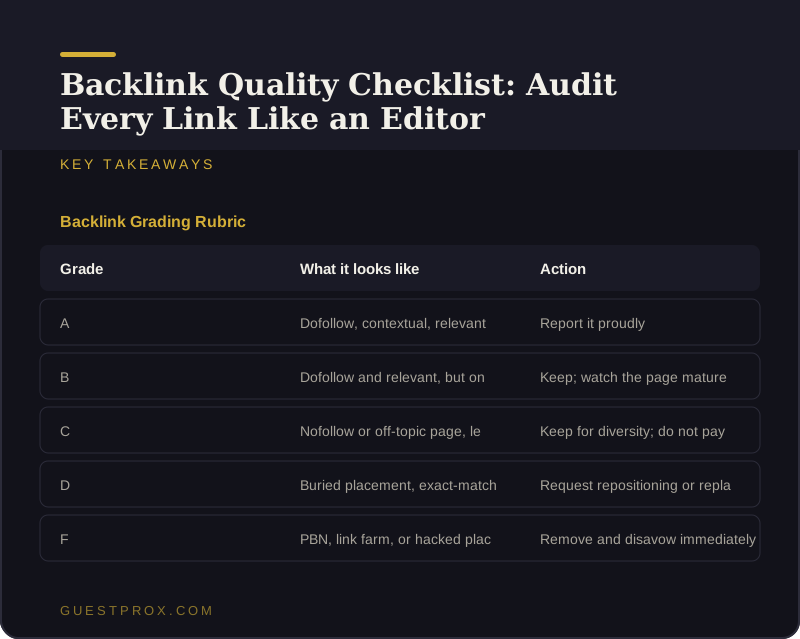
Score every placement before it goes into the client report.
| Grade | What it looks like | Action |
|---|---|---|
| A | Dofollow, contextual, relevant page with traffic, natural anchor | Report it proudly |
| B | Dofollow and relevant, but on a newer or lower-traffic page | Keep; watch the page mature |
| C | Nofollow or off-topic page, legitimate site | Keep for diversity; do not pay premium |
| D | Buried placement, exact-match anchor, weak page | Request repositioning or replacement |
| F | PBN, link farm, or hacked placement | Remove and disavow immediately |
Eight checks for every link, new or existing.
Companion reading on content and metrics.
Authoritative sources if you want to go deeper on this topic.
It depends on your competition, not on a magic number: a local business can win with a few dozen strong, relevant links, while a national keyword may need hundreds. What matters more than count is the gap: audit the top-ranking pages for your target keyword, grade their links with this checklist, and beat them on quality first. Ten A-grade links outperform a hundred D-grade links in almost every analysis.
Buying links means acquiring placements without evaluating them: no anchor review, no placement check, no domain vetting. Auditing is the discipline that makes link building defensible: every link is graded on anchors, position, page signals, and neighborhood before it counts. One approach accumulates risk; the other accumulates assets.
We don't publish prices. Every campaign is scoped to your targets and competition, so the fastest way to get an exact number is to message us on WhatsApp at +1 (213) 582-6001.
The link must be discovered, crawled, and indexed first, which typically takes days to weeks. Ranking impact follows over the following weeks to months as the link's equity factors into the page's valuation. One link rarely moves anything alone; impact compounds as the profile grows. Anyone promising movement from a single link on a fixed date is selling certainty they cannot deliver.
Disavow is a scalpel, not a broom: use it for clear-cut toxic links like PBNs, hacked placements, and obvious paid-link schemes. Do not disavow merely weak links; search engines ignore low-quality links on their own, and aggressive disavowing can remove links that were quietly helping. Audit first, and disavow only what you can defend as harmful.
Quarterly for most sites, monthly for aggressive campaigns. Each audit should re-verify your most valuable placements are still live and dofollow, check for new toxic links you did not earn, and review anchor distribution for drift. New placements get graded before they enter the report, so the quarterly audit is maintenance: catching decay, not discovering disasters.
Our link building service scores every placement on anchors, placement, and domain signals before it reaches your report. 100% manual outreach, no PBNs. Reach us on WhatsApp +1 (213) 582-6001 or contact@guestprox.com.
Global Service Delivery