
One bad placement can do more harm than ten good ones do good. Here is the exact evaluation framework we run on every site before it gets anywhere near a pitch.
Evaluating a guest posting site means verifying it has real organic traffic, genuine editorial content, a natural outbound link profile, and no signs it exists to sell links, before you pitch it. Five focused checks take about ten minutes per site and filter out the vast majority of bad prospects.
Most people vet backwards: they check authority metrics first and stop there. Metrics are the easiest thing to manipulate, which makes them the worst primary filter. This is our complete answer to how to evaluate guest posting sites before spending effort pitching them. Start with traffic and content, the two things that can't be faked cheaply, and use metrics only as a secondary confirmation.
To evaluate a guest posting site, verify real traffic, real content, and a clean link profile, in that order, before trusting any authority metric.

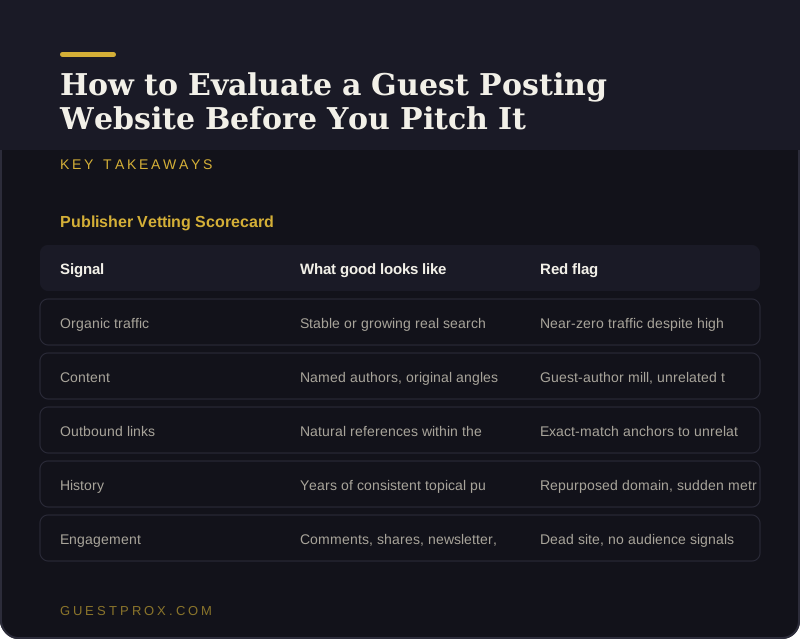
Run these in order. A site that fails check one doesn't need checks two through five.
Pull the site's organic traffic trend. You're looking for consistent, real search traffic, not a spike from one viral post, not a flatline near zero. Stable or growing traffic means Google genuinely sends the site readers, which means your link sits where algorithms and humans both pay attention.
No traffic with high authority metrics is the single most common footprint of a link-selling site. Walk away immediately. It is the first check in how to evaluate guest posting sites because it kills the most bad prospects the fastest.
Read recent posts. Real publications have identifiable authors, original angles, and content that took effort. Warning signs: dozens of guest authors with no bios, posts on wildly unrelated topics, thin articles clearly produced to host links. Ask yourself: would this site's editor reject a bad article? If the answer is no, it's not an editorial site.
Scan where the site links out. Natural editorial sites link to sources, tools, and references within their niche. Link sellers link to casinos, CBD stores, and essay mills from a 'business blog', dozens of exact-match commercial anchors with no topical logic. This check takes sixty seconds and eliminates most bad actors.
Check how long the site has operated under its current identity. Fresh domains with sudden authority, or old domains repurposed into unrelated niches, are classic PBN tells. A site with years of consistent topical publishing is what you want backing your link.
Comments, social shares, newsletter presence, an author community, none of these prove quality alone, but together they indicate a living publication. Dead sites with no audience engagement rarely pass editorial value to your link, even if their metrics look fine.
Some signals don't need deliberation. When learning how to evaluate guest posting sites, memorize this red-flag list first, it saves the most time. Any one of these ends the evaluation.
No named authors, hidden ownership, identical site structures across 'different' blogs, content clearly spun or AI-generated at scale, and backlink profiles full of reciprocal junk. Private blog networks exist solely to manipulate rankings, and links from them put your site in Google's crosshairs. We maintain a zero-tolerance policy: no PBNs, ever.
Authority metrics can be inflated with spammy link blasts that temporarily pump third-party scores. Signs include a huge referring-domain count with no traffic, anchors in foreign languages on an English site, or a DR that jumped 40 points in a month. Metrics are a starting point for investigation, never a verdict.
Hundreds of outbound links to unrelated money pages, 'sponsored' content with no disclosure, guest posts published daily across random topics. These sites may have traffic today, but they're one algorithm update away from worthlessness, and associating your brand with them is worse than the link is worth.
Our pass/fail reference for every prospect.
| Signal | What good looks like | Red flag |
|---|---|---|
| Organic traffic | Stable or growing real search traffic | Near-zero traffic despite high metrics |
| Content | Named authors, original angles, niche focus | Guest-author mill, unrelated topics, thin filler |
| Outbound links | Natural references within the niche | Exact-match anchors to unrelated commercial sites |
| History | Years of consistent topical publishing | Repurposed domain, sudden metric spikes |
| Engagement | Comments, shares, newsletter, community | Dead site, no audience signals |
| Link profile | Editorial links from real sites | Spam blasts, foreign anchors, reciprocal junk |
The framework holds everywhere, but some niches test it harder.
Finance, health, legal, Google holds these to higher standards, and so should you. Demand stronger authorship signals: real experts with verifiable credentials, editorial review processes, citations to primary sources. A placement that would be fine in a hobby niche can be a liability here if the site's expertise doesn't hold up.
Some industries have few quality publications. The answer is never to lower the bar, it's to widen the aperture: adjacent niches with genuine topical overlap, industry-adjacent news sites, professional association blogs. Relevance is a spectrum, and an honest adjacent placement beats a forced exact-niche one on a bad site.
The most dangerous prospect isn't the obvious link farm, it's the decent-looking site that's just okay. Mediocre placements don't hurt you, but they consume budget and report slots that strong placements would have filled. When a site is borderline, the disciplined move is to keep prospecting.
Theory is clean; practice is a browser with twelve tabs. Here is the actual order of operations we run per site, and why the sequence matters. Minutes zero to two: pull the traffic trend, if there is no real organic traffic, stop, because nothing else on the checklist can rescue a site nobody visits. This single gate kills most bad prospects before you've spent any real time.
Minutes two to five: read the content. Open three recent posts and one author bio page. You're checking for human authorship, topical consistency, and whether the writing took effort. Skim the homepage for the ratio of guest-authored to staff content, a site that's 90% guest posts is a marketplace, not a publication, so if the content fails, stop.
Minutes five to eight: scan outbound links, open two or three recent articles and look at where they link out. Natural editorial linking goes to sources, data, and tools in the niche. Dozens of exact-match anchors pointing at unrelated commercial pages, casinos from a marketing blog, essay mills from a tech site, ends the evaluation immediately. This is also where our backlink quality checklist doubles as a vetting tool: the same signals that judge inbound links judge outbound neighborhoods.
Minutes eight to ten: check history and engagement, a quick look at the domain's age and topical consistency, plus whether anyone actually engages: comments, shares, a newsletter. Then decide: pitch, park for later, or discard. Ten minutes, four gates, most sites fail at gate one. The discipline isn't in the checks themselves; it's in stopping at the first failure instead of rationalizing your way forward.
Everyone checks what links into a prospect. Few check what links out of it, and the outbound neighborhood tells you things the inbound profile can't. A site's outgoing links reveal its business model: editorial sites link to sources that serve readers; link sellers link to whoever paid most recently.
Run this scan on the site's last month of content, counting the commercial outbound links per article and noting their topical fit. One or two relevant commercial links per post is normal editorial behavior. Five-plus exact-match anchors to unrelated money pages per post is a link farm with a blog attached. Also watch the velocity: a site that suddenly triples its guest post output is monetizing harder, and its editorial value is diluting in real time.
Cross-reference the beneficiaries. If the same handful of domains appear across dozens of recent posts with keyword-rich anchors, you're looking at a private client list, not editorial judgment. Legitimate publications show diverse, reader-serving outbound patterns, Wikipedia, industry research, tools, news. When the outbound profile reads like an advertiser roster, treat the site as one.
This check also protects you after placement. A site with clean outbound patterns today can degrade, new ownership, new monetization pressure. That is why we re-verify publisher relationships continuously rather than trusting a vetting result from a year ago, and why the scorecard above is a living document, not a one-time stamp. For a deeper breakdown of the metrics involved, see our post on guest post metrics.
Vetting is a skill, keep sharpening it.
Authoritative sources if you want to go deeper on this topic.
No. DR measures the strength of a site's backlink profile as estimated by one tool, it says nothing about traffic, content quality, or whether the site sells links. We've seen DR 70 sites with zero readers and DR 45 niche publications driving real referral traffic. Use DR as a secondary filter after traffic and content checks.
There is no magic number, and anyone selling you one is guessing. What matters is that traffic is real, stable, and topically relevant to your niche. A 5,000-visitor niche publication your buyers actually read beats a 500,000-visitor generalist site that publishes everything.
Look for the cluster of tells: hidden ownership, no real authors, thin or spun content, identical designs across supposedly different sites, and backlink profiles built from reciprocal junk. Individually each can have innocent explanations; together they're conclusive. When in doubt, skip the site, there are always more prospects.
Some, referral traffic and brand visibility are real even without ranking credit. But if you're investing in guest posting for SEO, your placements should be dofollow and contextual. We verify this at publication; if a publisher only offers nofollow, we tell you before proceeding.
Yes. A site openly selling 'guest posts' to anyone with a budget has no editorial standards, which means your link sits alongside dozens of unrelated paid placements. Google devalues these neighborhoods aggressively. The 'write for us' page is fine; the 'buy guest posts here' price list is not.
Sites change, good ones get acquired and turn into link farms, traffic collapses, editorial standards slip. We re-check our publisher relationships continuously rather than trusting a vetting result from a year ago. For your own list, re-verify any site you haven't pitched in six months.
Message us on WhatsApp at +1 (213) 582-6001 or send the form below. No PBNs, no link farms, every publisher verified before outreach.
Global Service Delivery