
Anyone can Google a list of sites that accept guest posts. The skill is finding publications with real audiences that will actually move your rankings. Here is how to build that list yourself.
The first step in how to find guest posting sites is knowing what counts as a real opportunity: a legitimate website in your niche, with genuine organic traffic and an editorial process, where your content could plausibly appear. That definition rules out most of what you'll find on pre-made lists: sites built to sell links, abandoned blogs with inflated metrics, and PBNs wearing a guest-post costume.
The goal of prospecting isn't volume, it's a short list of sites you'd be proud to be associated with. Twenty vetted, relevant publications beat two hundred questionable ones every time, because editors at real sites are the bottleneck, not the list size.
A quality guest posting opportunity is a real, trafficked website in your niche with an editorial process, not a site that exists to sell links.

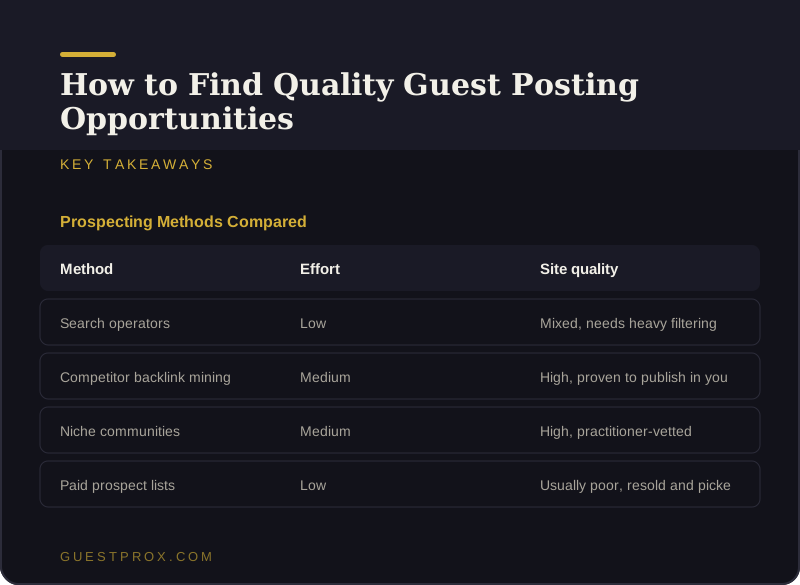
These are the sourcing methods that actually work, in order of reliability. Master them and the question of how to find guest posting sites stops being a bottleneck.
Queries like [your niche] + 'write for us', [your niche] + 'contribute', or [your niche] + 'guest post guidelines' surface sites openly accepting contributions. The trick is going beyond page one of results and combining operators with niche-specific terms, 'SaaS write for us' finds different sites than 'software contribute'.
Treat these results as leads, not wins. Openly soliciting sites get flooded with pitches, so your outreach has to be sharper, and vetting matters even more here.
Pull your competitors' backlink profiles and filter for referring domains that look like editorial publications. If a real site linked to a competitor's guest post, that editor has already said yes to your niche once. This is consistently the highest-quality source of prospects because every site on the list has proven it publishes external content.
Look for patterns: which publications link to multiple competitors? Those editors understand your industry and convert at higher rates.
Industry newsletters, expert roundups, and community-curated resource lists often link to publications you'd never find through search operators. Follow where your niche's practitioners actually read and share. A site recommended by three people in your industry beats a site with a 'write for us' page every time.
A public contribution page means the site gets pitched constantly, which means slower responses and pickier editors. It doesn't mean the site is bad, many excellent publications accept contributions openly, but it does mean you compete with everyone else who found the same page. Balance these with prospects discovered through competitor analysis.
Sourcing is only half the job. The filter is what protects your rankings.
Check whether the site gets real organic traffic and whether it's stable or growing. A site with strong-looking authority metrics but near-zero traffic is the classic footprint of a site built to sell links. Traffic can't be faked the way third-party metrics can, that's why we verify it before pitching anything.
Read five recent articles. Are they written by identifiable authors with expertise? Would you share one with a colleague? If the content reads like filler produced to host guest posts, your article, and your link, will sit in bad company. Editors at good sites also reject weak pitches faster, so this check saves you time twice.
Glance at the site's outbound links. Dozens of exact-match anchors to unrelated commercial pages is a billboard advertising link sales. A natural outbound profile, links to sources, tools, and references within the niche, signals an editorial site. This single check eliminates most bad prospects in under a minute each.
Where to spend your sourcing hours.
| Method | Effort | Site quality | Watch out for |
|---|---|---|---|
| Search operators | Low | Mixed, needs heavy filtering | Flooded inboxes, slow replies |
| Competitor backlink mining | Medium | High, proven to publish in your niche | Requires a backlink tool |
| Niche communities | Medium | High, practitioner-vetted | Slow to scale |
| Paid prospect lists | Low | Usually poor, resold and picked over | Link farms, PBNs, burned contacts |
Finding ten great sites is research. Finding two hundred without the quality collapsing is a system.
Once you've validated your vetting criteria on a small batch, build repeatable processes: saved search operator strings per niche, competitor backlink alerts, a shared prospect database with vetting notes. Systematize the mechanics, never the judgment, every site still gets human review before outreach.
Write down your minimum bar and enforce it when volume tempts you to bend it: real traffic, niche relevance, editorial standards, clean link profile. The moment you lower the bar to hit a number, you've traded the campaign's results for its report. We'd rather deliver fewer placements on great sites than hit a quota on mediocre ones.
Every pitch, yes or no, is data. Track which editors respond, what topics they prefer, what they rejected and why. Over years, this becomes the asset no tool can replicate: warm relationships across 20+ niches. Since 2018, ours has become the reason our prospecting starts warm while others start cold.
Finding a site is step one; deciding it's pitchable is step two, and it requires reading the publication the way its editor does. Open the last ten articles and look for patterns: do they publish contributors regularly or is every byline staff? Are recent pieces timely and opinionated, or generic filler? A site that hasn't published an outside voice in a year will be harder to crack than one with a standing contributor program, pitch accordingly.
Study the editorial calendar signals. Publications often run seasonal series, annual roundups, or recurring columns, pitching into an active series converts far better than pitching a standalone idea. Check their categories and tags for thin spots: a topic cluster with three strong posts and an obvious missing fourth is your pitch, pre-validated.
Read the author bios of recent guest contributors. If they're practitioners with real job titles, the bar is expertise, your pitch should lead with credentials. If they're mostly freelance writers, the bar is craft, lead with the angle and writing quality. Matching your pitch's emphasis to what the site actually rewards is a small adjustment that moves reply rates more than any subject-line trick, our blogger outreach guide breaks down this kind of pre-pitch research in detail.
Finally, check the comments and social shares on recent posts. Lively discussion tells you the audience is engaged, and gives you the exact questions readers are asking, which become your topic angles. A site with zero engagement might still be worth pitching for the link, but temper expectations about referral traffic. Audience vitality is the difference between a link and a link plus readers.
Some niches simply don't have hundreds of blogs accepting contributions. Regulated industries, hyper-specific B2B verticals, and local trades all hit the same wall: the obvious prospect list is short. The answer is never to lower your standards, it is to widen the aperture intelligently.
Adjacent niches are the first expansion. A commercial HVAC company can pitch facilities-management publications, energy-efficiency blogs, and commercial real estate sites, all topically adjacent, all with real audiences, none of them link farms. Draw the relevance radius honestly: if you can explain the connection in one sentence, an editor will accept it.
Trade associations and professional bodies are the most underused prospect source in B2B. Their blogs and journals need expert content, their audiences are exactly your buyers, and their editors are practitioners rather than content marketers, which means a practitioner-written pitch stands out. Membership directories often list publications you'd never find through search operators.
Local and regional angles work when national publications are thin. City business journals, regional industry roundups, and community publications accept expert contributions and carry real editorial weight. For local businesses, our local SEO link building approach leans on exactly these sources, relevance to the market you serve beats national vanity metrics.
Found prospects? Now vet them properly.
Authoritative sources if you want to go deeper on this topic.
Almost never. Lists get resold hundreds of times, the best sites on them stop responding, and the worst are link farms dressed up with metrics. The lists also age badly, editors change, policies change. Building your own list from competitor backlinks takes longer but produces sites nobody else is pitching.
Plan for three to five prospects per placement you want. Editors reject most pitches, go quiet, or ask for topics you can't deliver. A 10-placement campaign starts with 30 to 50 vetted prospects. Fewer than that and one slow editor can stall your whole timeline.
No. DR without traffic and relevance is decoration. A DR 50 site in your niche with real readers beats a DR 70 generalist blog that publishes anything for a fee. We target DR 40 to 90, but traffic and topical fit decide which sites make the final list.
Absolutely, they're your best prospects. An editor who published a competitor's guest post has already validated your niche. Just don't copy the competitor's angle. Bring a fresh topic and a better draft, and you'll often win the placement.
They're legitimate leads but competitive ones. Expect slower replies and stricter editors since they get pitched constantly. Use them as part of a balanced list, not the whole list, and make your pitch noticeably better than the template spam they receive daily.
The same methods, systematized: dedicated prospectors, competitor analysis tooling, relationship databases built over years, and ruthless vetting. Since 2018 we've built publisher relationships across 20+ niches, which is why our prospecting starts warm instead of cold. That is the agency answer to how to find guest posting sites at scale: systems plus relationships.
Message us on WhatsApp at +1 (213) 582-6001 or send the form below. We bring the vetted publisher list, you approve the strategy.
Global Service Delivery