
For SEOs and site owners buying guest post placements. A practical vetting method that separates real publications from link farms in about ten minutes per site.
Learning how to evaluate guest posting sites comes down to three checks run in order: verify real organic traffic, read the content like an editor, and scan for the red flags that mark a link farm. A site that passes all three is a publication worth paying for; a site that fails any one of them is a link farm wearing a blog costume.
Most buyers check a single metric, usually Domain Rating, and stop there. DR can be inflated with spammy links, and a high DR with zero traffic is the classic signature of a site built to sell links rather than to be read. Traffic is harder to fake, which is why it leads this audit.
This guide walks the checks in sequence so you can run them the same way every time: ten minutes per site, the same order, the same standards. Learn it once and you have a repeatable routine that protects every dollar you spend on placements.
Traffic is the hardest metric to fake and the easiest to verify, so it goes first. A site with genuine organic traffic has readers, rankings, and something to lose by publishing junk. A site with no traffic has none of those, no matter what its DR says.
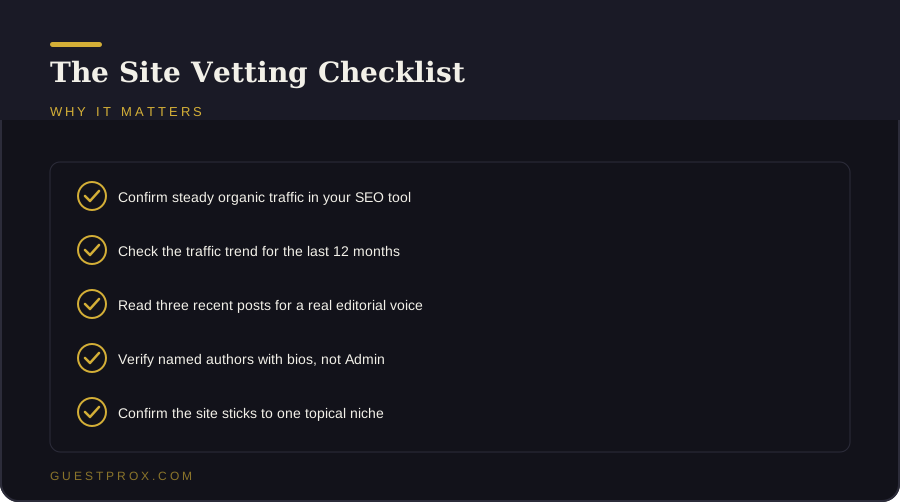
Open the domain in your SEO tool and check estimated organic traffic, then the trend line. Steady or growing traffic means the site is alive. A cliff-edge drop means an update hit it, rankings were lost, or the domain was repurposed.
Do not obsess over the exact number; estimates are estimates. What matters is the shape: alive and stable beats big and collapsing. A site trending down for a year is a decaying asset, and links from decaying assets decay with it.
Click into the top pages and top keywords. A real publication earns traffic across its topic: dozens or hundreds of keywords in its niche. A manufactured site often has traffic concentrated in a handful of unrelated keywords, or one old viral post carrying the whole domain. This is the step most publisher vetting skips, and it catches the most bad sites.
Also check the branded versus non-branded split. Some branded search is healthy; it means people know the site. But if nearly all traffic is the site's own name, the traffic is just people navigating to a homepage, not readers finding articles.
Compare the keywords driving traffic with what the site claims to cover. A marketing blog whose traffic comes from recipe keywords, or a tech site ranking for celebrity names, is renting relevance it does not have. Your link would sit on a page Google associates with a different topic entirely.
Topical alignment is what makes a link move rankings: a placement on a site Google already trusts in your niche passes relevance with authority, while a mismatched site passes neither, whatever the metrics say.
Traffic tells you the site is alive; reading tells you it is real. Spend five minutes on the actual content before you spend money. Editors at genuine publications have standards, and those standards are visible on every page. Five honest minutes here saves the cost of a wasted placement, there is no better ROI in the process.
Click three author names. Real sites have writer pages with bios, photos, and archives of past work. Fake sites have Admin, Guest, or no bylines at all, because there is no one behind the content. If you cannot find a human who writes for the site, there probably is not one.
This ninety-second check disqualifies a remarkable number of prospects: link farms do not employ writers, they employ uploaders.
Scan the navigation and categories. A real publication covers one topic deeply: marketing, finance, or home improvement. A link farm covers everything, because it accepts paid posts on any topic; if the same site publishes crypto news, plumbing tips, and fashion roundups, it has no topical authority to pass you. Topical focus is the fastest single read on guest post website quality: real publications have a beat, and they stay on it.
Depth beats breadth every time. Ten related categories in one niche is a publication. Fifty unrelated categories is a marketplace for links.
Check the dates on recent posts. A living site publishes regularly: weekly at least, often more. A site whose newest post is six months old is abandoned, and links from abandoned sites lose value as the domain decays.
Freshness also tells you the editorial bar is active. Sites that publish often have editors reviewing often, which means your post will actually be read before it goes live. That scrutiny is what you are paying for.
Comments, shares, and newsletter calls to action are weak signals alone, but together they sketch a readership. Real sites invite discussion and show evidence of it. Dead comment sections everywhere suggest the traffic numbers deserve a second look.
Treat engagement as corroboration, not proof. It supports what traffic and content already told you; it never overturns them.
Some sites fail the audit in seconds. These are the patterns that mean walk away, not negotiate. Learn them once and you will spot them on sight. Memorize these patterns until spotting them is reflex; speed matters when you are vetting at volume.
Every legitimate publication has contributor guidelines. The red flag is a guidelines page that accepts every topic, every anchor, and every link count with no editorial standards mentioned. That is not a publication; it is an order form.
Worse is the site advertising prices publicly for guest posts and link insertions. Real publications do not sell links from a menu; if the pricing is public, the links are worthless.
Open five recent posts and look at where they link. On a real site, most links are internal, pointing to related content. On a link farm, every post carries two or three exact-match outbound links to unrelated commercial pages: the business model made visible.
Also check for the sponsored-post takeover: if most recent posts are clearly paid placements with keyword-rich anchors, the site's link equity is spread across dozens of buyers. Your link becomes one more straw on a very crowded camel.
Private blog networks try to look like real sites and usually fail at the details: a generic theme with stock photos, a thin about page with no real people, no contact info beyond a form, and content written to fill space rather than inform.
No PBNs is a non-negotiable in our own placements, and it should be in yours. One PBN link in a profile is a risk; a strategy built on them is a countdown.
The classic contradiction is high DR with no organic traffic: authority metrics inflated by spammy referring domains, with no readers behind them. Another is huge traffic from a single page, where your link lands on a page nobody visits. Keep this guest post site checklist saved: run it in order, and most bad sites disqualify themselves before step three.
When metrics disagree, trust traffic and content over authority scores. Authority metrics describe the link graph; traffic describes reality. Reality wins.
Traffic tells you a site has readers. Its backlink profile tells you how it got its authority, and whether that authority is real. A site can have genuine traffic and a toxic link profile at the same time, usually because it bought links to inflate metrics before pivoting to selling placements. Check the profile before you pay.
You are looking for the same patterns you would flag on a client's site, applied to the publisher. Referring domain quality, anchor distribution, and link velocity tell the story in under five minutes.
Open the site's referring domains and scan the top fifty by authority. Real publications earn links from real sites in their niche, other blogs, news outlets, resource pages. Link farms accumulate links from directories, foreign-language spam, and obvious PBN footprints. If the publisher's own profile looks manufactured, its authority is manufactured too.
Pay special attention to exact-match anchors pointing at the publisher's homepage. A natural profile has branded and URL anchors in the majority; a profile built to inflate DR shows commercial anchors at scale. That inflation is what you would be paying for, and what an algorithm update eventually corrects.
Check when the site's links were acquired. A natural profile grows steadily over years. A manufactured one shows bursts: hundreds of referring domains appearing in a single month, then flatlines. Bursts mean campaigns, link purchases, not earned coverage, and burst-built authority is the first thing updates target.
Cross-reference bursts with the traffic trend from step one of this guide. Traffic that grew alongside steady link acquisition is healthy. Traffic that appeared from nowhere, or links that appeared without traffic following, deserves a hard no. Our link building metrics reference explains which numbers to trust when profiles get complicated.
Finally, check who the site links out to at scale. A publisher selling placements leaks outbound links to unrelated commercial pages with exact-match anchors, the same pattern step three of this guide flags in individual posts, visible here at domain level. Export the site's top outbound anchors; if they read like a keyword marketplace, the site is one.
This five-minute profile read catches the sophisticated farms that pass the traffic test: real visitors, manufactured authority, commercial outbound patterns. They are the most expensive mistakes because they look legitimate until you check. For the link-level companion to this domain-level audit, see the backlink quality checklist.
Checklists are for the common cases. Real prospecting surfaces edge cases, sites that fail a check for a legitimate reason and are actually good placements. Rejecting them automatically costs you some of the best links available, because everyone else's checklist rejected them too.
The skill is distinguishing a good story from an excuse. Every edge case below comes with the evidence that separates the two. No story, no placement, the rule from step three still holds.
A site six months old with thin traffic but real journalists, original reporting, and a clear niche can be a legitimate placement, early links from growing publications often become the most valuable in a profile. The evidence you need: named writers with verifiable backgrounds, genuinely original content, and traffic that is small but growing month over month.
What disqualifies the story: anonymous authors, aggregated content, or traffic that is flat at zero. New explains thin metrics; it does not explain absent humans. And size your bet accordingly, one placement to test, not ten on a promise.
A site with a traffic cliff two years ago followed by steady recovery can be fine: updates hit good sites too, and recovery demonstrates real editorial effort. The evidence: the drop aligns with a known update, recent content is strong, and the trend has been up for at least six months.
What disqualifies the story: the site was clearly repurposed, a former affiliate site now publishing advice in an unrelated niche, for example. Check the domain's history via archived snapshots. A repurposed domain carries the old topical profile, and your link inherits the confusion. When the history is clean and the recovery is real, why organic traffic matters more than any single authority metric explains exactly how to weigh the recovering numbers.
Some of the best placements come from sites with modest DR but deep topical authority: the trade publication everyone in an industry reads, the community site with no SEO footprint at all. Metrics tools undervalue them because their authority is reputational, not link-graph.
The evidence: recognition within the niche, cited by practitioners, referenced in communities, written by known experts. Ask someone in the industry whether they have heard of it; that single question outperforms every metric for these sites. Relevance this pure is rare, when you find it, take the placement.
Vetting ends at publication; risk management does not. Placements decay: pages get deleted in redesigns, links get stripped in content updates, sites get sold to new owners with different standards. A placement you never check is a placement you cannot defend in a report.
Monitoring is cheap and mostly automated. Set the checks once, review quarterly, and act on the exceptions. Here is the routine.
Every quarter, verify each placement is still live, still dofollow, still contextual, and still indexed. A simple spreadsheet with the placement URL, target page, anchor, and last-checked date is enough, check status codes, confirm the link in the page source, and confirm indexation. Most placements survive indefinitely; the audit exists for the ones that do not.
A site that passed vetting can deteriorate: sold to a link broker, abandoned by its editors, or hit by an update. Re-run the traffic trend check on your top referring publishers yearly. A publisher in visible decline is a signal to diversify, not necessarily to disavow, but stop building new placements there.
This is also where relationships pay off. An editor who knows you will warn you before a redesign or ownership change affects your links; a broker will not. Another quiet argument for evaluating a guest posting website as a long-term partner, not a one-time transaction.
A removed link gets a polite restoration email first, editors restore accidentally dropped links more often than you would expect, especially when you have the original agreement thread. A site that refuses or ignores gets replaced in your reporting and removed from future prospecting.
Document everything. The audit trail, what was found, when, what action was taken, is what turns link monitoring from busywork into evidence of professional management. Clients never ask for it until the day they desperately need it.
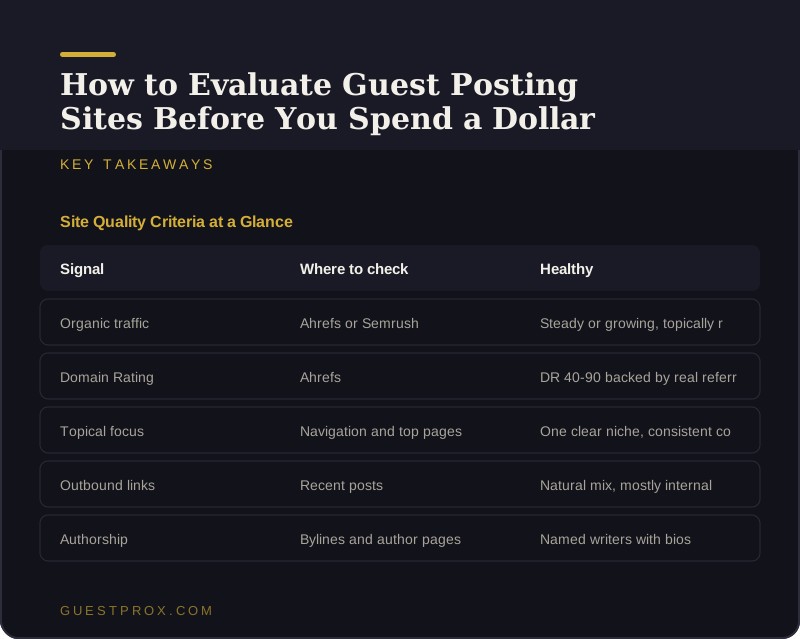
What to check, where to check it, and what a healthy signal looks like.
| Signal | Where to check | Healthy | Red flag |
|---|---|---|---|
| Organic traffic | Ahrefs or Semrush | Steady or growing, topically relevant | Zero traffic or a cliff-edge drop |
| Domain Rating | Ahrefs | DR 40-90 backed by real referring domains | High DR with no traffic behind it |
| Topical focus | Navigation and top pages | One clear niche, consistent coverage | Dozens of unrelated categories |
| Outbound links | Recent posts | Natural mix, mostly internal | Every post links out with exact anchors |
| Authorship | Bylines and author pages | Named writers with bios | Admin, Guest, or no bylines at all |
Ten minutes, eight checks, one decision.
Vetting is step one; these cover what comes next.
Authoritative sources if you want to go deeper on this topic.
DR 40 is a sensible floor for most campaigns, which is why our own placements start there and run to DR 90. Below 40, the site rarely has enough authority to move rankings, though exceptions exist for hyper-relevant niche sites with real traffic. Above the floor, weigh traffic and relevance over the DR number: a DR 45 site with strong niche traffic beats a DR 65 site with none.
Sometimes, if the low traffic is explained: a new publication in a tight niche, or a site recovering from a redesign, can be legitimate despite thin numbers. What you need is a story the data supports: real authors, recent posts, a clear niche. Low traffic with no story is just a bad site.
Buying links means paying for placements without checking what you are getting: no traffic verification, no content review, no questions asked. Vetting is the opposite: you inspect traffic, readership, and editorial standards before money changes hands, and walk away from anything that fails. Every placement we deliver goes through traffic verification before we ever pitch the editor.
We don't publish prices. Every campaign is scoped to your targets and competition, so the fastest way to get an exact number is to message us on WhatsApp at +1 (213) 582-6001.
About ten minutes once you have the routine: two minutes on traffic and trend, three minutes reading recent posts and checking authors, two minutes scanning outbound link patterns, and a final gut check on the about page. The first few take longer while you learn the patterns. After twenty sites, the red flags jump out on sight.
It happens: algorithms shift, pages get buried, editors deprioritize older content. Vet the site and monitor the placement: check quarterly that the page is still indexed, live, and carrying your link. A serious provider replaces removed placements. Vetting reduces risk; it does not abolish it.
Yes. Traffic verification happens before we pitch, not after the client pays. Every site in our network is checked for real organic traffic, topical relevance, and editorial standards, and placements go on DR 40-90 sites only. Doing outreach manually means choosing the sites instead of taking whatever a broker offers.
Our guest posting service only pitches DR 40-90 sites with verified real traffic. Tell us your niche and we will map out a placement plan. Reach us on WhatsApp +1 (213) 582-6001 or contact@guestprox.com.
Global Service Delivery