
For local businesses and the agencies serving them. Learn how to earn backlinks from local publishers, organizations, and community sites that strengthen your local search presence.
A local link building guide shows how to earn backlinks from websites tied to your city or service area instead of chasing national press. Local backlinks come from neighborhood news sites, chambers of commerce, event organizers, schools, and community organizations. Search engines read these geographically relevant links as evidence that your business belongs in local results.
Local links work differently from national ones. The sites are smaller, the editors answer their own email, and a single link from the dominant local news outlet can outweigh dozens of generic directory links. Anchor text stays mostly branded, outreach is relationship-driven, and relevance is measured in miles as much as in topics.
This guide covers how local links differ from national ones, the tactics that consistently earn them, and a repeatable outreach workflow you can run in-house or hand to an agency. Every tactic here assumes real effort and real relationships. There are no shortcuts that survive contact with a local editor.
A local backlink is a link from a website that is relevant to your city or service area. Earned from real local sites, these links tell search engines your business is an established part of the community.
National link building chases domain authority at scale. Local link building chases geographic relevance from sites your customers actually recognize. A link from your city's newspaper or the chamber of commerce carries local trust signals that a higher-DR national blog cannot replicate. In local search, who links to you matters less than where they are.
The mechanics differ too. Local publishers run lean, so pitches must be short, specific, and genuinely useful to their readers. Link velocity stays naturally low, which is fine, because local link profiles are small by nature. Ten excellent local links can define a competitive local link graph.
A plumber in Austin gains more from the Austin Chronicle than from a national home-improvement blog with triple the authority. Search engines associate the linking site's location with your business location. When both point to the same city, the relevance compounds.
Local links overwhelmingly use your business name or a plain URL as anchor text. That is natural and safe. Forcing exact-match keyword anchors into local placements looks manipulative, and local editors will usually rewrite them anyway.
You cannot automate your way into a local newsroom. The same five or ten publishers cover most local stories, which means every pitch is read by someone you may pitch again. Burn a local editor with a spammy template and the door stays closed. Treat each outreach like the start of an ongoing relationship, because it is.
Every tactic below has one thing in common: it gives the linking site a real reason to link. Local editors link to businesses that do interesting things, support the community, or publish genuinely useful local information. Start with the tactics that match what your business already does. Pick two, run them well for a quarter, then add a third.
Pitch stories, not links. Openings, expansions, milestones, and genuine local data all earn coverage that includes a link. Read the publication first and pitch the specific reporter who covers your beat. A two-sentence pitch that references their recent work outperforms a press release every time.
Youth leagues, charity runs, school programs, and community festivals usually list sponsors on their websites with links. Choose sponsorships your customers care about and confirm the link before you pay. A sponsorship page on a .org with real local traffic is worth more than a banner nobody clicks.
Chamber of commerce memberships typically include a directory listing with a link, and many host events that generate further mentions. Industry associations at the state or metro level work the same way. These are among the easiest legitimate local links to earn because the link is part of the membership.
Publish the guide, map, or dataset that only someone in your market could produce: neighborhood price comparisons, local regulation explainers, annual community surveys. This is the local version of digital PR. One strong piece of community content can earn links for years.
Ask suppliers and business partners who already list clients or dealers online. If you stock their products or use their services, a listing on their site is a natural, defensible link. Most businesses leave half of these unclaimed.
Local link building rewards systems over heroics. A steady pipeline of researched prospects and personalized outreach beats occasional bursts. Every local link building guide eventually comes down to the same unglamorous truth: the work is prospecting, qualifying, pitching, and following up, repeated weekly. The workflow below is the one we would hand a new hire on day one.
List the local publishers, associations, event organizers, schools, and nonprofits in your market. Study competitor backlinks filtered for local domains to find sites you missed. A spreadsheet of fifty real prospects beats a database of five thousand scraped domains.
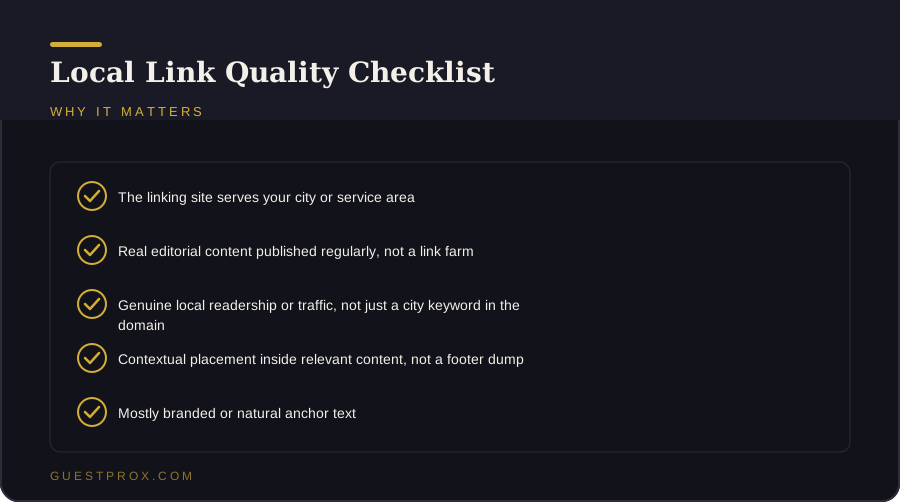
Check that the site publishes regularly, has genuine local traffic, and links out to real businesses. Skip link farms wearing a local costume: thin sites with a city name in the domain and no actual readership. One link from a real local site outweighs twenty from fabricated ones.
Lead with what is in it for their readers. Reference something they recently published. Propose the story angle, not the link. Local SEO link building succeeds on relevance and manners more than on clever templates.
One polite follow-up after five to seven days is standard. A second is acceptable if you add something new, like fresh data or a different angle. After that, move on. Local markets are small and reputations travel.
Log every placement with the URL, anchor text, and date. Watch for links that disappear when sites redesign. Report on links earned and traffic referred, not on vanity metrics. Geo relevant backlinks compound slowly, so measure in quarters, not weeks.
Outreach earns links one at a time. Content earns them while you sleep. The local businesses that accumulate links year after year almost always have one asset that local sites reference repeatedly: a guide, a dataset, or a tool only a local operator could build.
The test is simple: could a national site produce this? If yes, it will not earn local links. If only someone in your market could build it, local publishers have a reason to cite it. Home service businesses do this especially well: the playbook for building links for home service businesses shows how trades turn job knowledge into linkable assets.
Promote the asset once, then let it compound. Pitch it to local publishers at launch, add it to resource pages, and update the data yearly so the links keep coming. One maintained asset outperforms ten one-off outreach wins. If writing it in-house is the bottleneck, SEO content writing built for link earning is the practical shortcut.
Not every local site deserves a pitch. Score prospects on five factors before you write a word, and spend your effort where the score is highest. A simple rubric beats gut feeling and stops you from chasing dead sites.
Score each prospect out of twelve: nine and above gets a personalized pitch this month, six to eight goes on the nurture list, and below six gets dropped. The discipline matters more than the exact weights. Scoring forces you to look at the site instead of the metric.
Apply the rubric to competitor backlinks too. Filter a competitor's profile for local domains, score each one, and you will find prospects you missed plus a few the competitor wasted effort on. The local link building strategies for small businesses pair well with this scoring step: qualify first, then pick the tactic that fits the prospect.
Local link building lives near the paid-link line: sponsorships, donations, and scholarships all involve money changing hands and links appearing. The difference between legitimate and manipulative is not whether money moved. It is whether the link would exist without the SEO motive.
The practical test: would you do this if search engines did not exist? Sponsor the league because your customers' kids play in it, donate because the cause matters, fund the scholarship because you genuinely want applicants. When the answer is yes, the link is a byproduct of real business. Common questions about where legitimate outreach ends are covered in our frequently asked questions.
A sponsorship of a youth league that lists all sponsors with links is a legitimate community relationship. A scholarship page invented solely to harvest education links, with no real applicant process, is a scheme wearing a costume. Search engines have specifically called out fake scholarships. If the program would embarrass you on the front page of the local paper, do not run it.
Disclosure and attributes settle the gray areas. When a link is genuinely paid for, the honest implementation uses sponsored or nofollow attributes. The guide to dofollow, nofollow, and sponsored links explains when each applies. A sponsored link from a real local organization still carries brand and referral value; it just does not pass ranking equity, which is the correct trade.
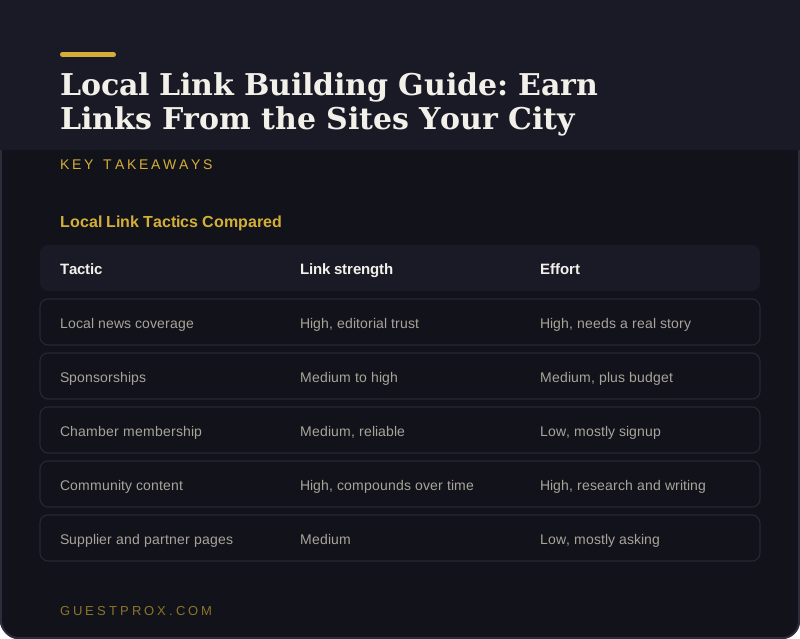
Match the tactic to your resources and timeline.
| Tactic | Link strength | Effort | Best for |
|---|---|---|---|
| Local news coverage | High, editorial trust | High, needs a real story | Businesses with news to share |
| Sponsorships | Medium to high | Medium, plus budget | Community-visible brands |
| Chamber membership | Medium, reliable | Low, mostly signup | Every local business |
| Community content | High, compounds over time | High, research and writing | Businesses with local data |
| Supplier and partner pages | Medium | Low, mostly asking | B2B and trade businesses |
| Local events you host | Medium to high | High, logistics | Businesses with a venue or audience |
Every local link you earn should pass these checks.
More guides and services for local authority.
Authoritative sources if you want to go deeper on this topic.
There is no fixed number, because local competition varies wildly by market and category. In many service-area markets, ten to twenty strong links from recognized local sites put you ahead of competitors relying on directories alone. Study the link profiles of the businesses currently ranking in your market and aim to match their local relevance, then exceed it. Quality and locality beat raw count every time.
Expect three to six months before local links move the needle in competitive markets. Local publishers move at editorial pace, and search engines take time to fold new local relevance signals into rankings. Businesses that commit to steady monthly outreach see compounding gains, while one-off bursts tend to fade.
We don't publish prices. Every campaign is scoped to your targets and competition, so the fastest way to get an exact number is to message us on WhatsApp at +1 (213) 582-6001.
Buying links means paying for placements on sites that exist to sell them, which violates search engine guidelines and risks penalties. Earning local links means doing things worth linking to: sponsoring events, joining associations, publishing community content, and pitching real stories. The first shortcut collapses when the selling site gets caught. The second builds an asset competitors cannot copy overnight.
Yes, they do different jobs. Citations establish consistent business facts across directories and maps, while local links build authority and local relevance. Running both in parallel is the standard approach for competitive local markets. Links without consistent citations send mixed signals about where you are.
Yes, and most do. Chambers accept new members, sponsorships are open to anyone with a budget, and local reporters always need fresh stories. Start with the tactics that require no prior relationships: memberships, sponsorships, and supplier listings. Use the early wins as social proof in later pitches to publishers.
Some will try, and a few tactics like chamber listings are inherently replicable. Your defensible edge is the combination: community content only you could create, relationships with local editors, and a steady cadence they would have to match for years. A diverse local link profile built over time is genuinely hard to replicate.
Our done-for-you local link building earns placements through manual outreach to publishers and organizations in your market. Tell us about your business and we will build the target list.
Global Service Delivery