
Not every link passes ranking signals, and that is fine. Here is what each attribute actually does and how to think about them in a campaign.
Dofollow vs nofollow is the most basic distinction in link attributes. Dofollow links pass ranking signals, while nofollow and sponsored links tell Google not to count the link as an endorsement, though they can still drive traffic and visibility. These attributes live in the link's rel tag and change how search engines treat the connection between two pages.
The confusion comes from treating nofollow as worthless. It is not an endorsement, but it is still a real link on a real page that real people can click. Some of the most valuable links on the web, from major news sites and Wikipedia, are nofollow. Dismissing them entirely misunderstands what links do beyond rankings.
This post explains how each attribute behaves, whether nofollow links help SEO at all, and what mix to aim for when you are building links deliberately.
Dofollow links pass ranking signals; nofollow and sponsored links tell Google not to count the link as an endorsement, though they can still drive traffic and visibility.
Four values, dofollow, nofollow, sponsored, and UGC links, cover nearly every link you will encounter. Knowing them precisely prevents a lot of muddled thinking.
A link with no rel attribute, or explicitly rel=dofollow, passes ranking signals. These are the links campaigns are built around: contextual, editorial placements on relevant sites. When someone says link building without qualification, they mean earning dofollow links.
rel=nofollow tells Google not to pass endorsement signals. Publishers apply it to user-generated content, untrusted links, and often to all external links as a blanket policy. Google may still use nofollow links for discovery and treats them as hints rather than directives since 2019, but they do not carry the ranking weight of dofollow links.
rel=sponsored marks links that exist because of payment or sponsorship. It is the honest label for paid placements, and using it is what keeps paid links within Google's guidelines. A sponsored link on a major publication can still be worth having for the traffic and brand exposure alone.
rel=ugc identifies user-generated content like forum posts and comments. You will mostly encounter it rather than build it deliberately. It exists so Google can discount large volumes of untrusted links without punishing the host site.
Directly, barely. Indirectly, more than most people admit.
A nofollow link on a high-traffic page sends visitors who convert, subscribe, and sometimes link to you themselves with dofollow links. That second-order effect is genuine link building, just one step removed. Dismissing it is short-term thinking.
Every real site accumulates nofollow links: social profiles, press mentions, forum discussions, Wikipedia references. A profile with zero nofollow links looks curated in a way that invites scrutiny. Some nofollow presence is simply what normal looks like.
Being mentioned and linked across the web, regardless of attribute, builds the entity associations that increasingly matter for AI search and brand-driven queries. Links are citations, and citations have value beyond the ranking signal they pass.
Priorities should be clear, but not absolute. The best campaigns are deliberate about attributes without being dogmatic.
Your core effort should go toward dofollow, contextual links on relevant, trafficked sites. That is where ranking movement comes from, and it is what we optimize our outreach for: real editors, real articles, real endorsement signals.
A nofollow link from a major publication or a highly relevant community is worth having. Do not chase them as primary targets, but do not turn them down either. Traffic, visibility, and second-order links are legitimate returns.
If money changes hands for a placement, the sponsored attribute is the correct label. Trying to pass paid links as editorial endorsements is exactly the behavior guidelines target. Honest labeling protects the site long-term.
A few persistent myths cause more bad decisions than any algorithm update.
Not quite. Since 2019 Google treats nofollow as a hint, and it has always used such links for discovery. The page gets crawled, the brand gets seen, and visitors click through. Ignored is the wrong mental model; de-weighted for ranking is closer to reality.
Chasing only dofollow produces an unnatural profile and forces you to reject genuinely valuable placements. Some of the best links available come from major publishers with blanket nofollow policies. Judge the page and its audience, not just the attribute, our guide to backlink types breaks down what to look for.
They do not pass ranking signals, but a sponsored placement on a publication your buyers read drives qualified traffic and builds brand familiarity. Treat it as media buying with SEO side benefits rather than as link building, and evaluate it on those terms.
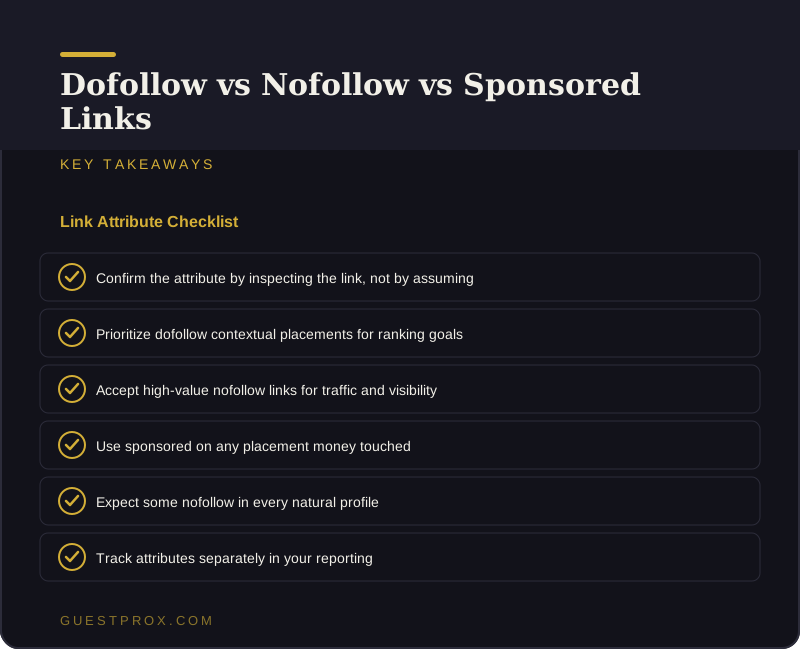
Run through this before counting any link as a win.
More on link types and campaign strategy.
Authoritative sources if you want to go deeper on this topic.
Dofollow links pass ranking signals to the target page, while nofollow links tell Google not to count the link as an endorsement. Nofollow links can still drive traffic and help with discovery, but they do not carry the same ranking weight.
No. They do not pass endorsement signals, but they drive referral traffic, aid page discovery, appear in every natural link profile, and can lead to second-order dofollow links when visitors reference your content. Major publications linking to you with nofollow is still a win.
Whenever payment, free products, or any compensation influenced the placement. It is the honest label that keeps paid links within Google's guidelines. Using it does not make the link worthless; the traffic and brand exposure from a good publication remain valuable.
There is no fixed ideal, but campaigns built for rankings should be predominantly dofollow editorial placements. A natural profile always contains some nofollow from social, press, and community mentions. Worry less about the ratio and more about whether each link came from a real, relevant page.
In business terms, yes. A nofollow link on a page your buyers actually read can drive more revenue than a dofollow link on an obscure blog. Rankings are one outcome of links; traffic, credibility, and downstream links are others worth counting.
Yes. Our outreach targets contextual dofollow placements on real, trafficked sites. Message us on WhatsApp at +1 (213) 582-6001 to discuss what a campaign for your site would look like.
We earn contextual dofollow placements through manual outreach to real editors. Message us on WhatsApp at +1 (213) 582-6001 or send a message through the form.
Global Service Delivery