
Not all backlinks work the same way. Here are the main types, how each is earned, what weight it carries, and which ones deserve your effort.
Backlinks differ along three axes: how they were earned, where they sit on the page, and what attributes they carry. An editorial mention in a news article, a guest post you wrote, and a link inserted into an old resource page each behave differently in search, and each suits different goals.
Learn the types and you can read any link profile like a story: what the site owner did, what it cost them, and whether it is likely helping or hurting.
Backlink types describe how a link was earned, editorially given, outreach-built, or self-created, and each type carries different weight.
These are the links worth building. Every one represents someone's editorial decision to reference your site.
Links a publisher adds on their own initiative because your content deserves citation, a journalist referencing your study, a blogger recommending your tool. No pitch, no payment, no negotiation. These editorial backlinks are the gold standard because the editorial choice is completely genuine.
You cannot buy this behavior directly, but you can deserve it: original research, useful tools, and definitive resources earn editorial links over time.
Links inside articles you wrote for another publication. You control the topic, the anchor, and the target page, which makes this the most plannable link type. Quality depends entirely on the publication: a guest post on a real industry blog is an asset; the same post on a link farm is a liability.
This is our core service and the backbone of most campaigns we run, predictable, relevant, and scalable when the vetting is strict.
Links inserted into existing articles that already rank and already receive traffic. Faster to land than guest posts and they inherit the page's established authority immediately. The constraint is fit: your link has to genuinely belong in the article, which limits scale.
Best used surgically for priority pages where you need authority quickly on specific anchors.
Links earned when press and industry media cover your data, story, or expertise. Often from the highest-authority domains available, sometimes nofollow, always valuable for brand authority. Unpredictable by nature, you cannot schedule a viral story. When you do have genuine news, our digital PR service turns it into coverage.
Links you place yourself. Lower weight individually, but they have legitimate supporting roles.
Listings on legitimate directories, industry associations, chambers of commerce, genuine local directories. Essential for local SEO through NAP consistency, marginal for authority building. Build the real ones once and move on.
Links in comments, forums, and community profiles. Almost always nofollow, and trivially easy to spam, which is why they pass little ranking value. Their legitimate use is participation: answering questions where your resource genuinely helps, which occasionally earns real editorial links downstream.
Links you paid for, which Google requires to carry rel=sponsored or rel=nofollow. Properly attributed, they are a legitimate advertising channel that drives traffic. Disguised as editorial links, they are a guideline violation. The attribute is the whole difference.
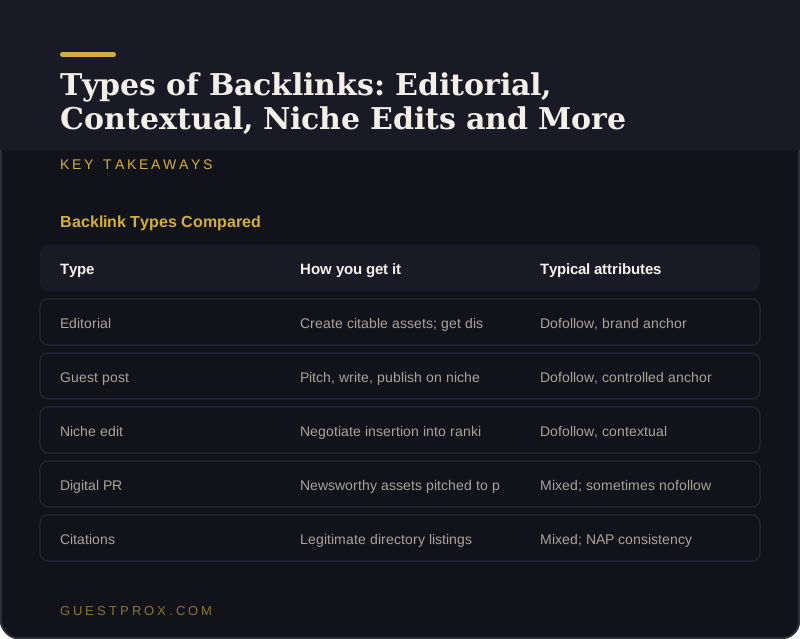
How each type is earned and where it fits.
| Type | How you get it | Typical attributes | Best use |
|---|---|---|---|
| Editorial | Create citable assets; get discovered | Dofollow, brand anchor | Long-term authority foundation |
| Guest post | Pitch, write, publish on niche sites | Dofollow, controlled anchor | Targeted rankings, predictable scale |
| Niche edit | Negotiate insertion into ranking pages | Dofollow, contextual | Fast authority to priority pages |
| Digital PR | Newsworthy assets pitched to press | Mixed; sometimes nofollow | Brand authority spikes |
| Citations | Legitimate directory listings | Mixed; NAP consistency | Local SEO foundation |
| UGC / forum | Community participation | Nofollow | Traffic and relationships, not rankings |
Weight follows editorial independence and relevance. A link someone chose to give, on a relevant page, to your relevant page, moves rankings most. Everything else is supporting cast.
Four factors multiply: the linking domain's authority, the topical relevance between the pages, the editorial nature of the placement, and the link's prominence in the content. A guest post link on a relevant industry blog scores well on all four. Contextual backlinks like these remain the workhorse of serious campaigns.
Natural link profiles are diverse: some editorial, some outreach-built, some brand mentions, some nofollow. A profile of 100% guest post links with exact-match anchors looks manufactured even if every placement is legitimate. Mix tactics, vary anchors, and let some links be imperfect, reality is messy, and that messiness is the signal of authenticity.
New site, low authority: start with guest posts on vetted niche blogs plus foundational citations. It is controllable, topically relevant, and steady, exactly what a young profile needs. Skip the PR moonshots until there is something substantial for coverage to point at; journalists linking to a five-page site helps less than you would hope.
Competitive keyword, established site: combine niche edits on already-ranking pages with guest posts for anchor control. The edits deliver fast authority to the target page, they inherit the page’s existing standing immediately, while the guest posts let you shape context and anchors precisely. Our niche edits service handles the negotiation-heavy outreach this requires.
Brand launch or genuine news: use digital PR. A funding round, original research, or a genuinely novel product is newsworthy raw material, one good cycle can produce the domain-level authority that months of outreach cannot replicate. Do not waste news on guest posts; pitch it to journalists while it is fresh.
Agency with multiple clients: you need predictable monthly output across accounts, which means the guest posting production line, vetted prospects, pitched topics, written articles, verified placements, preferably white-labeled. Our white-label guest posting exists for exactly this: your brand on the reports, our team on the outreach.
Revisit the mix every two quarters. As your profile grows, the right blend shifts, early on you need controllable relevance, later you need authority spikes and diversity. A link-type audit twice a year keeps the profile evolving instead of fossilizing around whatever worked first. Schedule it like any other review.
Journalist requests, the HARO-style platforms where reporters seek expert quotes, are free, editorial, and often high-authority. The hit rate is low and the turnaround is same-day, so most teams never build the habit. Answer two relevant queries a week; over a year, the wins compound into links you would never get by pitching cold.
Unlinked brand mentions are the warmest outreach in existence: sites already mention your brand without linking. A short, polite email converts a surprising share of them, you are not asking for a favor, you are helping them complete a reference. Every brand should run this scan quarterly.
Resource pages, curated lists of tools, guides, and references in your niche, actively want additions. If your page genuinely belongs on the list, asking for inclusion is legitimate and the success rate beats cold guest post pitches. The constraint is honest: your resource has to deserve the slot.
Podcast and webinar appearances earn show-notes links from real, trafficked sites, plus an audience that actually listens. Founders and in-house experts are usually sitting on this channel unused. For a full comparison of the two most confused placement types, see guest posting vs niche edits.
The overlooked types share one trait: they reward consistency over intensity. Two journalist answers a week, a quarterly mention scan, one resource-page pitch a month, none of it feels productive in week one. A year later, these quiet channels often produce the most editorially genuine links in the profile.
Judge quality and build strategy around these types.
Authoritative sources if you want to go deeper on this topic.
Editorial links from authoritative, relevant publications, the ones given freely because your content deserved citation. They are also the hardest to get on demand, which is exactly why they carry the most weight. In practice, most campaigns are built on guest posts and niche edits, with editorial and PR links as the high-value additions.
No. Nofollow links from real, trafficked sites drive visitors, build brand familiarity, and diversify your profile naturally. Google also treats nofollow as a hint rather than a hard ignore. Chase dofollow for ranking power, but never sneer at a nofollow link from a great publication.
Aim for natural diversity rather than a quota. A healthy profile for most businesses includes guest posts, some editorial or PR links, brand mentions, citations if local, and a scattering of nofollow. If one tactic exceeds 70-80% of your profile, diversify.
Essentially no ranking value, they are nofollow and trivially spammable. Their value is relationships and occasional referral traffic. Anyone selling comment links as an SEO service is selling 2010.
A guest post link sits in a brand-new article written for the occasion; a niche edit is inserted into an article that already exists, ranks, and gets traffic. Niche edits are faster and inherit existing page authority; guest posts offer more control over topic and context. Both are legitimate when the placement is editorial and relevant.
The tactic is not the problem, the pattern is. Fifty guest posts on vetted, relevant, trafficked sites with varied anchors looks like a real content marketing program. Fifty guest posts on unrelated blogs with identical anchors looks manufactured. Vary your publishers, anchors, and target pages.
We build balanced profiles: guest posts, niche edits, and editorial wins. Message us on WhatsApp at +1 (213) 582-6001 to plan yours.
Global Service Delivery