
For marketers who have on-page handled and need the off-site half. What actually builds authority once your content is in shape.
An off page SEO guide explains everything that builds your site's authority outside your own pages: backlinks, brand mentions, reviews, citations, and digital PR. If on-page SEO is what you say about yourself, off-page is what the rest of the web says about you.
Search engines use off-page signals as independent votes. Your own site claims you are an expert; a hundred relevant sites linking to you corroborates it. No amount of on-page tuning substitutes for that external validation.
This off page SEO guide focuses on the signals you can actually influence: earned links through manual outreach, consistent citations, review generation, and brand building that attracts mentions. Each tactic is ranked by effort versus impact, so you know where to start.
By the end of this off page SEO guide, you will know exactly which signals to build first, how to measure them, and what to safely ignore.
Off-page SEO is the practice of building your website's authority and trust through signals outside your own site, primarily backlinks, plus brand mentions, reviews, citations, and PR coverage.
Off-page work fails when it is scattered. Ten half-finished initiatives produce less than one fully executed channel. A real strategy is simply the discipline of sequencing: do the highest-impact thing first, finish it, then add the next. Write the sequence down and assign one owner per channel, shared ownership of off-page work means no ownership.
For most sites the sequence is fixed. Links first, because they carry the most ranking weight. Then brand signals, mentions, reviews, PR, which compound the value of links and protect you when algorithms shift toward entity-based understanding.
Backlinks remain the heaviest single off-page factor. A steady cadence of relevant, contextual links from real-traffic sites moves rankings more than everything else on this page combined.
We build ours through 100% manual outreach to DR 40-90 sites, guest posts for control, niche edits for speed. No PBNs, no link networks, nothing you could not defend in a manual review.
Once links are flowing, build the signals that make your brand look real: consistent citations, a growing review profile, unlinked mentions converted into links. These do not just help rankings; they raise click-through rates when you do rank.
Brand searches are the tell. When more people search for your company by name each month, every other off-page signal gets easier to earn.
A site with fifty great links and zero reviews looks lopsided; so does a site with five hundred reviews and three links. Balance across signals reads as a real business, because real businesses are balanced.
Audit quarterly. Find the thinnest signal relative to competitors ranking above you, and make that the next quarter's focus.
Links get the headlines, but the rest of the off-page toolkit decides close races. When two sites have similar link profiles, reviews, citations, and brand mentions break the tie, especially in local and YMYL niches.
These techniques share one trait: they make you look like a legitimate, active business. Search engines are ultimately trying to answer whether you are real and trusted. Every technique below is evidence for the defense.
Citations are mentions of your business name, address, and phone number across directories and data aggregators. For local rankings they are foundational, inconsistent NAP data confuses search engines and costs you pack placements.
Audit the top fifty directories, fix inconsistencies, and keep new citations to reputable, relevant sources. One accurate profile beats ten sloppy ones.
Review count, velocity, and rating feed directly into local rankings and indirectly into everything else through click-through behavior. A steady stream of genuine reviews beats a one-time burst every time.
Ask every happy customer, make it frictionless with a direct link, and respond to every review, including the bad ones. Response rate is a visible trust signal to both Google and prospects.
People mention brands without linking all the time. Set up alerts for your brand name, find the mentions, and ask for the link with a polite, specific email. Conversion rates run high because the author already chose to mention you.
This is the cheapest link acquisition there is, no content to write, no cold pitch, just a nudge. Run the check monthly.
Original data and genuine expertise earn coverage that outreach templates cannot. One podcast appearance or data-driven story can produce a cluster of high-authority links plus branded search lift.
Start where your expertise is unfair: proprietary data, contrarian takes backed by experience, or stories only you can tell. Generic thought leadership earns generic silence.
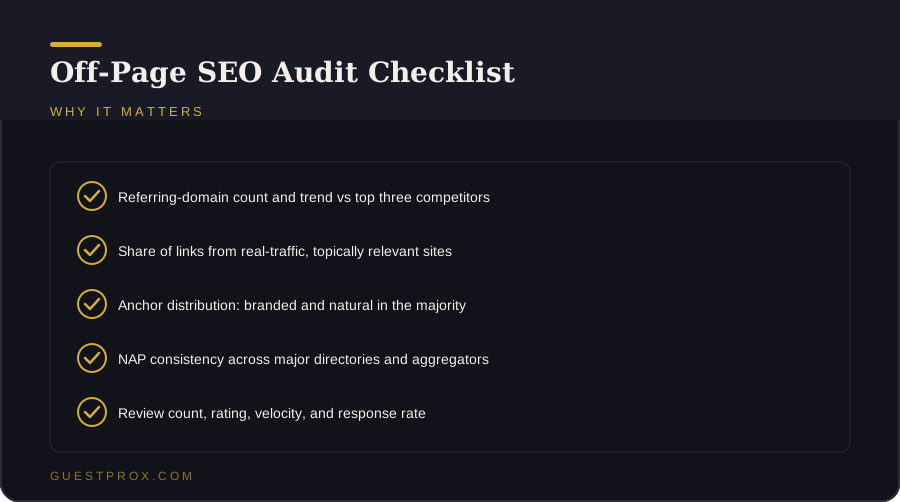
Off-page progress shows up in leading indicators months before rankings move. Track referring domains (not just total links), the traffic of linking sites, review velocity, and branded search volume. When those four rise together, rankings are a matter of time.
Benchmark against the sites outranking you, not against absolute numbers. If position three has eighty referring domains and you have twenty, you know the size of the gap. Off-page SEO is a race against specific competitors, not a checklist. Re-run the comparison every quarter; gaps close and open as competitors build, and your priorities should move with them.
One domain linking ten times is one relationship. Ten domains linking once is ten votes. Report and optimize for referring-domain diversity, it is the metric most correlated with durable gains.
Watch the mix too: a growing share of links from real-traffic, topically relevant sites means the campaign is compounding correctly.
Rising searches for your brand name signal growing off-page authority that tools measure poorly. It captures PR, podcasts, social, and word of mouth in one number.
When branded search climbs alongside referring domains, you have built something algorithm updates tend to reward rather than punish.
The strongest off-page asset is not a link, it is a brand name people type into Google. Branded search volume captures everything tools measure poorly: PR, podcasts, word of mouth, social. And it compounds: every brand search makes the next link easier to earn and every ranking more likely to get clicked.
Building it is unglamorous work. Publish genuinely useful things under a consistent name, show up where your buyers already gather, and make it easy for people to mention you, a memorable name, a clear one-line description of what you do, and content worth citing.
People cite brands that give them something to cite: original data, a named framework, a contrarian position argued well. Generic thought leadership earns generic silence. One proprietary study or one sharp methodology document will generate more unlinked mentions than a year of blog posts.
This is where off-page meets the AI search era: citable brands get referenced by answer engines, not just linked by bloggers. Our notes on AI search visibility and link building cover what we know so far about earning those citations.
Every podcast appearance, guest post, and PR hit should end with the listener or reader knowing your name and what you do. Most practitioners waste the attention: they get the link and forget the brand. Add the one-liner everywhere, author bios, podcast intros, conference slides, until strangers can describe your business in a sentence.
Then watch branded search trend monthly. When it climbs alongside referring domains, you have built the kind of authority that algorithm updates reward rather than punish. That combined trend is the real scoreboard; see our off-page SEO checklist for a new website for the full measurement setup.
Brand mentions earn links. Links earn rankings. Rankings earn visibility. Visibility earns more mentions. Each turn of the wheel makes the next turn cheaper, which is why the first year of brand building feels expensive and every year after feels inevitable. Start the wheel before you need it.
Local businesses do not need every off-page tactic, they need the right three, in the right order, executed without gaps. This sequence assumes a real business with a real service area and no existing off-page foundation. Adjust the pace to your capacity, but not the order.
The order exists because each phase makes the next one work better. Citations make you findable, reviews make you choosable, and local links make you rankable. Skip a phase and the later ones underperform.
Audit your name, address, and phone number across the major directories and data aggregators. Fix every inconsistency, suite numbers, old phone numbers, misspelled street names, because conflicting NAP data directly costs local pack placements. Claim and complete your Google Business Profile if you have not: categories, services, photos, hours.
Then build citations on the directories that matter for your market, prioritizing relevance over count. Fifty accurate listings beat two hundred sloppy ones. Our local citation building service exists precisely because this phase is tedious and unforgiving of errors.
Build a review request into your completed-job workflow: a direct link, sent at the moment of satisfaction, with no friction. Respond to every review within days, including the bad ones, especially the bad ones. Response rate is a visible trust signal to Google and to prospects reading the reviews.
Velocity matters more than volume. Ten reviews a month for six months beats sixty in one week followed by silence. Steady velocity reads as a real business serving real customers, because that is what it is.
Now earn the links only a local business can get: chamber of commerce, local press, sponsorships, community organizations, supplier and partner pages. These links are defensible because a national competitor cannot replicate them without being local too. Five such links often move a local pack more than fifty generic ones.
Pitch local journalists with genuinely local stories, milestones, community involvement, data about your market. Local press links carry both authority and relevance, and they generate the branded searches that feed the flywheel above. Pair this phase with the local citation guide if your citation foundation still has gaps.
Not every off-page tactic is merely ineffective, some are actively dangerous. This register lists the tactics that trigger penalties or waste money with near certainty, with the reasoning for each. If a provider proposes any of them, that is your signal to leave.
The common thread is deception: anything designed to make a link look earned when it was bought, or to make a business look reviewed when it was not. Search engines have spent two decades learning to detect exactly these patterns.
Private blog networks exist for one purpose: manufacturing ranking signals. Spam teams hunt them continuously, and when a network is caught, every site it linked to can be penalized, including yours. The short-term movement is real and the long-term cost is catastrophic.
We operate with no PBNs, 100% white hat, since 2018, because there is no version of this tactic that survives contact with a manual review. Any provider who is vague about how placements are earned is telling you everything.
Purchased reviews and selective solicitation, asking only happy customers, both violate platform policies and erode the trust reviews are supposed to build. Platforms remove fake reviews in waves and can suspend profiles that accumulate them.
The honest alternative is unglamorous: ask everyone, make it easy, respond to everything. A 4.6 rating with four hundred genuine reviews and thoughtful responses outperforms a suspicious 5.0 every time, with customers and with algorithms.
Watch for the rebranded classics: excessive link exchanges, widget and badge links with optimized anchors, forum signature spam, and article syndication blasts. Each was a legitimate tactic once; each is now a footprint the moment it scales.
The test is simple: would you proudly show this link to a reviewer? If the answer requires explaining, the link fails. Earned links need no explanation, which is why manual outreach to real editors remains the entire strategy. Our digital PR work earns links the same way: stories worth covering, placed with journalists who chose them.
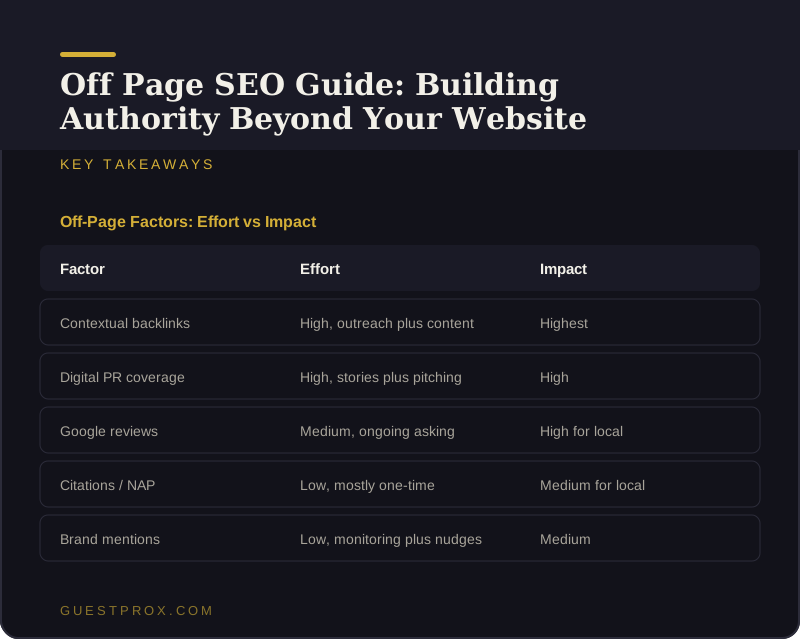
Where each off-page signal ranks on work required versus ranking influence.
| Factor | Effort | Impact | Notes |
|---|---|---|---|
| Contextual backlinks | High, outreach plus content | Highest | The core ranking signal; prioritize first |
| Digital PR coverage | High, stories plus pitching | High | Authority spikes plus brand lift |
| Google reviews | Medium, ongoing asking | High for local | Feeds local pack and click-through |
| Citations / NAP | Low, mostly one-time | Medium for local | Foundational; fix once, maintain lightly |
| Brand mentions | Low, monitoring plus nudges | Medium | Unlinked mentions are the cheapest links available |
Run this quarterly against every site you care about.
Round out the off-site side of your SEO.
Authoritative sources if you want to go deeper on this topic.
Link building is the largest part, but off-page SEO also covers reviews, citations, brand mentions, and PR. Think of links as the votes and everything else as the evidence you are a real, trusted entity. Competitive niches increasingly require both.
We don't publish prices. Every campaign is scoped to your targets and competition, so the fastest way to get an exact number is to message us on WhatsApp at +1 (213) 582-6001.
Legitimate off-page work, earned links, genuine reviews, accurate citations, carries no penalty risk. Penalties target manipulation: PBNs, paid link schemes, fake reviews. Our work is 100% white hat with no PBNs, and every placement is verifiable, so there is nothing to hide.
Buying links rents placements from whoever will sell them, usually on sites built for that purpose. Real off-page SEO earns placements on sites with actual audiences through outreach and merit. The first collapses under scrutiny; the second compounds, because each link sits on a real asset.
Expect two to four months for links to move rankings, and a similar window for review and citation work to affect local packs. Off-page is a compounding channel: the first quarter builds the base, and later quarters build on it. Anyone promising faster is selling shortcuts.
Perfect on-page makes you eligible to rank; off-page is what actually gets you ranked. Search engines need independent confirmation that your content deserves its position. In our experience, sites that stall on page two almost always have an authority gap, not a content gap.
For local businesses, it means Google Business Profile reviews, accurate citations across directories, and locally relevant links, from chambers, local press, sponsors, and community sites. Local packs weigh proximity and prominence heavily, and these signals are prominence.
From outreach to citations to review strategy, GuestProx builds your off-site authority. See our off-page SEO service for packages.
Global Service Delivery