
Everyone has a theory about links and AI search. This guide separates what is documented about citations in AI answers from what is still speculation, so you can invest without the hype.
AI search and link building is the question of how backlinks and brand mentions influence visibility in AI-generated answers: Google AI Overviews, ChatGPT, Perplexity, and other LLM-powered results. As these surfaces grow, every SEO wants to know whether the links they have been building still matter there.
The honest answer is more complicated. What is documented: AI answers cite sources, and those citations skew toward authoritative, well-known sources with strong traditional search presence. What is not documented: any confirmed direct mechanism by which a backlink causes an AI citation. This guide keeps those two categories strictly separate.
We will not claim to have cracked any algorithm. We will show you what the evidence supports, what is plausible but unproven, and what nobody knows yet.
AI search and link building studies how backlinks and brand mentions relate to citations in AI-generated answers, separating documented patterns from speculation.
A few patterns show up consistently enough across AI Overviews, Perplexity, and similar surfaces to treat as working facts. None of them require believing anyone's proprietary study.
AI Overviews link to the pages behind their summaries, and independent analyses of those citations consistently find established, authoritative domains overrepresented. The sites AI answers cite most are the sites that already dominate traditional search results for the query.
The practical read: the authority you built for classic SEO, editorial links from trusted publications, strong brand presence, recognizable expertise, is the same authority AI surfaces draw on. Nothing about AI search rewards a different kind of credibility than Google always rewarded.
LLMs are trained on vast web text, and brands mentioned frequently across credible sources become entities the model recognizes. When an AI answer needs an example, a tool recommendation, or a trusted source, it reaches for entities it knows well.
This is where digital PR and link building converge: the same editorial placements that earn backlinks also generate the brand mentions that build entity recognition. A quoted expert in a major publication gets both the link and the mention.
Pages ranking in the top results for a query appear disproportionately in AI answers about that query. The correlation is strong enough that the best-supported strategy for AI visibility is, unglamorously, to keep doing the SEO that wins traditional rankings.
Anyone selling AI visibility as a separate discipline disconnected from classic authority building should be asked for evidence. The documented pattern points the other way: AI citations follow established authority.
The plausible-but-unproven middle ground is where most of the industry's theorizing lives. Treat everything in this section as informed reasoning, not fact.
The reasonable theory: backlinks from diverse, credible sources corroborate that an entity, your brand, is real, notable, and trusted. An LLM trained on the web encounters your brand across many authoritative contexts and weights it accordingly.
This is plausible because it matches how these systems behave with well-known entities. It is unproven because no provider has confirmed backlinks as a direct input to answer generation. Build links for the documented benefits and treat entity effects as a likely bonus.
Intellectual honesty requires stating what would change our minds. If controlled tests showed AI citations tracking something entirely unrelated to web authority, say, structured data alone, or paid API partnerships, the entity theory would need revision.
So far, the observed citation patterns track traditional authority closely enough that the simplest explanation holds: AI systems cite the sources the web already treats as authoritative. Keep watching the evidence.
Nobody outside the providers knows exactly how training data, retrieval, and ranking interact in any given AI answer. Attribution is murky: when ChatGPT cites a source, we cannot see whether a backlink, a mention, the content itself, or some combination caused it.
Vendors claiming certainty about AI citation mechanics are selling confidence, not knowledge. The responsible posture is to invest in the inputs that correlate with citations while measuring honestly.
If you cannot measure it, you cannot improve it, and AI visibility is currently hard to measure well. Here is what works today without inventing data.
Monitor whether and where your brand appears in AI answers for your target queries. Check AI Overviews for your key terms, test your brand in ChatGPT and Perplexity with realistic prompts, and log which pages get cited.
This is manual and imperfect, but it is real observation rather than modeled guesswork. Track it monthly and look for trends, not single data points.
You cannot directly control AI citations, but you control the inputs that correlate with them: editorial backlinks from authoritative sites, brand mentions in credible publications, and content structured to answer questions directly.
Report these inputs honestly. A campaign that earned twelve editorial placements and forty brand mentions on real publications is a documented result. Claiming it bought a specific number of AI citations would be invention.
A wave of tools now sells AI visibility scores and share-of-answer metrics. Some are useful for tracking; none of them measure what they imply with the precision their marketing suggests. Sampling methods, prompt selection, and model changes all inject noise.
Use these tools as directional indicators if you like, but do not make budget decisions on single-number scores from black-box tools. Ground decisions in the placements and mentions you can verify.
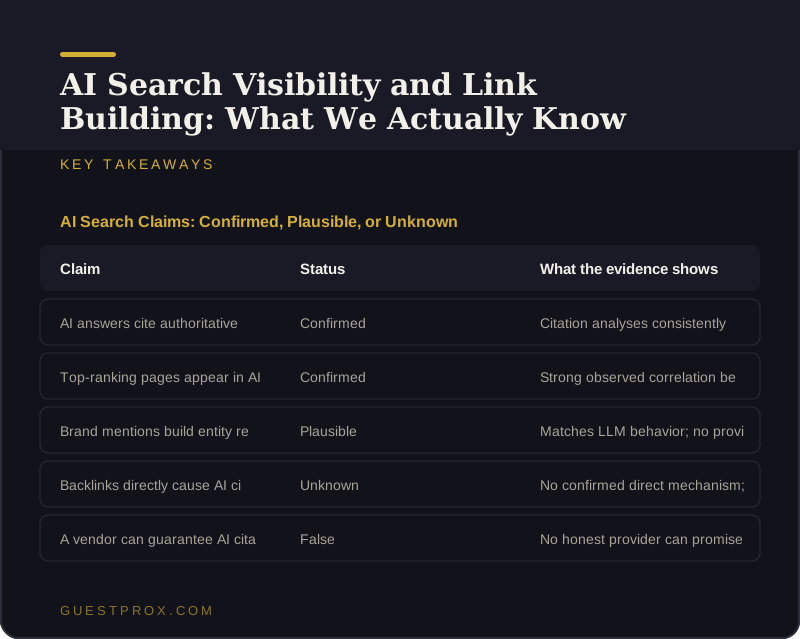
Where each common claim actually stands on the evidence.
| Claim | Status | What the evidence shows |
|---|---|---|
| AI answers cite authoritative sources | Confirmed | Citation analyses consistently show established domains overrepresented |
| Top-ranking pages appear in AI answers | Confirmed | Strong observed correlation between rankings and AI citations |
| Brand mentions build entity recognition | Plausible | Matches LLM behavior; no provider has confirmed the mechanism |
| Backlinks directly cause AI citations | Unknown | No confirmed direct mechanism; correlation exists via authority |
| A vendor can guarantee AI citations | False | No honest provider can promise this; treat such claims as a red flag |
| AI visibility scores are precise | Unknown | Directional at best; sampling and model changes add noise |
Digital PR, content outreach, and the practical playbook for AI citability.
Authoritative sources if you want to go deeper on this topic.
No direct mechanism has been confirmed. What is documented is a strong correlation: the authoritative sources AI answers cite are overwhelmingly the same sites that dominate traditional rankings, which are built on backlinks. Build links for their proven SEO value and treat AI citation effects as a likely but unproven bonus.
We don't publish prices. Message us on WhatsApp at +1 (213) 582-6001 for a quote.
No, and treat anyone who promises it as a red flag. No provider has disclosed how citations are selected, and the systems change constantly. What an honest agency can do is build the verifiable inputs that correlate with citations: editorial backlinks, brand mentions on credible publications, and quotable expert content.
For brand mentions and entity recognition, digital PR has an edge because it earns coverage and quotes on publications LLMs encounter heavily. Guest posting still builds the backlink foundation. The strongest approach combines both, which is why our outreach covers editorial placements, commentary, and contributed content.
Manually and regularly: check AI Overviews for your key queries, test realistic prompts in ChatGPT and Perplexity, and log which of your pages get cited. Track the inputs you control, editorial placements and brand mentions, and report those honestly. Be skeptical of single-number AI visibility scores from black-box tools.
The evidence points the other way. AI answers draw on the web's existing authority structure, which backlinks built. As long as AI systems cite sources, the credibility signals behind those sources matter. Link building is not being replaced; its outputs are being consumed by new surfaces.
We build the editorial placements and brand mentions that correlate with AI citations, on real DR 40-90 sites with full reporting. Message us on WhatsApp at +1 (213) 582-6001 or use the contact form.
Global Service Delivery