
For content writers and SEOs commissioning guest posts. The editorial standard that gets drafts accepted: titles, depth, structure, and link placement that reads naturally.
A guest post checklist is a quality standard for the article itself: the title, the depth, the structure, and exactly where the link sits inside the draft. It answers a single question: would a real editor publish this piece if no link were involved?
Editors reject most guest post submissions on quality long before they consider the topic. Thin intros, generic advice, and a link dropped into the opening paragraph all signal the same thing: the article exists for SEO, not readers. This checklist fixes each failure point before you submit.
Use it in three passes: first, judge the article as a piece of writing; second, judge the link placement inside it; third, check the publishing-readiness details like attribution, formatting, and originality. A draft that clears all three gets published. A draft that fails any one of them gets ignored.
Forget the link for a moment and read the draft as a reader would. If the article is not worth publishing on its own merits, no editor will touch it. This pass is about earning the placement before you earn the click. Read the draft once with the link mentally deleted, if it still earns publication, the foundation is solid.
Write the title a real reader would click, not a keyword string a rank tracker would love. Specific beats broad: one concrete outcome outperforms a promise of everything. Keep it tight enough to survive search results and social shares.
Avoid clickbait superlatives and keyword stuffing in equal measure. Editors see hundreds of pitches; a clear, honest title signals a clear, honest article. If you cannot write the title without forcing the keyword phrase in, the angle is wrong.
The first hundred words decide whether the editor keeps reading. State what the article covers and why it matters, then move on: no throat-clearing, no dictionary definitions, no announcing what the article will discuss.
A good test: delete the first paragraph. If the article still makes sense, the first paragraph was filler and the editor will notice. Start where the value starts.
Generic advice is the number one reason drafts get rejected. Replace every generic claim with something concrete: a step, an example, a number from your own experience, a mistake you made and what it taught you. Treat this pass as the heart of your guest posting checklist: if the article is not useful, nothing else matters.
Length follows depth; it does not create it. A focused 1,200-word article that teaches one thing well beats a wandering 2,500-word article that teaches nothing. Write until the reader can act, then stop.
Most readers scan before they commit, so give them signposts: descriptive H2s and H3s, short paragraphs, and bullets where a list serves better than prose. Each section should deliver one idea and hand off cleanly to the next.
Read the headings alone when you finish. If they tell the story of the article without the body text, the structure works. If they read as decoration, rewrite them until they carry meaning.
Now judge the link the way an editor judges it: as a guest in the reader's experience. A well-placed link feels like help. A badly placed link feels like the reason the article exists. Editors can tell the difference instantly. Editors apply this test instinctively; applying it yourself first is what separates professionals from spammers.
The link belongs in the body of the article, inside a section where it genuinely helps the reader go deeper. Not in the first paragraph, where it screams SEO intent. Not crammed into the conclusion as an afterthought. Mid-article, surrounded by relevant discussion, is where natural citations live.
Ask directly: if this link were removed, would the sentence still make sense, and would the reader miss the resource? If yes to the first and no to the second, the link is decoration. Move it or cut it.
Search engines read the words around your link, and so does the editor. The sentence containing the link and the paragraph around it should be topically aligned with the linked page. A link to a keyword research tool inside a paragraph about keyword research is a citation. The same link inside a paragraph about office furniture is a paid placement wearing a costume.
Write the paragraph first and let the link arise from it, not the reverse. When the text demands a resource, the link feels inevitable; when the link demands text, the paragraph feels forced.
The anchor should sound like something a writer would actually link: branded terms, partial phrases, or plain descriptive language. Repeated exact-match anchors are the footprint search engines look for, and editors recognize them too. Anchor planning crosses into link territory: our backlink quality checklist covers auditing anchors across your whole profile.
Vary anchors across your placements and keep a simple plan of what you have used where. One exact-match anchor will not hurt you; a profile built on them will. Natural linking is varied linking.
Resist stuffing multiple client links into one article. One well-placed link outperforms three awkward ones, and editors notice when a draft exists to carry links rather than ideas. If the brief demands more, each link needs its own natural home or the draft needs rethinking.
The same restraint applies to internal links to the host site. A few genuine internal links show you read the publication; a dozen show you are gaming it.
The article is good and the link is natural. Now the details that separate professionals from spammers: originality, voice, attribution, and formatting. Editors check these reflexively, and failures here kill otherwise good drafts.
Every claim should be something you can stand behind: your own experience, your own data, or a cited source. Never invent statistics, case results, or credentials to sound authoritative. Fabricated claims are the fastest way to get blacklisted by an editor who fact-checks.
Run an originality check before submitting, and be honest about AI assistance if the publication asks. Many editors now screen for synthetic text; a draft that reads as generated gets rejected regardless of its ideas.
The draft should read as if one knowledgeable person wrote it in one sitting. Shifting tones between sections, or a formal intro collapsing into slang, tells the editor the piece was assembled rather than written. Pick a voice and hold it.
Proofread for grammar, then read it aloud once: your ear catches what your eyes skip. Clean copy signals a professional; sloppy copy signals a link scheme.
Attach a short bio: two or three sentences on who you are and why you are qualified. Real credentials beat vague titles; a specific role with years of experience beats a generic enthusiast label. Editors publish people, not keywords.
If you are writing on behalf of a client, say so honestly where the publication requires disclosure. Undisclosed ghostwriting discovered later burns the relationship permanently.
Deliver the draft formatted: proper headings, short paragraphs, bullets where they help, no walls of text. Include at least one relevant image with descriptive alt text that you have rights to use. Editors should be able to publish with minimal cleanup.
Match the publication's house style where you can see it: heading capitalization, list formatting, link style. A draft that arrives already looking like the site's content is a draft that gets published faster.
Most rejected drafts were doomed before the first sentence, not by bad writing, but by a missing brief. Writers guess at the angle, the audience, and the link rationale, and editors receive the guesswork. A thirty-minute brief prevents a week of rewrites.
The brief is a one-page document written before drafting starts. It forces every decision the draft depends on: who the reader is, what the article argues, why this publication, and why the link belongs. If you cannot fill in a section, you are not ready to write.
Audience in one sentence: who reads this publication and what do they already know? Angle in one sentence: what does this article claim that the publication has not already said? Outline: the H2s in order, each earning its place. Link rationale: the exact page, the exact anchor concept, and the sentence-level reason the reader benefits. Voice notes: three adjectives describing how the publication writes, pulled from reading it.
Send the angle, not the draft, to the editor or your strategist first. A two-line angle check takes a day; a full rewrite takes a week. Editors would rather redirect a pitch than reject a draft, and strategists would rather fix a brief than salvage 2,000 words.
This is also where link planning belongs: confirm the target page and anchor concept while the outline is still fluid, so the article grows around the link instead of having it bolted on. Our guide to writing a guest post publishers actually want covers the drafting that follows a solid brief.
If someone else writes the draft, the brief is the entire handoff. Include two or three reference articles from the publication, the non-negotiables (original examples, no fabricated stats), and what the editor explicitly dislikes if you know it. Vague briefs produce vague drafts; specific briefs produce publishable ones.
Review the brief, not the draft, for strategic errors. Once drafting starts, the writer's job is execution, and judging execution is faster and fairer than judging improvisation.
Getting a revision request is good news, it means the editor wants to publish your piece. Yet most contributors respond badly: defensively, slowly, or by ignoring the actual feedback. Revisions are a negotiation skill, and the writers who master it get published more with less rewriting.
Read the feedback twice before touching the draft: once for what it says, once for what it means. Editors rarely have time to articulate the real problem precisely. Your job is to fix the real problem, not just the words they used.
Structural revisions, requests for a stronger angle or fewer sections, mean the editor sees potential and wants focus. Comply generously; the editor knows their audience better than you do. Tone revisions, too promotional, or too basic for the readership, mean recalibration, usually toward more depth and less selling. These are quick wins.
Link revisions are the sensitive ones. If the editor wants the link moved, moved it is, placement is their prerogative. If they want it removed, you have a business decision: publish without the link for the relationship and brand value, or withdraw politely. Never argue a link back into a draft; the relationship is worth more than any single placement. For the mistakes that trigger revisions in the first place, see guest posting mistakes that waste budgets.
Turn revisions around in days, not weeks, editorial calendars move on without you. Reply with a short summary of what changed, section by section, so the editor can verify without re-reading the whole draft. Thank them for the specific feedback, not generically; it signals you actually processed it.
If you disagree with a change, propose an alternative rather than refusing. Editors accept alternatives from contributors who demonstrate they understood the underlying concern. Defiance gets you archived; collaboration gets you published.
A rejected draft is not a wasted draft. Strip the publication-specific framing and you usually have a solid article for your own blog, a different publication with a different angle, or raw material for two or three smaller pieces. The research and structure transfer; only the targeting was wrong.
Before repurposing, diagnose the rejection honestly using the checklist in this guide. If the draft failed on depth, fix the depth before pitching it elsewhere, the same flaw will fail twice. If it failed on fit, re-angle and re-pitch within the month while the material is fresh. Good writing is an asset; treat rejections as routing errors, not verdicts.
Publication is not the finish line, it is the handoff from writing to asset management. A link nobody monitors is a link that can quietly disappear, and a placement nobody promotes underperforms its potential. Thirty minutes of post-publication work protects the hours the draft took.
Do this work in the first week while the details are fresh. After that, the placement joins the quarterly monitoring routine and you move on to the next draft.
Open the live page and check: the link is present, dofollow, pointing at the correct URL, with the agreed anchor. Screenshot the placement and archive the live URL, if the link ever disappears, the screenshot plus the agreement thread is your restoration evidence.
Check that the page is indexed within two weeks. New posts on real publications usually index quickly; if yours does not, a nudge, sharing the article socially, linking to it from a relevant page, often resolves it. An unindexed placement is a placement that does not exist yet.
Share the article with your audience and tag the publication and editor. Editors track who promotes, and promoters get faster yeses on the next pitch, this is the cheapest relationship investment in outreach. It also drives real referral traffic, which is the point everyone forgets while chasing rankings.
Consider linking to the guest post from your own relevant content where it genuinely fits. It is good practice, it helps the page get crawled, and it signals to the editor that you treat the placement as a real asset rather than a link receipt. That attitude is what turns one placement into a column.
Log the placement the same day: live URL, publication DR and traffic, anchor, target page, date. Consistent logging is what makes monthly reporting honest and quarterly audits possible, reconstructing placements from memory six months later is how links go missing unnoticed.
If you outsource writing or outreach, require this handoff from your provider: every placement delivered with verification details, not just a URL. Professional SEO content writing operations include post-publication verification as standard; if yours does not, ask why.
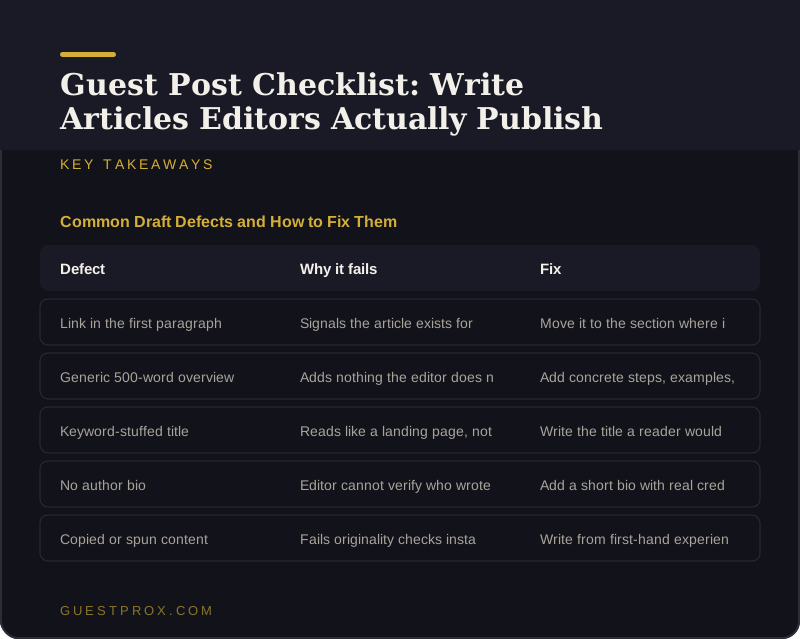
The fastest reasons editors reject guest posts, and the fix for each.
| Defect | Why it fails | Fix |
|---|---|---|
| Link in the first paragraph | Signals the article exists for SEO | Move it to the section where it helps the reader |
| Generic 500-word overview | Adds nothing the editor does not already have | Add concrete steps, examples, or data |
| Keyword-stuffed title | Reads like a landing page, not an article | Write the title a reader would click |
| No author bio | Editor cannot verify who wrote it | Add a short bio with real credentials |
| Copied or spun content | Fails originality checks instantly | Write from first-hand experience or fresh research |
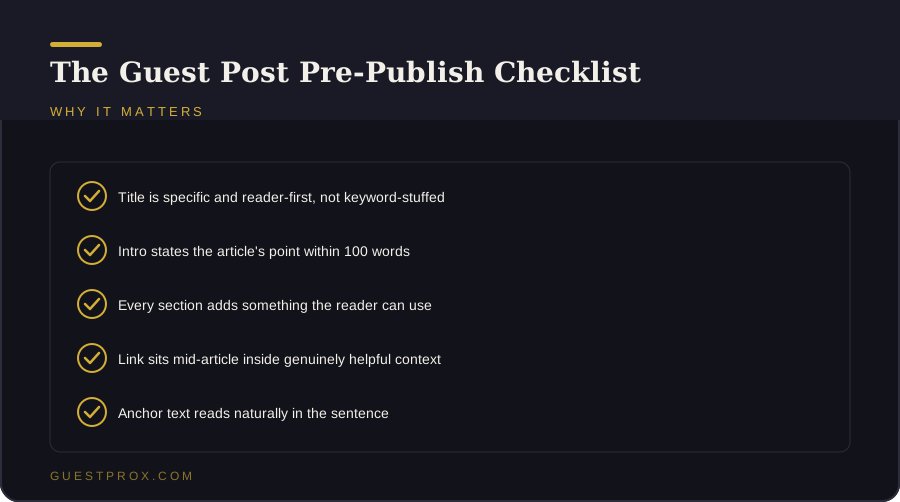
Run every draft through these eight checks before submitting.
The article is one half; these cover the link and the strategy.
Authoritative sources if you want to go deeper on this topic.
Long enough to teach something useful, and not a word longer. In practice that means 1,000 to 2,000 words for a substantive topic, but length is a floor, not a goal: a focused 1,200-word article beats a padded 2,500-word one every time. Editors judge depth, not word count. Write until the reader can act, then stop.
One client link, placed with intent, is the professional standard. Two can work if each has a genuinely natural home in different sections. Three or more tells the editor the article is a link vehicle, and most will reject it or strip the extras. When a brief demands multiple links, push back: restraint is what gets the piece published.
Mid-article, inside the body text, where the linked resource genuinely helps the reader. Never in the first paragraph, where it signals SEO intent, and never exiled to the author bio as the only link, where it carries less weight. Remove the link and ask whether the reader would miss it: if yes, the placement is right.
Increasingly, yes. Many publications now screen submissions for synthetic text, and editors can usually tell: generic phrasing, hedged claims, structure without substance. AI can help with outlining and tightening, but the ideas, examples, and experience must be yours. A draft that reads as generated gets rejected before the link is ever discussed.
Buying links skips the editorial process entirely: money changes hands and a link appears, often on a site with no standards. This checklist exists for the opposite approach, where a real editor publishes your draft because readers benefit. One approach rents a link; the other earns a placement that lasts.
We don't publish prices. Every campaign is scoped to your targets and competition, so the fastest way to get an exact number is to message us on WhatsApp at +1 (213) 582-6001.
Thank them and check the link survived intact. Editors rewriting guest posts is normal and usually a good sign: they care enough to match house style. Review the changes for accuracy, confirm your anchor and placement were not altered into something unnatural, and keep the relationship warm.
Our guest posting service handles the writing and the outreach: drafts built to this checklist, placed on real DR 40-90 sites. Message us on WhatsApp +1 (213) 582-6001 or email contact@guestprox.com.
Global Service Delivery