
Most wasted link building budgets aren't lost to scams. They're lost to small, repeatable mistakes, wrong metrics, skipped vetting, thin content. Here are the big ones and how to avoid them.
When a guest posting campaign fails, the post-mortem rarely finds a single dramatic cause. What it finds is a stack of small mistakes: placements bought on DR alone, anchors nobody planned, articles nobody would read, links nobody verified. Each one is survivable. Together, they zero out the return.
The mistakes below come from auditing failed campaigns, ours in the early years, and many more from clients who came to us after. Every one is avoidable, and avoiding them costs nothing but discipline. Most guest post errors trace back to skipped vetting or missing planning. Our guest posting process was built specifically to prevent this stack of small failures.
Failed campaigns are rarely scammed. They are usually the sum of small, avoidable mistakes compounding over months.

These happen before outreach starts, which makes them the most expensive kind, they corrupt every placement that follows.
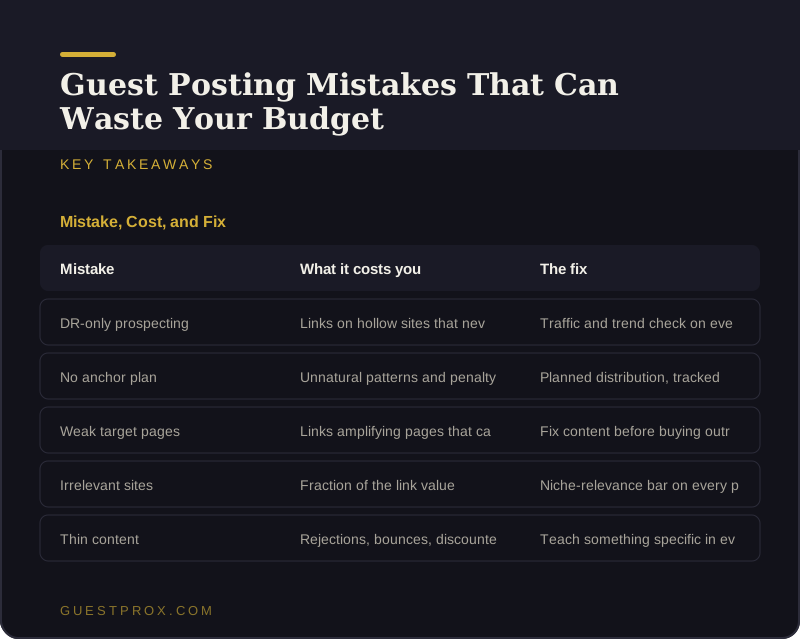
The most common mistake in the industry. A buyer filters prospects by DR 50+, approves the list, and ends up with links on hollow sites that Google ignores. DR is a starting filter, not a verdict. Every prospect needs a traffic and trend check before it earns a pitch.
We have seen campaigns where half the placements sat on traffic-dead domains. The links existed. The rankings never moved.
Without a plan, anchors default to whatever is easiest, usually the same exact-match keyword on every placement. That pattern is both unnatural and risky. A real editorial link profile mixes branded, partial-match, generic, and naked-URL anchors.
Plan the distribution before the first pitch, track it per placement, and adjust as the campaign runs. It takes an hour and prevents the most avoidable penalty trigger in link building.
Links amplify what they point to. Pointing great links at thin, outdated, or irrelevant pages is like installing a powerful engine in a car with no wheels. Before spending on outreach, make sure the target pages deserve to rank, genuinely useful, current, and matching search intent.
We turn down campaigns where the site is not ready, because links cannot fix a page Google has good reasons not to rank.
The strategy is sound, but the day-to-day work leaks value at every step.
A link from an off-topic site passes a fraction of the value of a niche-relevant one, and a pattern of irrelevant links looks manufactured. Yet irrelevant pitching persists because generalist blogs are easier to land. Easy placements are usually cheap for a reason, they are worth less.
Hold the relevance bar even when it slows prospecting. One relevant link beats five irrelevant ones.
Editors reject it, readers bounce from it, and Google's helpful-content systems are built to discount it. The article is the vehicle your link rides in, if the vehicle is junk, the link inherits the junk's reputation.
Every article should teach something specific enough that removing any paragraph would lose meaning. That is a low bar that most guest posts still fail.
Links get published wrong: nofollow instead of dofollow, wrong URL, wrong anchor, or the article quietly never gets indexed. Then links disappear entirely during redesigns. Campaigns that never recheck bleed placements silently.
Verification is unglamorous and non-negotiable: confirm attributes at publish, confirm indexation within weeks, and recheck quarterly.
The mistakes buyers make when choosing who does the work.
The cheapest placements are cheap because corners were cut: unvetted sites, spun content, no reporting. A placement that does nothing is not a bargain at any price, it is a 100% loss plus the months you waited. There is a whole economy of bad guest posting built on this exact shortcut.
Judge vendors on their vetting process and reporting transparency, not on per-link cost. Ask to see their checklist and a sample report before committing.
A report that lists domains and DR scores but no live URLs cannot be audited, which is precisely why some vendors write them that way. Real reporting shows the URL, the anchor, the attributes, and the publish date. If a vendor will not show you where your links live, assume the worst.
The eight mistakes above in actionable form.
| Mistake | What it costs you | The fix |
|---|---|---|
| DR-only prospecting | Links on hollow sites that never move rankings | Traffic and trend check on every prospect |
| No anchor plan | Unnatural patterns and penalty risk | Planned distribution, tracked per placement |
| Weak target pages | Links amplifying pages that can't rank | Fix content before buying outreach |
| Irrelevant sites | Fraction of the link value | Niche-relevance bar on every pitch |
| Thin content | Rejections, bounces, discounted links | Teach something specific in every article |
| No verification | Silent link loss over time | Check attributes, indexation, and quarterly |
| Price-only vendor choice | 100% loss on worthless placements | Judge vetting process and sample reports |
| URL-less reporting | Unauditable, possibly fictional work | Require live URLs on every report |
The most expensive mistake is invisible: never rechecking live links. Sites redesign, get acquired, or quietly drop old archives, and every year a meaningful share of placements change attributes, lose indexation, or vanish entirely, with nobody emailing you when it happens. Quarterly rechecks catch the decay; campaigns that never recheck bleed placements silently for years. Our backlink audit guide covers the recheck routine.
Anchor drift is the slow version of having no anchor plan. The campaign starts disciplined, then placement thirty uses exact-match again because it was easy, then placement forty does too. Six months later the distribution you planned no longer describes the profile you have. The plan needs an owner and a running tally, updated with every single placement, no exceptions.
Target-page decay wastes good links. The page you pointed placements at gets rewritten by a new content manager, redirected in a site migration, or quietly deoptimized, and the link still exists, pointing at a weaker target. Re-audit your target pages annually: do they still deserve the equity, do they still match intent, do the URLs still resolve where you think they do.
Finally, the set-and-forget campaign. Link equity is relative, while you coast, competitors keep building, and a profile that was strong eighteen months ago is average today. A campaign paused for a year usually cannot just resume; the competitive gap moved. Steady beats sporadic, and maintenance is a line item, not an afterthought.
The common thread: all four leaks are invisible without a monitoring routine. Put link rechecks, anchor tallies, and target-page audits on a quarterly calendar with an owner, the same way you'd schedule financial reviews. Campaigns don't decay because people are careless, they decay because nobody was assigned to watch.
Step one: export every placement with its live URL, anchor text, target page, and publish date. No URL, no credit, treat undocumented placements as suspect until proven otherwise. If your vendor cannot produce this list, you have already found your first problem, and it is bigger than any single bad link.
Step two: spot-check the fundamentals on each URL, is the link still live, still dofollow if that is what was agreed, is the page indexed, and has the domain’s traffic collapsed since placement day? Work through the list with a spreadsheet and mark every placement green, yellow, or red. Most campaigns find at least a few reds, and that is normal, now you know where they are.
Step three: tally the distributions, what share of anchors are exact-match, and what share of links point at the homepage versus deep pages? If sixty percent of anchors repeat one keyword on one page, your next ten placements should be branded anchors to deep pages; rebalance deliberately. Run the survivors through our quality checklist to confirm they are worth keeping.
Step four: find the gap. Pull a competitor link gap analysis and list the domains linking to your rivals but not you, that is your rebuild list, pre-qualified by the fact that they link to sites like yours. An afternoon of auditing usually produces a clearer plan than the original campaign brief did.
The checklists and guides that prevent these mistakes.
Authoritative sources if you want to go deeper on this topic.
We don't publish prices. Message us on WhatsApp at +1 (213) 582-6001 for a quote.
First, audit: list every placement with its live URL, check each site's current traffic and content quality, and identify the worst offenders. Disavow only the clearly manipulative ones, over-disavowing can hurt. Then rebuild properly on vetted sites. Recovery is slow but entirely possible with clean new links.
Ask for the live URLs of your last ten placements and run the traffic and relevance checks on each. If the vendor cannot produce URLs, or the sites fail basic vetting, you have your answer. Good vendors welcome audits; bad ones deflect them.
Not always, but be skeptical of the economics. Real outreach, prospecting, pitching, writing, follow-up, takes hours per placement. If the price cannot plausibly cover that labor, something was skipped, and it is usually vetting or content quality.
Most campaigns show ranking movement within 4 to 12 weeks of placements going live and getting indexed. If nothing has moved after three months of verified, relevant placements, the problem is usually the target pages or the keyword difficulty, not the links.
Yes. Bad links can be disavowed or left to decay while you build clean ones, thin content can be rewritten, and anchor profiles can be rebalanced with new branded placements. What cannot be fixed is time, which is why getting it right the first time matters.
We built our process by making these errors early so you don't have to. Message us on WhatsApp at +1 (213) 582-6001 for an honest assessment.
Global Service Delivery