
Every placement we deliver passes a 25-point quality check across the publisher, the content, and the link itself. Here is the full checklist, so you can hold any vendor, including us, to the same standard.
A guest post checklist is a quality-control pass over three things: the publisher, the content, and the link. Skip it and you end up paying for placements that look fine in a spreadsheet and do nothing in search, or worse, create risk. Some teams call it a guest posting checklist or a publisher checklist, the name doesn't matter, the discipline does.
Use this checklist in order. Publisher checks come first because a great article on a bad site is still a bad placement. Content checks come second because editors reject thin work and readers ignore it. Link checks come last because a placement is only finished when the link is live, correct, and verified.
Check the publisher first, the content second, and the link last, in that order, every time.

Most bad placements fail here, before a single word is written. Run these eight checks on every site before you pitch. For how the numbers fit into vetting, see our guest post metrics guide.
Once the publisher passes, the article itself has to earn its place. Editors can smell filler, and so can Google.
A placement is not done when the article is published. It is done when the link is verified and documented. This is also what separates real fulfillment from reselling, our guest posting reports include live URLs on every placement.
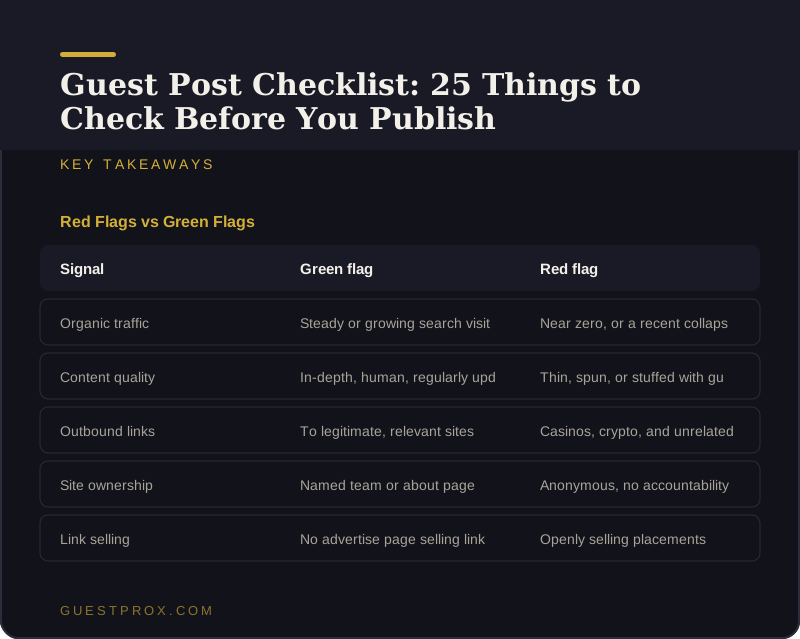
The fastest version of the checklist: six signals that decide most placements.
| Signal | Green flag | Red flag |
|---|---|---|
| Organic traffic | Steady or growing search visitors | Near zero, or a recent collapse |
| Content quality | In-depth, human, regularly updated | Thin, spun, or stuffed with guest posts |
| Outbound links | To legitimate, relevant sites | Casinos, crypto, and unrelated commercial pages |
| Site ownership | Named team or about page | Anonymous, no accountability |
| Link selling | No advertise page selling links | Openly selling placements |
| Reporting | Live URLs shared proactively | Vague summaries, no URLs |
Vetting one site takes twenty minutes. Vetting fifty takes a system. Build a scoring sheet with fixed columns: domain, DR, monthly traffic, traffic trend, niche fit scored one to five, outbound cleanliness, advertise page yes or no, and a final verdict. Fixed columns force consistent judgment, without them, every prospector invents their own standards.
Time-box the work. A five-minute triage, traffic graph, content skim, outbound glance, eliminates roughly seventy percent of prospects. Only survivors get the full twenty-five checks. Delegate triage to a junior or VA and keep final calls with someone senior enough to spot the subtle failures.
Keep a rejection log with reasons. After a few hundred prospects, patterns emerge: one broker’s sites always fail the advertise-page check, or expired domains keep slipping through from a particular source. The log turns one-off rejections into source-level rules that save hours.
Review the bar quarterly. Niches change, Google updates reshuffle traffic, and a site that passed last year may fail today. The checklist is a living filter, not a one-time gate. Our publisher quality guide documents the full vetting standard we apply on every campaign.
Finally, calibrate the checklist against outcomes. Every quarter, compare approved placements against their actual ranking impact and look for checks that predicted poorly. If sites passing all twenty-five still underperform, your bar is measuring the wrong things, tighten the checks that correlate with results and loosen the ones that don't.
The expired-domain rebuild: DR 62, ninety monthly visitors, and an archive showing it used to be a local newspaper, now publishing generic business tips with no bylines. It fails the traffic check, the trend check, and the niche-coverage check in under a minute. The DR is real but historical; the publication it describes no longer exists.
The marketplace in disguise: a clean-looking blog with a write-for-us page listing placement prices, and outbound links to casinos and crypto schemes across recent posts. It fails the link-selling check and the outbound-neighborhood check simultaneously. Pretty design, zero editorial standards, walk away no matter how tempting the metrics look.
The traffic cliff: two hundred thousand visitors collapsing to fifteen thousand after a core update, with an archive stuffed with five-hundred-word guest posts on random topics. Google already rendered its verdict; buying a link there means paying for a seat on a sinking ship. Trend lines are autopsies, read them before you commit.
The near-miss that passes: DR 48, steady twenty-thousand monthly visitors in your exact niche, but a thin about page and no masthead. A real editor replies from a real inbox, the content is genuinely useful, and nothing else fails, so this is a judgment call, not an automatic reject. The checklist is a tool for thinking, not a robot for rejecting, and borderline cases are exactly where human judgment earns its keep. See how to evaluate a guest posting website for the pre-pitch version of this process.
More on vetting publishers and judging link quality.
Authoritative sources if you want to go deeper on this topic.
About 15 to 30 minutes per site once you know what to look for: traffic check, content skim, outbound link scan, indexation spot-check. It feels slow until you compare it to the cost of a bad placement, which is the fee plus the months you wait for results that never come.
It depends which one. Failing traffic or link-selling checks is disqualifying, those indicate structural problems. Failing something minor, like a thin about page on an otherwise strong niche blog, can be acceptable if the other 24 checks pass. The checklist is a judgment tool, not a robot.
Yes. Tools surface candidates, but the final call is always human. Metrics can be gamed; a two-minute read of a site's recent articles tells you things no dashboard will. That manual pass is most of what separates real outreach from marketplace reselling.
DR alone is a weak filter. We target DR 40 to 90 as a range, but a DR 45 site with strong traffic in your exact niche beats a DR 70 generalist blog with dead traffic. Run the full checklist instead of setting a single-number cutoff.
We don't publish prices. Message us on WhatsApp at +1 (213) 582-6001 for a quote.
Absolutely, that is one reason we published it. Ask your provider for the live URLs, then run checks 1 through 8 on each domain. If they hesitate to share URLs, you have your answer before opening the checklist.
This is our actual QA process on every campaign. Message us on WhatsApp at +1 (213) 582-6001 and we'll show you what vetted placements look like.
Global Service Delivery