
DR, DA, traffic, referring domains, relevance, five numbers decide whether a placement is worth it. Here is what each one actually measures and how to read them as a set.
Guest post metrics are the numbers buyers use to judge a placement before it goes live. The standard set is DR (Domain Rating), DA (Domain Authority), organic traffic, referring domains, and topical relevance. Together they answer one question: is this site a real publication whose link will count?
They are useful shorthand, and dangerously misleading in isolation. Every one of these metrics can be gamed, and every one misses something important. This guide explains what each metric actually measures, what a healthy reading looks like, and how to combine them into a judgment you can trust.
No single metric judges a placement. Read DR, traffic, and relevance together, and distrust any one of them standing alone.

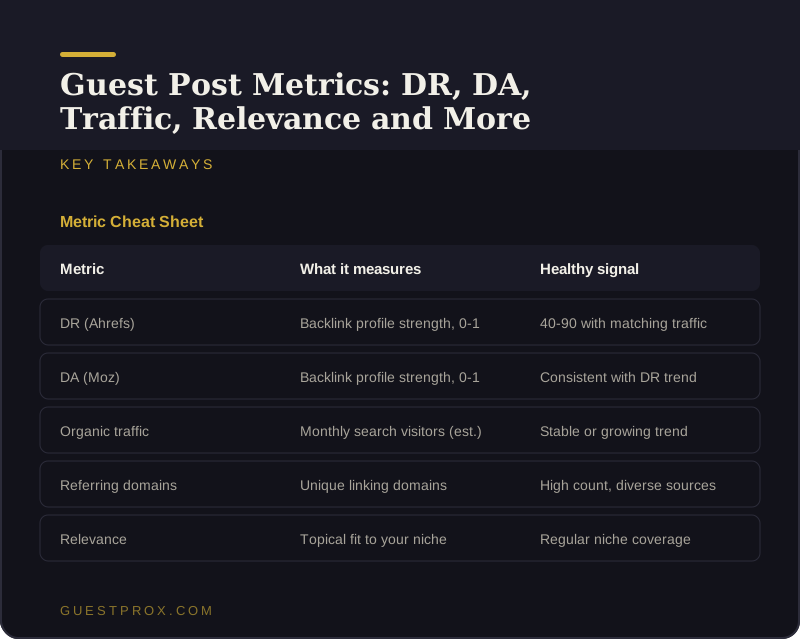
Five metrics cover nearly every placement decision. Learn what each one is really telling you.
DR is Ahrefs' estimate of a domain's backlink profile strength, scored 0 to 100. It is calculated from the quantity and quality of referring domains, on a logarithmic scale, so the jump from DR 70 to 80 represents far more link equity than 20 to 30.
What DR misses: everything about the site itself. It says nothing about traffic, content quality, or whether the site is topically relevant to you. A DR 75 site can be a rebuilt expired domain with no readers.
DA is Moz's equivalent score, also 0 to 100, also based on the link profile. The two correlate but are not interchangeable, they use different crawlers, different indexes, and update on different schedules.
The DR vs DA question comes up constantly. Practical note: pick one as your reference and learn its quirks rather than averaging them. We quote DR because our prospecting stack is built on it, but a DA reading tells the same story in a different dialect.
Estimated monthly search visitors. This is the hardest metric to fake at scale and the closest thing to proof that Google currently trusts the site. A publication with steady organic traffic has passed Google's quality filters recently, not five years ago. That is why experienced buyers evaluating organic traffic guest posts start with the traffic graph before looking at any authority score.
Watch the trend, not just the number. Stable or growing traffic is the signal. A cliff-edge drop usually means a penalty or a core update demotion, and you do not want your link on that ride.
The count of unique domains linking to the site. It is the raw material behind DR and DA, and it is worth checking directly because it reveals concentration risk. A site with DR 60 from 200 referring domains has a thinner foundation than a DR 60 with 5,000.
Also scan for quality: hundreds of links from directories, forums, and foreign-language spam inflate the count while adding nothing.
The only qualitative metric in the set, and the one most buyers underweight. Relevance is the fit between the site's subject matter and yours. A DR 45 SaaS blog linking to your SaaS product will typically move rankings more than a DR 70 general news site.
Judge it by reading: does this site publish in my niche weekly, or did it accept one off-topic post for a fee? The answer is usually obvious within two minutes.
Individual metrics lie. Combinations tell the truth. Here are the three reading rules we apply to every prospect.
When DR and traffic disagree, trust traffic. High DR with near-zero traffic is the classic signature of a manipulated site, often a rebuilt expired domain or a PBN dressed as a blog. Real publications that earned their links almost always have readers.
Our internal bar: meaningful, stable organic traffic first, DR 40 to 90 second, relevance always. That bar is exactly what our guest posting service applies to every prospect before outreach begins.
Learn the three most common inflations. Expired-domain rebuilds inherit the old domain's links and DR but publish unrelated new content. Link schemes buy bulk links to pump DR while traffic stays flat. And traffic itself can be juiced with bot visits, which is why you check the trend and the keyword profile, not just the headline number.
The giveaway is always inconsistency: metrics that should move together, moving apart.
When two sites pass the quantitative checks, relevance decides. Same-niche placement wins over generalist placement at equal metrics, because the link carries topical weight on top of raw authority, and because readers actually click through.
What each metric measures, the healthy signal, and its blind spot.
| Metric | What it measures | Healthy signal | Blind spot |
|---|---|---|---|
| DR (Ahrefs) | Backlink profile strength, 0-100 | 40-90 with matching traffic | Says nothing about traffic or relevance |
| DA (Moz) | Backlink profile strength, 0-100 | Consistent with DR trend | Different index; not interchangeable with DR |
| Organic traffic | Monthly search visitors (est.) | Stable or growing trend | Can be geo-mismatched to your market |
| Referring domains | Unique linking domains | High count, diverse sources | Count alone hides spam sources |
| Relevance | Topical fit to your niche | Regular niche coverage | Qualitative, requires human judgment |
Mistake one: buying on DR alone. A buyer approves twenty placements on DR 55+ sites, half of which have no meaningful traffic, and six months later rankings have not moved. The links exist, the spreadsheet proves it, but they sit on hollow domains Google ignores, because DR was the only filter and therefore the only thing the vendor optimized for. Our traffic vs DR breakdown shows why the traffic check has to come first.
Mistake two: treating DR and DA as interchangeable. They come from different crawlers, different indexes, and different update schedules, a DA 50 is not a DR 50, and teams that mix the two mid-campaign corrupt every comparison they make. Pick one, learn its quirks, and standardize across the whole campaign. The DR vs DA comparison covers exactly where the two diverge.
Mistake three: ignoring geography and keyword footprint. Eighty thousand monthly visitors sounds excellent until you learn seventy percent are in a market you do not serve, or the traffic comes from two viral posts on topics unrelated to the site’s niche. Always check where the traffic comes from and which keywords drive it, the headline number without that context is decoration.
Mistake four: reading a snapshot instead of a trend. DR today says nothing about trajectory; a site at DR 58 and climbing is a different buy than DR 58 and collapsing. Pull twelve months of traffic and authority history on every serious prospect. Inconsistency between metrics that should move together is the single most reliable signal of manipulation.
The meta-lesson: every metric mistake comes from wanting a shortcut. DR-only buying skips the traffic check, DA/DR mixing skips standardization, snapshots skip the trend pull. Each shortcut saves ten minutes and risks the whole placement. The buyers who get burned are rarely lazy, they're just in a hurry, and hurry is what the metric-gamers count on.
Weight the metrics instead of eyeballing them. Our working split: traffic trend thirty-five percent, topical relevance thirty percent, authority score twenty percent, risk signals fifteen percent. Score each factor one to five, multiply by the weights, and set a minimum bar, say, three point five, below which no prospect gets pitched.
Run two sites through it. Site A, DR 62, near-zero traffic, off-topic content, scores high on authority and collapses everywhere else, landing around one point eight: reject. Site B, DR 44, steady niche traffic, clean outbound profile, lands around four point one: pitch. The framework turns gut feel into a repeatable team process, which is the whole point.
Revisit scores quarterly. Sites get sold, editors leave, Google updates reshuffle traffic, a placement that scored four last year can be a two today. Keep the original screenshots from vetting day; if a vendor’s numbers don’t match what you recorded, you have the receipt. Discipline compounds; so does sloppiness.
None of this requires exotic tooling, just a spreadsheet and the willingness to reject tempting prospects. The full methodology is documented in our link building metrics guide, which the team references on every campaign.
One more rule: never let the spreadsheet overrule an obvious red flag. If a site scores a four but the content is clearly spun or the about page is fake, the score is wrong, not the instinct. Frameworks beat gut feel at scale, but they don't replace the two-minute human read that catches what numbers miss.
Go deeper on vetting and the traffic question.
Authoritative sources if you want to go deeper on this topic.
No. A DR 80 link from an irrelevant, traffic-dead site will underperform a DR 40 link from a thriving niche publication. DR measures the strength of a site's backlink profile in the abstract; rankings respond to relevance, traffic, and placement quality too. Judge the combination, not the headline number.
Pick one and learn it well. They measure similar things with different data, so mixing them across a campaign creates noise. We standardize on DR because our tooling is built around it, but a team standardized on DA is making the same class of decisions.
There is no universal minimum, it scales with the niche. A specialized B2B blog with 5,000 monthly visitors can be an excellent placement. What matters is that traffic exists, is stable, and comes from real informational keywords in the site's niche, not a couple of fluke rankings.
They can be inflated short-term with bots or paid clicks, but sustained, keyword-diverse organic traffic is very hard to fake. Check the trend over 12 months and glance at which keywords drive the visits. Bot traffic shows up as spikes with no keyword footprint.
Less, but they are not irrelevant. A nofollow link from a high-traffic, relevant publication still sends visitors and builds brand familiarity that makes your other outreach convert better. Judge nofollow placements on traffic and relevance, not on link equity.
Every placement report includes the live URL, the site's DR and traffic at the time of placement, and the anchor and target page. If you ever want the raw vetting data behind a placement, ask, transparency is the point of reporting.
We verify traffic, authority, and relevance before we pitch. Message us on WhatsApp at +1 (213) 582-6001 to discuss your campaign.
Global Service Delivery