
A site can show DR 70 and receive 200 visitors a month. That gap tells you everything about which metric to trust. Here is why traffic wins.
DR estimates the strength of a site's backlink profile. Organic traffic shows how many real visitors arrive from Google each month. The first is a third-party calculation; the second is observed behavior. When the two disagree, trust the behavior. Framed as DR vs organic traffic, the contest isn't close: behavior beats estimation.
This matters because DR is easy to inflate and traffic is hard to fake. Link sellers know buyers filter by DR, so an entire industry exists to manufacture high-DR sites with no readers. Traffic is the lie detector that exposes them. It is the first filter in our publisher vetting process.
DR tells you what a site's link profile looks like. Traffic tells you whether Google currently trusts the site. Trust the second.
DR is a useful number that answers a narrow question. The trouble starts when buyers treat it as a complete answer.
Domain Rating scores a domain's backlink profile from 0 to 100 based on the number and quality of referring domains. It is logarithmic, so gains at the top end are exponentially harder. It is a reasonable proxy for website authority, how much link equity a site can pass.
What it does not measure: whether anyone reads the site, whether the content is any good, whether Google currently ranks its pages, or whether it has any connection to your industry. Those four gaps are where bad placements hide.
Three common inflations: expired domains rebuilt with unrelated content inherit the old backlink profile; bulk link schemes pump referring domains while traffic stays flat; and private networks cross-link to simulate authority. All three produce impressive DR with hollow sites underneath.
None of these tricks produce real search traffic, because Google's rankings respond to content quality and user behavior, things you cannot buy in bulk.
Traffic is not perfect either. But faking it convincingly is an order of magnitude harder than faking DR, which makes it the better primary filter.
Rankings are Google's live assessment of a site. Steady organic traffic means the site's pages are winning real queries right now, not three years ago, not in some tool's index, but in the actual search results. A link from a page Google currently ranks carries the weight of that current trust.
The classic trap: a domain with DR 65, thousands of referring domains, and 150 monthly visitors. The links are real but historical; the site they point to no longer exists in any meaningful sense. One glance at the traffic graph, flatlined or near zero, exposes what the DR score hides.
We reject these sites reflexively. If the readers are gone, the editorial value is gone, and you are buying a number, not a placement.
Traffic alone is not the whole story either. Check that the visitors come from keywords in the site's niche and from geographies you care about. A site with 100,000 monthly visitors from irrelevant viral content is a worse placement than a 5,000-visitor niche authority, for your purposes, anyway.
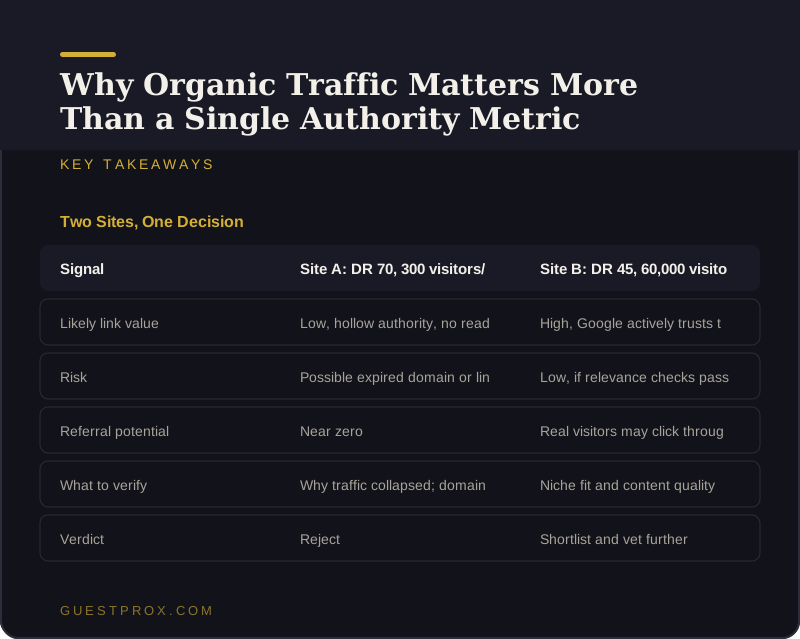
How the same DR can hide two completely different placements.
| Signal | Site A: DR 70, 300 visitors/mo | Site B: DR 45, 60,000 visitors/mo |
|---|---|---|
| Likely link value | Low, hollow authority, no readers | High, Google actively trusts these pages |
| Risk | Possible expired domain or link scheme | Low, if relevance checks pass |
| Referral potential | Near zero | Real visitors may click through |
| What to verify | Why traffic collapsed; domain history | Niche fit and content quality |
| Verdict | Reject | Shortlist and vet further |
You do not need expensive tooling to apply this. Open any SEO tool's site explorer and run this sequence on every prospect.
First, look at the 12-month organic traffic trend. You want stability or growth. Second, glance at the top keywords, are they real informational queries in the site's niche? Third, compare traffic to DR. A large gap between the two is your signal to dig deeper or walk away.
Do this before you read a single article on the site. It filters out most bad prospects in minutes, leaving your reading time for sites that might actually be worth pitching. Our outreach team runs this exact sequence before any pitch goes out.
The traffic-first rule has one legitimate exception: brand-new publications from known editorial teams. A new site has no traffic history to judge, so you evaluate the people behind it, their track record, their editorial standards, and whether real writers are producing real work.
Treat these as speculative placements with speculative expectations. They can become excellent links as the publication grows, but priority should reflect what the site is today, not what it might become.
Start with the shape of the twelve-month curve: a smooth stable or gently rising line means a healthy publication, while a sawtooth pattern usually means normal seasonality. A cliff-edge drop means a penalty or a core-update demotion, walk away. A slow bleed means editorial decline, which is just a cliff in slow motion.
Next, open the keyword footprint. Real publications rank for hundreds of genuine informational queries in their niche, spread across many pages. Red flags: traffic concentrated in two or three pages, one viral outlier on an unrelated topic, or rankings only for the site’s own brand name. Depth and spread signal resilience; concentration signals fragility.
Then check geography. If you sell in the US and seventy percent of a prospect’s traffic comes from elsewhere, discount the placement heavily, those readers will never become your customers and the relevance signal is diluted. Most SEO tools show country splits; it takes ten seconds and buyers skip it constantly.
Finally, benchmark against niche peers, not absolute numbers. Eight thousand monthly visitors is thin for a national news blog but strong for a specialized trade publication. Compare prospects to the median of their own category. Our link building metrics guide includes the peer-comparison approach we use during vetting.
Make the traffic check a team habit, not a solo skill. A shared checklist, trend shape, keyword footprint, geography, peer benchmark, takes five minutes per prospect and removes the single biggest source of bad placements. The teams that do this boring work consistently are the teams whose links keep working.
Viral junk traffic is the most common trap: half a million monthly visitors from two celebrity-news posts on an otherwise B2B site. The number is real and the value is near zero, the audience doesn’t match, the content doesn’t match, and viral spikes decay. Always verify that the traffic-driving keywords match the site’s stated niche.
Watch for the sudden vertical jump in the traffic graph, the signature of a 301 redirect from another domain. Sometimes it is legitimate consolidation; often it is a penalized or unrelated domain’s traffic being funneled into a fresh-looking site. Check domain history and the Wayback Machine before trusting the curve.
Bot inflation is harder to spot but leaves tells: smooth traffic numbers paired with zero engagement, no comments, no social shares, no brand searches, no newsletter mentions. Real audiences leave footprints beyond the analytics dashboard. A site nobody talks about but everybody supposedly visits deserves skepticism.
The subtlest trap is the branded-only mirage: fifty thousand monthly visitors, ninety-five percent of them searching for the site’s own name. That means Google trusts the brand but the editorial pages, the ones your link would sit on, may rank for nothing at all. Check which pages get the traffic, not just the domain total. More on reading these signals in our guest post metrics guide.
Document what you find. Screenshot the traffic graph and keyword footprint on vetting day and file it with the placement record. When a site's traffic collapses a year later, you'll know whether the decline started before or after your link, and whether the vendor sold you a healthy site or a dying one.
More on metrics and relevance.
Authoritative sources if you want to go deeper on this topic.
High DR is never bad by itself, it becomes a warning sign only when traffic does not match. DR 70 with proportionate traffic is a genuinely strong site. DR 70 with no traffic is a manufactured number. Always read the two together.
New sites are a judgment call. A new publication from a known editorial team can be a fine placement, but you are betting on future authority rather than buying current authority. Price and expectations should reflect that, and the site should still show real editorial standards from day one.
Yes, with adjusted expectations. Local blogs and news sites naturally have smaller traffic numbers than national publications. Judge them against local peers, not national benchmarks, and weight relevance and community trust more heavily.
Yes, algorithm updates, redesigns, and editorial decline happen. That is why we recheck placements periodically and why diversification across many sites beats concentration on a few. No single link should carry your strategy.
Every prospect gets a traffic and trend check before outreach begins. Sites with hollow or collapsing traffic never make the pitch list, regardless of their DR. It is the cheapest quality filter in the process.
You need both, but if forced to choose, relevance edges it for ranking specific pages. A relevant link from a modest-traffic niche site typically moves the needle more than an irrelevant link from a high-traffic generalist. The best placements have both.
We check traffic before we pitch, every site, every campaign. Message us on WhatsApp at +1 (213) 582-6001 to talk about your goals.
Global Service Delivery