
A relevant link from a modest site routinely beats an irrelevant link from a giant. Here is how relevance works, how Google judges it, and when it beats raw authority.
Backlink relevance is the topical fit between the linking site, the linking page, and your site. A relevant link tells Google your site is trusted by its own industry, and it consistently outperforms a stronger but unrelated link for the keywords that matter.
Think of authority as volume and relevance as direction. A loud voice in the wrong room still gets ignored. Relevance points the authority at the right audience and the right queries. A link from your industry’s leading publication can outperform five links from bigger but unrelated sites. Campaigns built on topical relevance backlinks compound faster because every link reinforces the same topical story, which is why our off-page SEO campaigns are built relevance-first.
Relevance is the topical fit between who links to you and what you do, and it multiplies whatever authority the link carries.

Google does not have a single relevance score it publishes. But its systems clearly read topical fit at three levels, and link builders ignore any of them at their peril.
What the publication is about overall. A SaaS blog linking to your SaaS product is site-level relevant; a general news site linking to the same product is not, even if the news site has ten times the authority.
Judge it by the site's recent archive, not its about page. Sites drift. A marketing blog that pivoted to crypto last year is a crypto site now, whatever its tagline claims.
What the specific linking page covers. This matters more than site-level fit: a relevant article on a generalist site can outperform an irrelevant article on a niche site. The page is where your link actually lives, so its topic is the primary relevance signal.
When prospecting, read the target page's topic before checking the domain's theme. Page first, domain second.
The words around your link tell Google what the endorsement is about. An anchor like project management software inside a paragraph about team workflows is a precise relevance signal. The same link anchored as click here inside a generic paragraph says almost nothing.
This is why guest posting retains an edge: you shape the surrounding text, so the relevance signal is deliberate rather than accidental.
The eternal question in prospecting: the DR 70 generalist or the DR 40 specialist? The answer is situational, but the situations are predictable.
Ranking specific pages for specific keywords. If you want your project management tool to rank for team collaboration software, links from productivity and SaaS publications will move that needle faster than links from high-authority unrelated sites. Relevance concentrates the link's effect exactly where you need it.
New and mid-authority sites should weight relevance even more heavily, it is the fastest path to topical authority, which is how smaller sites outrank bigger ones.
Building overall domain strength and brand trust. A link from a major national publication lifts everything slightly, diversifies your profile, and carries brand value no niche blog can match. For competitive head terms where everyone has relevant links, raw authority becomes the tiebreaker.
Digital PR exists largely for this purpose: authority and visibility at a scale niche outreach cannot reach.
A campaign’s prospect list should be tiered: sweet-spot targets at the top, relevant mid-tier sites as the reliable core, and high-authority generalists as diversifiers. Track which tier produces your best ranking movements and shift effort toward it each quarter. It is the same tiering our guest posting campaigns use.
If you can only afford to be picky about one thing, be picky about relevance. Authority without relevance is the most common form of wasted link budget we see in audits.
Start every campaign by defining topical boundaries: the core topics your site covers, adjacent topics that count as relevant, and topics that do not. Write it down, vague relevance standards drift under prospecting pressure.
Then tier your targets. Tier one: the leading publications in your niche. Tier two: solid relevant sites with real traffic. Tier three: high-authority generalists for diversification. Most outreach goes to tiers one and two; tier three fills the gaps.
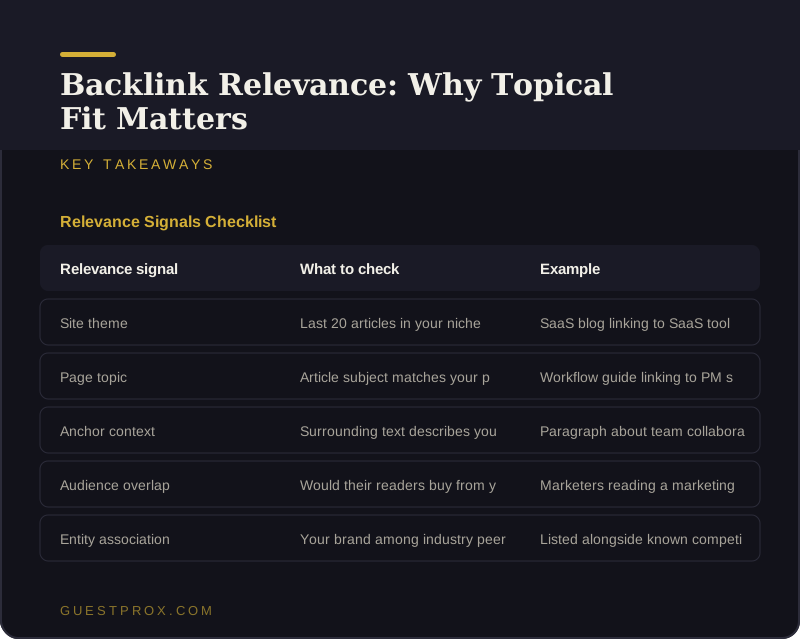
What to check and what good looks like.
| Relevance signal | What to check | Example |
|---|---|---|
| Site theme | Last 20 articles in your niche? | SaaS blog linking to SaaS tool |
| Page topic | Article subject matches your page? | Workflow guide linking to PM software |
| Anchor context | Surrounding text describes you? | Paragraph about team collaboration |
| Audience overlap | Would their readers buy from you? | Marketers reading a marketing blog |
| Entity association | Your brand among industry peers? | Listed alongside known competitors |
| Link neighborhood | Other outbound links on the page | Surrounded by quality industry links |
Write a topical boundary document before outreach begins: core topics that are definitely relevant, adjacent topics that count with the right page, and excluded topics that never qualify. Vague relevance standards drift under prospecting pressure, the written document is what keeps a prospector from approving an off-topic site at 5pm on a Friday.
Make it concrete per niche. A SaaS project-management tool: core is productivity software, SaaS, and team collaboration; adjacent is remote work and HR tech; excluded is general news and coupons. A law firm: core is legal and local business; adjacent is real estate and finance; excluded is entertainment. Two minutes of examples prevents two months of drift.
Apply the audience test as the tiebreaker: would this publication’s readers plausibly become your customers? If yes, the relevance is real even when topic labels do not match perfectly. A marketing blog read by founders is relevant to B2B SaaS even if the category names differ. For SaaS specifically, our SaaS link building service prospects against exactly these boundaries.
Revisit the boundaries quarterly. Sites drift, the marketing blog that pivoted to crypto is a crypto site now, and niches evolve. A boundary document from last year describing a different internet is worse than useless; it is a false sense of discipline.
Write the boundaries down where the whole team can see them, a one-page doc, not tribal knowledge. When a prospector is unsure whether a site qualifies, the document decides in ten seconds. Ambiguity is where off-topic placements sneak in; the written standard is what keeps them out.
Relevance now feeds two systems, not one: classic rankings still reward topical fit, and AI Overviews and LLM answers cite the publications that authoritatively cover a topic. Being the brand that niche authorities reference makes you citable in both places. Our AI search link building guide breaks down what we know so far.
Entity association is the mechanism. When your brand appears alongside known industry entities across relevant publications, both search engines and language models build a clearer picture of what you are and who vouches for you. Relevant links have always been entity signals; AI search just made the signal more visible.
The practical shift is small: keep prospecting relevance-first, and add the publications AI systems visibly cite in your niche. Check which sources appear in AI Overviews for your target keywords, those domains earned their citations through topical authority, and a link from them carries weight in both systems. More on this in AI search visibility and link building.
What does not change: manufactured relevance fools neither system for long. One off-topic post on a relevant-looking domain might pass a casual check, but it will not survive the page-level scrutiny that both Google’s systems and AI citation models apply. Real topical fit, on real pages, remains the whole game.
Start tracking AI citations now, even informally. Note which domains appear as sources in AI Overviews for your keywords and whether your brand shows up. That list becomes your relevance-first prospecting tier for the next era, the publications already shaping what AI tells your customers.
Authority, metrics, and the traffic question.
Authoritative sources if you want to go deeper on this topic.
Relevance itself has no downside, but over-concentration does. If every link comes from the same narrow corner of your industry with identical anchors, the pattern looks engineered. Relevance should describe most of your profile, not every single link, natural profiles include some variety.
Judge the page, not the domain. A well-written article on your exact topic, published on a broad site, is relevant where it counts, at the page level. Check that the page genuinely covers your subject rather than mentioning it in passing.
Less. When the goal is visibility rather than rankings, a podcast mention, a news feature, audience size and credibility matter more than topical precision. Match the metric to the goal: relevance for rankings, reach for awareness.
Not necessarily, reject only if it is clearly manipulative or from a degraded site. A genuine editorial link from a major publication is worth having even off-topic; it diversifies your profile and builds brand authority. Just do not build a strategy around them.
On highly relevant pages, you can use more descriptive, keyword-rich anchors safely, because the context already supports them. On less relevant pages, lean branded or generic, forcing keyword anchors into weak contexts is what creates unnatural patterns.
Yes, it is a primary prospecting filter alongside traffic. Every campaign brief defines the topical boundaries before prospecting starts, and off-topic sites do not make the pitch list regardless of their metrics.
Relevance is our first prospecting filter. Message us on WhatsApp at +1 (213) 582-6001 and tell us your niche.
Global Service Delivery