
For SEOs evaluating link opportunities or vendors. Learn which scores signal real ranking power, and which ones sellers inflate to look good.
Link building metrics are the scores SEOs use to judge whether a backlink is worth pursuing. Domain Rating, Domain Authority, Trust Flow, referring domain counts, and organic traffic estimates all try to answer one question: will a link from this site move my rankings? This page breaks down what each metric actually measures, where sellers manipulate them, and which signals deserve your attention.
The key thing to understand is that every one of these scores is a third-party estimate. Google has never confirmed using any of them, and all of them can be gamed. A high score tells you a site looks strong to a tool, not that a link from it will help you. The rest of this page shows how to read past the numbers.
Used correctly, backlink metrics are a filtering system, not a verdict. They help you shortlist sites worth a closer look and reject obvious junk quickly. The final decision always comes from inspecting the site itself: real content, real traffic, and real editorial standards.
These scores are third-party estimates of a site's authority and traffic. None of them are Google ranking factors.

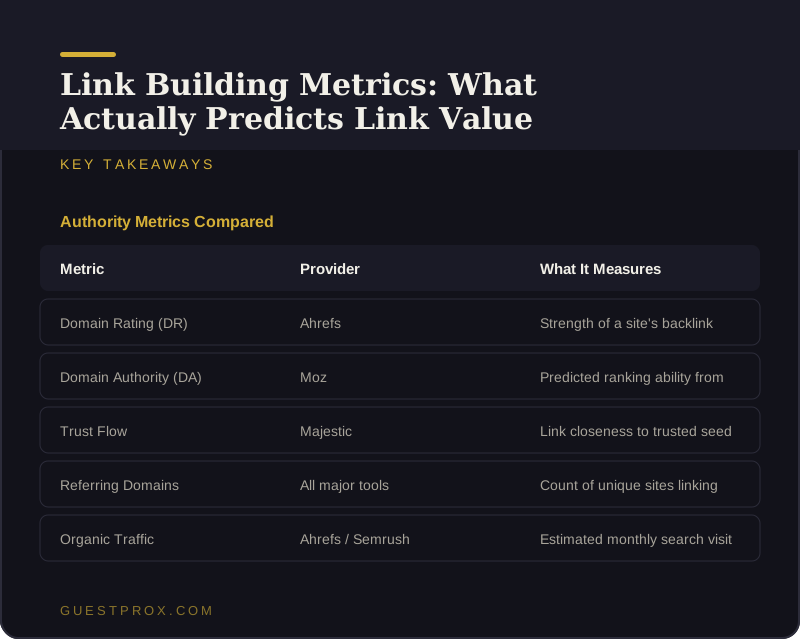
The three authority scores behind most link building metrics come from three different companies with three different formulas. They correlate on strong sites and diverge on manipulated ones, which is exactly why comparing them is useful. Read them together and the disagreements tell you more than any single score.
Domain Rating scores a site's backlink profile on a 0-100 scale, weighted by how many unique domains link to it and how strong those domains are. It updates fast and forgives easily, which also makes it the simplest authority metric to inflate: point enough low-quality links at a fresh domain and DR climbs while nothing else about the site improves.
Domain Authority predicts how likely a site is to rank, trained on Moz's own link index. In the DR vs DA debate, the practical difference matters less than the shared weakness: both are link-graph math, both ignore whether anyone actually visits the site, and both can rise without a single real reader. Use them together as a cross-check, never as a standalone verdict.
Trust Flow starts from a seed set of trusted sites and measures how closely a site is linked to them, which makes it harder to fake with raw link volume. A site with high DR but single-digit Trust Flow is waving a red flag: it has many links but few from places the model trusts. That gap is one of the fastest ways to spot an inflated profile.
If you take one idea from this page, take this: a site with real organic traffic is alive, and a site with only a high authority score might be a stage set. Traffic means Google already sends the site visitors, which means its pages rank, its content works, and its outbound links sit in front of real readers. Treat link building metrics as the starting filter for that judgment, never the final answer.
Authority scores describe a site's link graph. Traffic describes its actual performance in search. When the two disagree, trust traffic: a DR 65 site with near-zero organic traffic is almost always a rebuilt expired domain or a link farm with a polished score. A DR 35 site with steady, topically relevant traffic is usually the better link.
Open the site's organic traffic history and look for stability, not just size. Gradual growth or a flat line suggests a real audience. A sudden vertical spike followed by a cliff often marks an expired-domain redirect or a penalty recovery in progress.
Raw referring-domain counts complement traffic: a site with steady traffic and a growing, diverse set of linking domains is building genuine authority. Watch the relationship between the two instead of the raw number. Thousands of referring domains with no traffic is the classic inflated-DR footprint, while modest domain counts with real traffic usually mean an honest, working site.
Sellers who inflate metrics count on buyers checking one number and stopping there. The patterns below take five minutes to verify and separate real publishers from operations built to sell links. Bookmark this section; it is the part of link building metrics most buyers skip and most regret skipping.
The most common trick is a high DR paired with no organic traffic, thin content, or a brand-new design on an old domain. Expired domains keep their old backlinks, so buyers resurrect them, post generic filler, and sell links off the inherited score. Always check traffic and content age alongside DR; the score alone proves nothing.
Some sellers buy traffic or rank for unrelated keywords to make their dashboards look healthy. A supposed US marketing blog getting most of its visits from unrelated regions, or ranking for celebrity names and coupon terms, is not a real publication. Match the traffic's geography and topics to the site's claimed audience before trusting any number.
Link farms leave structural traces because they operate at scale. Any one of these is a reason to walk away.
Domain Rating describes the whole site. URL Rating, the page-level score, describes the specific page your link will sit on. Most buyers check the domain score and never look at the page score, which is like judging a restaurant by its neighborhood. A DR 70 site can host your link on a page with almost no authority of its own.
For niche edits, the page score is the whole game: your link lands on an existing URL, so that URL's strength decides what you get. A niche edit on a weak page passes a fraction of what the same edit on a strong page passes, even on identical domains.
For guest posts, the page score is unknowable in advance, which is why site-level signals and traffic matter more. Judge the section your post will appear in: does that category rank, get traffic, and attract real links? New posts inherit the section's strength, not the homepage's.
A high domain score with a low page score usually means a deep or orphaned page: fine for a niche edit if the page still ranks, weak if it does not. A low domain score with a high page score means one standout page on a modest site, often an excellent placement if the page is topically relevant.
Treat the page score as a tiebreaker between otherwise equal prospects. It rarely justifies paying more on its own, but it consistently separates placements that move rankings from ones that just fill reports. The walkthrough of DR, DA, traffic, and relevance covers more of these pairings, and our contextual link building process checks both scores before any prospect makes the shortlist.
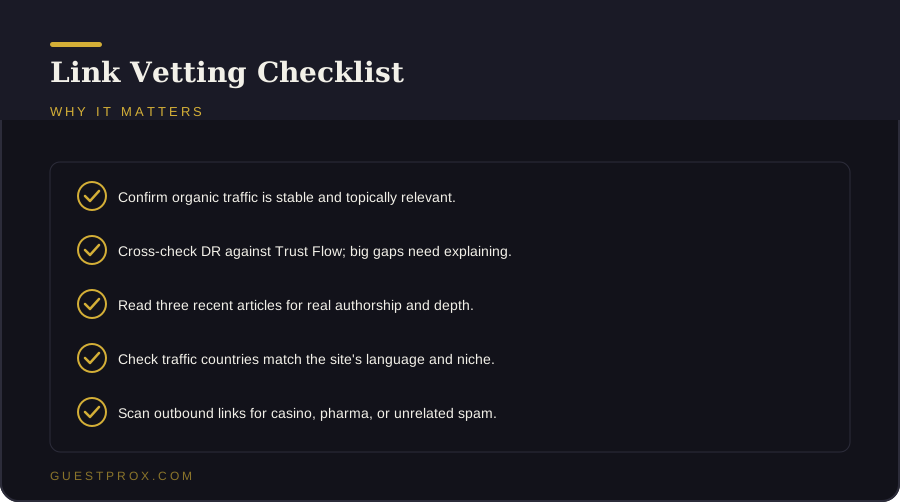
You do not need an hour per prospect. Ten focused minutes, in the right order, catch nearly every bad site. Run the steps in sequence and stop the moment a step fails: a site that fails early never redeems itself later.
Ten minutes is a filter, not a verdict. Sites that pass all five steps earn a deeper look: link neighborhood analysis, anchor placement terms, and the full proof requirements from this page's backlink quality checklist. Sites that fail any step get rejected in ten minutes instead of forty.
Run this framework the same way every time. Consistency is what makes it fast: after twenty prospects, pattern recognition does half the work. The longer method for evaluating a prospect site before you pitch is the expanded version of this same sequence.
Basic inflation is easy to spot: high DR, no traffic. Advanced sellers know that, so they stage the traffic too. The checks below catch the operations that survive a casual glance.
Expired domains keep their old backlinks, which is why sellers resurrect them. Check the archive history: if the site was a plumbing blog in 2021, went dark for two years, and is now a digital marketing publication with fifty generic articles, the authority is inherited, not earned. Content published after the resurrection tells you what the site actually is.
Also check the backlink profile's anchor history. Links built for the old site's topic, pointing at a new site about something else, mean the inherited authority has nothing to do with the current content. Search engines discount this faster than sellers admit.
Some sellers point redirects from old domains at their link farm to inflate authority, or buy cheap traffic to make dashboards look alive. Redirects show up as referring domains with suspicious anchor patterns; bought traffic shows up as visits from countries and keywords that match nothing on the site. Both fail the topical fit test.
When a site looks strong on every metric but something feels off, trust the content read. A real publication is obvious within three articles. If you cannot tell what the site is for after reading three posts, no metric rescues it. The comparison of traffic versus authority scores explains why the content read outranks every number.
What each popular score measures, and where it misleads.
| Metric | Provider | What It Measures | Biggest Blind Spot |
|---|---|---|---|
| Domain Rating (DR) | Ahrefs | Strength of a site's backlink profile, 0-100 | Ignores traffic; easy to inflate with bulk links |
| Domain Authority (DA) | Moz | Predicted ranking ability from link data | Ignores traffic; trained on Moz's index, not Google's |
| Trust Flow | Majestic | Link closeness to trusted seed sites | Harder to fake, but says nothing about traffic |
| Referring Domains | All major tools | Count of unique sites linking in | Raw counts hide link quality completely |
| Organic Traffic | Ahrefs / Semrush | Estimated monthly search visits | Estimates vary by tool; check trends, not exact numbers |
Run these checks on every site before you pay for a placement.
Keep judging link opportunities with these companion resources.
Authoritative sources if you want to go deeper on this topic.
There is no magic number. A DR 40 site with real, relevant traffic usually beats a DR 70 site with none. GuestProx places on DR 40-90 sites specifically because that range combines meaningful authority with verifiable traffic, and every site is checked for both before outreach.
Only when the higher DR comes with real traffic and topical relevance. Paying a premium for a naked DR number is how buyers end up with links from polished-looking farms. Ask the seller for traffic screenshots and niche fit first; if they hesitate, the DR is doing all the selling.
Yes, if the DR is inflated. Links from expired domains, hacked sites, or farms can drag down trust or simply do nothing while costing you budget. The danger is rarely the number itself; it is the manipulated site behind the number. That is why vetting traffic, content, and outbound links matters more than any score.
Buying links usually means paying for whatever placement is fastest, with no questions asked about the site. Real vetting means rejecting most candidates: checking traffic history, content quality, and outbound link patterns before anyone is contacted. Manual outreach to vetted publishers is slower and costs more per link, but the links survive algorithm updates.
Each tool crawls a different slice of the web and applies its own formula. Ahrefs, Moz, and Majestic will never agree exactly, and small gaps are normal. Large gaps, like DR 70 with Trust Flow 8, are the signal worth investigating, not the minor differences.
Quarterly is enough for most profiles. Sites get sold, repurposed, or hacked, and a publisher that was clean six months ago can turn into a link farm. A quick quarterly pass over your newest referring domains catches decay before it compounds.
Mostly yes for counting purposes; tools count nofollow links in referring-domain totals, though they contribute less authority in Google's eyes. Do not dismiss a site over its nofollow ratio. A natural profile includes plenty of nofollow links, and traffic-rich sites pass value through visibility and referral visits regardless of link attributes.
Our link building service checks traffic, authority, and editorial standards on every site before outreach begins. Tell us about your goals and we will show you what real vetting looks like.
Global Service Delivery