
For founders, in-house SEOs, and agencies who want a repeatable process. Learn how guest posts get accepted, and what separates links that move rankings from filler.
A guest posting guide is a practical playbook for earning backlinks by publishing original articles on other websites. You pitch real editors, write something genuinely useful for their readers, and earn a contextual link back to your site in return.
It still works because the underlying mechanics are sound. A relevant site with real traffic vouches for you with a link, and search engines treat that as a trust signal. Results collapse only when people cut corners: spun content, irrelevant sites, paid placements dressed up as editorial. Call it guest posting or follow a guest blogging guide, the mechanics are identical.
This guest posting guide follows the same process we use at GuestProx, where we have delivered 1259+ guest posts for 57+ clients since 2018. Every step assumes manual outreach, real editors, and sites with verifiable traffic. If a tactic would not survive a manual review, it is not in here.
Guest posting is the practice of earning a backlink by publishing an original, genuinely useful article on a third-party website, placed through manual outreach and editor approval, never through paid link schemes or PBNs.

Most guest posting campaigns fail before the first email goes out. The site list gets built first and the strategy never does. Flip the order. Decide what each placement has to accomplish, rank a service page, support a new content hub, diversify anchors, and the rest of the plan writes itself.
Link to pages that can convert or rank, not the homepage by default. A deep product or service page with a targeted anchor moves the needle; a homepage link with a branded anchor mostly pads a report. Map every target page to two or three planned placements before prospecting starts.
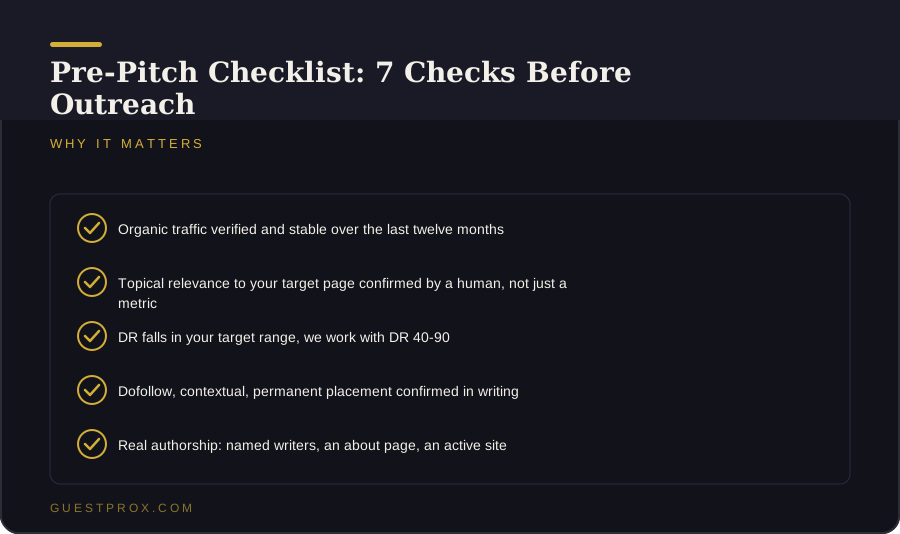
For every site on your list, answer three questions: does it get real traffic, is it topically relevant, and would you show this placement to the client with pride? If any answer is no, cut it.
We keep a working filter of DR 40-90 with verified organic traffic, checked before pitching. Metrics alone never close the deal, but they keep obviously weak sites out of the pipeline.
Exact-match anchors still have a place, but they should be the minority. Spread commercial intent across partial matches, branded terms, and plain natural language.
Write the anchor plan before outreach begins, then assign anchors as placements land. Retrofitting anchors onto random wins is how profiles end up looking engineered.
For most sites, four to eight well-vetted placements per month beats twenty thin ones. Search engines read velocity; a sudden spike of links from unrelated sites looks bought, because it usually is.
Keep outreach, writing, and publishing in a steady rhythm without rushing editors. Consistency across quarters matters more than any single month, the least glamorous lesson in any guest posting guide, and the most profitable.
A site's DR tells you how strong its backlink profile looks. It tells you nothing about whether anyone reads the site. Traffic verification comes first: real organic visitors, steady over six to twelve months, from keywords that make sense for the niche.
Then read the site like an editor would. Are posts written by named authors? Is there a visible editorial standard, or does every article read like it was commissioned for a link?
Would your target customer plausibly land there? These questions filter out most link farms wearing a blog costume.
We target DR 40-90 as a working range, not a trophy case. Below 40, too many sites lack the authority to move rankings; above 90, editorial gates are so tight that placement rates collapse.
Within that range, relevance and traffic decide. A DR 45 site in your exact niche with steady visitors will outperform a DR 70 generalist blog every time.
Watch for write-for-us pages that accept anything, author bios linking out to casinos and CBD on the same page, and sites where every post is a guest post. Those are link marketplaces, not publications.
Also check outbound link density. If an article links to twelve unrelated commercial sites, your link is one of twelve diluted signals. Editors who protect their readers protect your link's value too.
Before writing a word, confirm the link will be dofollow, contextual inside the article body, and permanent. Ask whether the site charges editorial fees, some legitimate publications do, and that is fine as long as you know upfront.
Get the turnaround in writing too. A site that takes four months to publish breaks your campaign cadence. Two to six weeks is normal for real editorial calendars.
Editors accept articles that make their site better. That is the entire game. Pitch topics with a clear angle for their specific audience, and your acceptance rate climbs without any trickery. Editors talk to each other, too, a writer known for clean, on-brief drafts gets faster replies across the industry.
Write the article you would be proud to put your own name on. Original research, concrete examples, and data beat generic advice every time, and editors can tell within two paragraphs which one they received. When in doubt, cut the generic paragraph and replace it with one specific example from your own work.
Send two or three specific headline options with a one-line angle for each, tailored to what the site recently published. Reference an actual article of theirs and explain how yours extends the conversation.
Never send the full article unsolicited. It signals you will publish it elsewhere if they decline, which removes their incentive to say yes.
Read three recent posts before writing. Match their typical length, formatting habits, and level of technical detail. An 800-word listicle pitched to a site that publishes 2,500-word deep dives will be rejected on fit alone.
Keep self-promotion to the link itself: one contextual link where it genuinely helps the reader, plus a normal author bio. Anything more reads as advertorial and gets cut in editing.
Share the published article with your audience and tag the publication. Editors notice who promotes, and it measurably improves your odds on the next pitch.
Then monitor the placement. Check monthly that the link is live, dofollow, and indexed. Good partners keep links permanent; if one disappears, a polite follow-up usually restores it.
Editors reject topics before they reject writing. The pitch that wins is never a generic post about a broad subject, it is a specific angle the publication has not covered well, or has not covered at all. Your job at the topic stage is research, not creativity, and most pitchers skip it entirely.
Read the last twenty posts in the category you are targeting. List what they covered, what they glossed over, and what they got wrong. Gaps are pitches: a post that updates dated advice, challenges a popular take with evidence, or applies a general concept to one specific industry gives the editor something their archive lacks.
Then check who else is pitching the same editors. If three competitors published on a site last quarter, your angle must be visibly different or you are the fourth version of the same article. Differentiation at the topic stage is cheaper than differentiation at the writing stage.
Search the site for your topic and read what already ranks. If the existing coverage is thin or dated, your pitch is the better version, say so explicitly, and say what you would add. If the coverage is already excellent, pick a different angle instead of pitching a duplicate. Pitching a duplicate burns a contact you may never get back.
This archive check doubles as how to evaluate a guest posting website before you pitch it: sites with thin, outdated archives are often easier to place on, but harder to be proud of.
When the industry shifts, an algorithm update, a new tool, a policy change, editors need coverage fast and credible voices are scarce. A pitch that ties your experience to the news arrives exactly when editors are hungry for it.
The catch is that you must add something beyond the news itself: what changed, what it means for the reader, and what to do this week. Commentary without a practitioner's read is noise, and editors can tell the difference in one paragraph.
Original numbers get published on weaker relationships than opinion pieces ever will. A survey of fifty site owners, an analysis of your own campaign data, or a structured teardown of ten competitors is content the editor cannot get anywhere else.
You do not need a research department. You need a spreadsheet, a defensible method, and the discipline to write up what the data actually says, including the parts that surprised you. Numbers earn the reply; honesty earns the second placement.
The cheapest placement you will ever earn is the second one from the same editor. No prospecting, no cold pitch, no trust-building from zero, just a short email to someone who already published you. Yet most campaigns treat every placement as a one-off and start the whole machine over each month.
Think of it as a ladder with four rungs: one-off placement, repeat contributor, invited columnist, and referral source. Each rung changes the economics of your outreach, faster acceptance, warmer terms, introductions to other editors, and climbing it is a deliberate process, not luck.
Sixty to ninety days after publication, pitch the same editor again with something better than the first piece. Reference the published article's reception, real shares, real comments, and propose a follow-up that extends the conversation. Editors say yes to proven contributors because proven contributors lower their risk.
This is the core mechanic behind getting editors to say yes consistently: you stop being a stranger and start being a reliable source of clean copy.
If the editor is open to it, a niche edit placement in an existing high-traffic article can be a faster second win than a full new draft, same trust, less writing, and the page already carries authority.
After two or three successful pieces, ask directly whether a monthly or quarterly contribution would fit the editorial calendar. Frame it as reliability, an editor who knows a good draft lands on the first of the month will plan around you.
Recurring slots also stabilize your link velocity, which makes reporting cleaner and campaigns easier to forecast. Predictability is a feature your clients will pay for, even if they never articulate it.
Ask editors who like your work which other publications they read. A warm introduction from one editor to another converts at rates cold outreach never touches, because the trust transfers with the introduction.
The outreach world is smaller than it looks. Being known as the contributor who delivers clean, on-brief copy on time travels between editors faster than any pitch ever will. Treat every editor relationship as the start of three more.
Most rejected pitches are never diagnosed, so the same mistake repeats for months. Rejections carry information if you sort them into four types: silence, the polite no, the topic mismatch, and the quality rejection. Each one points at a different failure, and each one has a different fix.
Silence after two follow-ups usually means the prospect was wrong, bad fit, dead inbox, or an editor buried in pitches. A polite no with a reason is the most valuable reply you will get; it tells you exactly what to change. Topic mismatch means your research was shallow. A quality rejection means the depth or writing fell short of the bar.
Do not rewrite the pitch until you know which type of rejection you received. Rewriting the angle when the problem was list quality wastes a week; polishing prose when the problem was topic fit wastes the contact.
Re-pitch when the editor named a fixable reason, or when six months have passed and your angle is genuinely new. A short note referencing the earlier exchange shows you listened, which editors remember.
Move on when the fit was wrong from the start. A mismatch does not become a match through persistence, it becomes a spam complaint. Archive the prospect, keep the lesson, and spend the energy on blogger outreach to sites that actually fit.
For the full sequence from first search to live link, see how guest posting works from prospecting to publication, diagnosis gets easier when every stage is tracked.
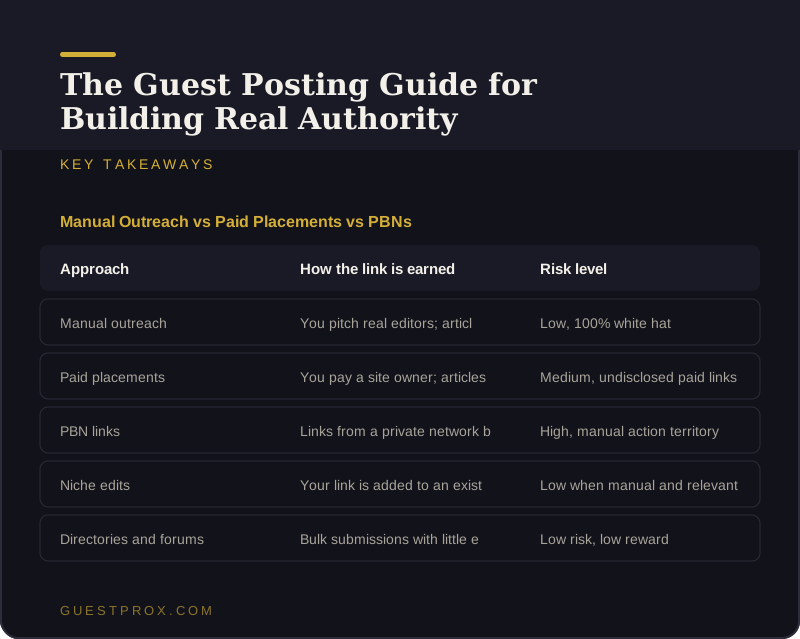
The three ways guest post links get built, and what each one actually costs you.
| Approach | How the link is earned | Risk level | What you really get |
|---|---|---|---|
| Manual outreach | You pitch real editors; articles are reviewed and published | Low, 100% white hat | Contextual dofollow links on real-traffic sites |
| Paid placements | You pay a site owner; articles publish with little review | Medium, undisclosed paid links violate link scheme policies | Fast links, but footprints and deindex risk |
| PBN links | Links from a private network built to manipulate rankings | High, manual action territory | Short-term movement, then penalties when networks are caught |
| Niche edits | Your link is added to an existing ranking article | Low when manual and relevant | Faster impact since the page already has authority |
| Directories and forums | Bulk submissions with little editorial control | Low risk, low reward | Minimal ranking value; fine for citations, not authority |
Run every prospect through this list before a single email goes out.
Go deeper on the mechanics behind successful guest posting.
Authoritative sources if you want to go deeper on this topic.
Expect two to four months before new placements move your rankings. Search engines need to crawl the linking page, pass the signal, and re-evaluate your page against competitors. Campaigns compound: month six almost always outperforms month one on the same effort.
We don't publish prices. Every campaign is scoped to your targets and competition, so the fastest way to get an exact number is to message us on WhatsApp at +1 (213) 582-6001.
Manual outreach to real sites with genuine content is exactly what Google's guidelines describe as legitimate. Penalties come from manipulation patterns: paid links at scale, PBNs, spun content, and irrelevant placements. We do none of that, 100% manual outreach, 100% white hat, no PBNs.
Buying links means paying for placement with no editorial standard, the site publishes anything for a fee. Real guest posting means an editor reviews your article and accepts it on merit, with the link as a natural citation. One builds an asset; the other rents a footprint that can vanish.
For most small to mid-size sites, four to eight well-vetted placements monthly is strong. Competitive niches like finance or SaaS may need more, but relevance and authority per link matter far more than raw count. Start at a pace you can sustain, then scale once the process is proven.
Yes, dofollow contextual links pass ranking signals, which is the point of the exercise. A natural profile includes some nofollow links too, and we never pressure a site to change its policy. But if a publisher only offers nofollow or author-bio links, weigh that before investing writing time.
GuestProx handles everything: outreach, topic pitching, content written to the publisher's standards, and placement. If you prefer to write, we can work from your drafts. Most clients hand us the target pages and let our team run the full process, with monthly reporting on every live link.
GuestProx runs 100% manual outreach and places guest posts on real DR 40-90 sites. See our guest posting service for packages and turnaround times.
Global Service Delivery