
Most people only see the published article. Here is everything that happens before it goes live, and why each step decides whether the link actually helps your rankings.
If you're wondering how guest posting works in practice, it runs as a six-stage pipeline: prospecting, vetting, outreach, writing, publication, and reporting. A site is found, checked for quality, pitched to a real editor, given an original article, published with your link inside, and then documented in a report you can verify yourself.
Every stage filters out bad outcomes. Skip prospecting and you pitch irrelevant sites. Skip vetting and you land on link farms. Skip real outreach and editors ignore you. The pipeline looks slow compared to buying links, but it is the reason the links actually move rankings and survive algorithm updates.
Guest posting works by finding real publications, earning an editor's approval through manual outreach, publishing original content, and placing a contextual backlink inside it.
The unglamorous work happens before any editor hears from you. This is where campaigns are won or lost.
We start with your niche and competitors. Which sites link to businesses like yours? Which publications cover your topics with real audiences? We combine search operators, competitor backlink analysis, and our existing publisher relationships into a list of candidates, usually several times larger than the number of placements needed, because not every pitch lands.
Volume matters here for a practical reason: editors reject far more pitches than they accept. A healthy prospect list is what keeps a campaign on schedule. This list-building discipline is the unglamorous part of how guest posting works at agencies, and the part most DIY efforts underinvest in.
Every candidate site gets checked before anyone pitches it. We verify real organic traffic, read the actual content for quality and authorship, examine outbound link patterns for signs the site sells links indiscriminately, and check the site's history. Sites that fail, PBNs, link farms, metric-inflated shells, are cut.
This step is what separates legitimate guest posting from the link-selling marketplaces. Most bad placements in this industry trace back to skipped vetting, not bad writing.
With a vetted list in hand, the human work begins, real blogger outreach to editors, not blasts.
A real person researches each publication and writes a personal pitch: why this topic fits their audience, what angle makes it fresh, and why we're credible to write it. No templates blasted at scale, no automation. Editors can smell mass outreach instantly, and it burns the relationship for everyone.
Follow-ups are polite and spaced. If an editor declines or goes quiet, we move on, there are always more vetted sites than placements needed.
Once a topic is approved, our writers produce the article to that publication's standard, not a generic 500-word filler piece. It needs to read like something the site would publish from a regular contributor, because editors compare it against exactly that. Your link goes in where it genuinely helps the reader, with anchor text planned against your campaign's anchor strategy.
You approve the topic direction before writing starts. Most publications request small revisions; we handle them as part of the process.
The finish line has its own quality controls.
When the article goes live, we verify the essentials: the link is present, it is dofollow, it sits contextually in the body content, and the page is indexed. If anything is off, a missing link, a nofollow added without discussion, we go back to the editor before the placement counts as delivered.
Our Starter campaigns typically complete in about 15 days from kickoff to final report, with larger campaigns scheduled in phases.
You receive a report with every live URL, the metrics of each publication, and anchor text used. No screenshots of spreadsheets as proof, actual links you can click. For agency partners, reports are white-labeled under your brand. The whole point of the pipeline is that nothing about it needs to be taken on trust. That verifiability is the final proof of how guest posting works when done honestly: everything clickable, nothing hidden.
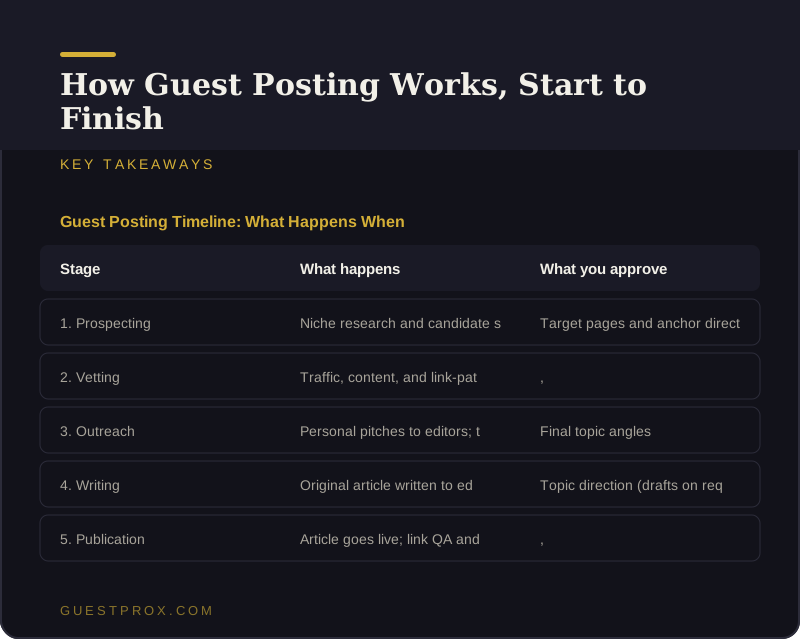
A typical campaign, stage by stage.
| Stage | What happens | What you approve |
|---|---|---|
| 1. Prospecting | Niche research and candidate site discovery | Target pages and anchor direction |
| 2. Vetting | Traffic, content, and link-pattern checks per site | , |
| 3. Outreach | Personal pitches to editors; topic negotiation | Final topic angles |
| 4. Writing | Original article written to editorial standard | Topic direction (drafts on request) |
| 5. Publication | Article goes live; link QA and index check | , |
| 6. Reporting | Live URLs, metrics, and anchors delivered | , |
Most guest posting campaigns don't fail, they stall. Knowing the common choke points helps you plan around them.
Editors are the scarcest resource in the pipeline. A great prospect list means nothing if pitches sit unanswered for three weeks. We run wide prospect lists and parallel outreach precisely so one slow editor can't stall a campaign.
If your campaign has a hard deadline, say so at kickoff, prospecting breadth and follow-up timing get planned around it.
Some publications request substantial revisions: different angle, more depth, fewer promotional touches. This is normal and healthy, it means standards exist. Budget time for one revision round per placement and treat editor feedback as free consulting on what that audience wants.
Parallel prospecting, pre-approved topic angles, writers briefed before approval lands, and QA checklists at publication. Our Starter campaigns typically complete in about 15 days because the pipeline is designed so stages overlap instead of waiting on each other.
The six-stage pipeline doesn't start from nothing. Before prospecting begins, three inputs get locked: which pages you're promoting and why, what your current anchor profile looks like, and which competitors you're trying to beat. Skip this intake and every downstream stage optimizes blindly, great sites, wrong pages, anchors that unbalance your profile.
Target-page triage is the highest-impact part. We rank your candidate pages by commercial value, current position, and link gap versus competitors, then assign the strongest, most relevant placements to the pages closest to converting. A page ranking 11th for a buying keyword gets priority over a page ranking 4th for an informational one. This is where competitor link gap analysis earns its keep: it shows exactly which links rivals have that you don't.
The anchor baseline matters just as much. We audit your existing profile before planning a single new anchor, if you're already heavy on exact-match, the campaign leans branded and naked URLs until the mix normalizes. Planning anchors after placements are live is like budgeting after spending. The spreadsheet comes first.
Finally, success criteria get written down: which keywords, what movement, over what window. 'More links' is not a goal. 'Move these three commercial pages from page two to page one within two quarters' is. Clear targets let us tell you at week eight whether the campaign is on track or needs adjusting, instead of discovering it at month six.
Publication isn't the end of the work, it's the start of the waiting period where Google does its part. New links get crawled, the linking pages get re-evaluated, and your target pages shift, usually inside that 4-to-12-week window. During this stretch we monitor every placement: link still live, still dofollow, page still indexed. Links are assets; assets get maintained.
Placements occasionally die young. Sites redesign and drop old content, domains change hands, editors prune archives. When a placement disappears prematurely, we work to replace it, which is only possible because vetting favored established publications with real archives in the first place. Ephemeral sites produce ephemeral links.
The relationship layer compounds quietly in the background. Every successful placement warms the next pitch to that editor and their network. Over a year of steady campaigns, outreach to familiar publications converts at multiples of cold outreach, this is the compounding return that one-off link buys can never produce. It is also why consistent cadence beats sprint-and-stop bursts: relationships need rhythm.
And the data feeds the next campaign. Which publishers drove referral traffic, which anchors correlated with movement, which topics editors accepted fastest, all of it sharpens the next round of prospecting. A mature guest posting program gets cheaper per result over time, not because the work gets sloppy but because the learning accumulates. That is the difference between buying links and building a capability.
If you ever leave, the assets stay yours. Live placements on real publications don't evaporate when a contract ends, they keep passing authority as long as the articles exist. That permanence is the quiet argument for editorial tactics over rented ones: you are building equity, not paying rent. Ask any provider what happens to your links if you stop paying, and listen carefully to the answer.
Understand the process from every angle.
Authoritative sources if you want to go deeper on this topic.
From prospecting to live link, a single placement usually takes one to three weeks depending on editor response times. Our Starter campaigns typically complete in about 15 days. Editors are the variable, some reply in a day, some take two weeks, which is why campaigns run multiple prospects in parallel.
Yes. You approve the strategy up front, target pages, anchor direction, and the caliber of sites. On request, we share the vetted prospect list for your sign-off before outreach begins. Nothing gets pitched that you wouldn't want your brand associated with.
Rejections happen and they're normal. If a draft doesn't meet a publication's bar, we revise it to their feedback. If the topic itself is declined, we pitch a new angle or move the placement to another vetted site. You never pay for effort, only for live, verified placements.
Rarely, but it happens, sites redesign, prune old content, or change ownership. We QA every link at delivery, and if a placement disappears prematurely through no fault of the content, we work to replace it. This is another reason vetting for established, real publications matters.
Every live URL, the publication's key metrics, the anchor text used, and the publication date, all clickable and verifiable. For agencies, reports are white-labeled. If a provider's 'report' is a spreadsheet of domains without live links, that's a red flag.
Buying links means paying for placement regardless of editorial standards, usually on sites built to sell links. Our process earns placement through pitching real editors at real publications. The link is a byproduct of content the publisher actually wanted, which is exactly why it holds value.
Message us on WhatsApp at +1 (213) 582-6001 or send the form below. We'll map out a campaign around your site and show you what the pipeline looks like for your niche.
Global Service Delivery