
Editors at real publications delete most pitches in seconds. Here is what the surviving ones have in common, learned from thousands of outreach conversations since 2018.
Guest post outreach is the process of contacting editors and site owners to propose article topics for publication on their websites. It is a sales conversation where the product is your content and the buyer is an editor protecting their publication's standards.
Most outreach fails before the editor finishes the first sentence, not because the writer lacks skill, but because the pitch was never really about the publication. Editors say yes when three things align: the topic genuinely fits their audience, the angle is fresh enough to be worth publishing, and the sender looks credible enough to deliver. Everything in this post is about engineering that alignment.
Guest post outreach is pitching article ideas to editors of real publications, and getting a yes means proving your topic serves their readers, not just your link profile.
Understanding failure modes is faster than studying success. These three kill the vast majority of pitches.
Mass outreach tools let one person email a thousand editors before lunch. Editors know it instantly: generic greeting, vague topic suggestions that could fit any blog, no sign the sender has read a single article on the site. These pitches don't just fail, they train editors to distrust outreach, making it harder for everyone.
We do the opposite: fewer pitches, each researched, the approach detailed in our blogger outreach guide. Our response rates come from relevance, not volume, and our publisher relationships survive because editors know our emails are worth opening.
The most common pitch topic is some variant of '10 Tips for [niche]' that the publication has already covered three times. Editors don't need content, they need content their readers haven't seen. Before pitching, read the site's recent archives and propose the article-shaped hole you found there, not the article you already wanted to write.
A good test: if your proposed topic could be pitched unchanged to twenty different sites, it's not a topic. It's a template.
Editors ask one silent question: can this person actually deliver a good article? A pitch from a stranger with no samples, no relevant background, and a free email address starts at a disadvantage. Close the gap with specifics, relevant experience, links to published work, a sharp topic summary that demonstrates expertise in two sentences.
Agencies solve this at scale through reputation: editors who've accepted our writers' work before say yes faster. That relationship capital is most of what you're buying with an outreach service.
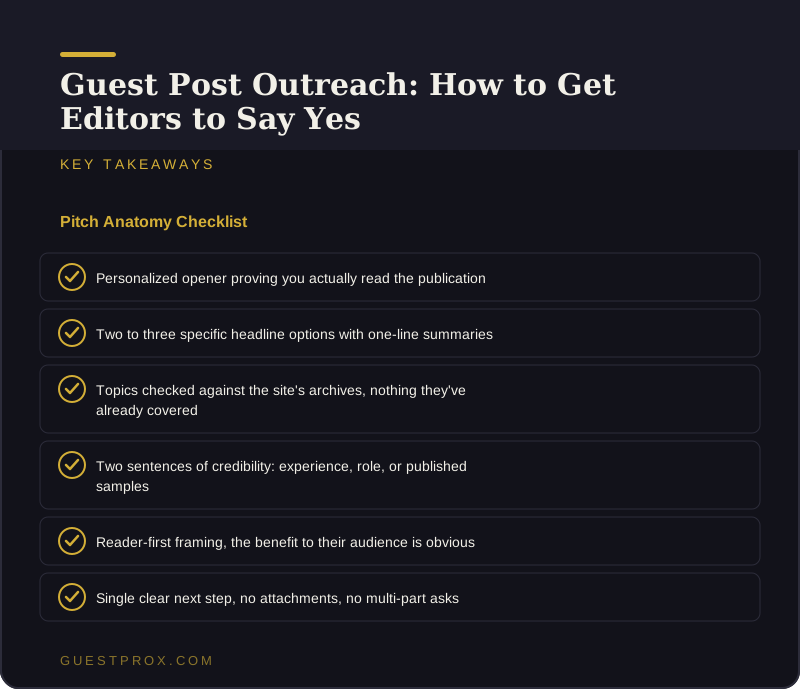
Four elements, in this order. Miss one and the pitch wobbles.
Open with something specific, a recent article you read, a series you follow, a gap you noticed. One genuine sentence of familiarity outperforms three paragraphs of flattery. Editors can distinguish the two in about four seconds.
This is also the fastest filter for bad prospects: if you can't find anything specific to say about a site, it probably isn't worth pitching.
Propose two or three concrete headlines with one-line summaries, each clearly written for that publication's readers. Specificity signals effort and makes the editor's decision easy, they're choosing between options, not evaluating a vague offer to 'contribute content.'
Frame topics around the reader's benefit, not your keyword. 'How small firms can...' beats 'The ultimate guide to...' because it promises a specific reader a specific outcome.
Two sentences on why you're the right person to write this: practitioners beat generalists. 'I run outreach for 50+ clients' is more convincing than 'I'm a passionate writer.' If you have published work elsewhere, link it, one strong sample outweighs a paragraph of claims.
Close with a single, low-friction ask: which topic interests them, or whether they'd like to see an outline first. Don't attach a full draft uninvited, don't ask for five things, and don't write a closing paragraph longer than the pitch. Make saying yes the path of least resistance.
Every pitch we send clears all seven.
Doing outreach for dozens of clients teaches lessons that solo campaigns never surface.
It's mostly reputation and process. Editors who've accepted our writers' work before open the next pitch faster. Dedicated prospectors build better lists than someone doing it an hour a week. And systematic follow-up, polite, spaced, value-adding, recovers a meaningful share of would-be non-responses.
Every pitch either builds or spends relationship capital. We never pitch off-topic ideas to good contacts, never blast, never argue with a rejection. A publisher relationship that survives five years is worth more than any single placement, we treat it that way, and editors notice.
Two good pitches with no response, or one clear no, and we move on, but we keep the door open. People's roles change, editorial calendars shift, and today's pass becomes next quarter's yes. The database remembers; the relationship stays warm without pestering.
Not every rejection is a rejection. Editors reply in a handful of patterns, and reading them correctly saves good prospects from premature burial. 'Not right now' with a specific reason, full calendar, recent similar piece, is a timing no. Log it, wait a quarter, and pitch a fresh angle, these convert well on the second approach because the editor already knows your name.
'We don't accept guest posts' is usually final for that publication, but check the archives before believing it. Some sites say this while publishing contributor content under other labels, 'partner content,' 'expert columns.' If the archives show outside voices, the no is about your pitch or your timing, not their policy. Adjust and try once more with a sharper angle.
Silence is the most common reply and the least informative. After two spaced follow-ups, move on, but keep the contact warm in the database. Editors change roles, calendars open up, and a pitch that died in March can land in September. The mistake isn't the silence; it's deleting the contact in frustration, for the mechanics of those follow-ups, see our outreach email templates.
The yes-with-conditions, 'interesting, send an outline' or 'we'd need it shorter', is where deals are won. Respond fast, deliver exactly what was asked, and don't renegotiate the conditions. Editors testing you with a small ask are measuring reliability; pass the test and the relationship opens. Speed and compliance beat brilliance here.
Pitching the wrong person is the most common veteran error. The editor-in-chief doesn't assign guest contributions at most publications, section editors and managing editors do. A pitch to the wrong inbox either dies or gets forwarded with its priority stripped. Spend the extra ten minutes finding who actually handles contributors; the masthead usually tells you.
Ignoring stated guidelines is the fastest way to look amateur. If the guidelines say 'no listicles' and you pitch '7 ways to...', you've announced you didn't read them. Guidelines also reveal what the publication is tired of, treat the 'please don't pitch us' section as free competitive intelligence about which angles are oversaturated.
Over-personalization backfires more than people expect. Referencing the editor's recent vacation photos or their kid's soccer team doesn't build rapport, it reads as surveillance. Professional familiarity means their work, not their life. One specific sentence about a recent article is warmth; three paragraphs about them personally is a red flag.
Finally, the calendar mistake: pitching during the publication's busiest season or on Monday morning when inboxes are carnage. B2B editors are most responsive mid-week; nobody wants a new project on Friday afternoon. None of this replaces a good pitch, but timing removes friction, and our blogger outreach team plans send windows around exactly these patterns.
From pitch to published.
Authoritative sources if you want to go deeper on this topic.
One polite follow-up after five to seven days, and a final brief one a week later. Then stop. Editors are busy, not hostile, most non-responses are about timing, not rejection. Pestering burns the contact for future campaigns, which is the opposite of what outreach is supposed to build.
Specific beats clever. 'Guest post pitch: [specific headline] for [publication]' outperforms vague curiosity plays because busy editors triage by relevance. There is no magic subject line, the open comes from the sender looking legitimate and the topic looking relevant in the preview.
Don't offer payment for editorial coverage, it changes the relationship and many legitimate publications refuse it. Some sites do charge editorial or processing fees openly; that's a business decision to evaluate case by case. Never disguise a paid placement as earned editorial.
Mastheads, author bios, contact pages, and professional networks, in that order of reliability. Role-based addresses like editor@ or submissions@ work when a name isn't available. What doesn't work: guessing patterns and blasting all of them. One verified contact beats ten guessed ones.
Diagnose before you scale. No responses across many pitches usually means the topic is wrong, the targeting is off, or the sender looks untrustworthy. Fix the pitch on a small test batch before sending more. Volume never fixes a broken message, it just multiplies the failure.
Yes. Every pitch references the specific publication, proposes topics fitted to its audience, and comes from a real sender identity. It's slower than automation and converts dramatically better, which is why our publisher relationships compound instead of burning out.
Message us on WhatsApp at +1 (213) 582-6001 or send the form below. Our team pitches real editors every day, put that relationship capital to work for your site.
Global Service Delivery