
Templates fail when people copy them word for word. These work because each one is a structure to customize, with notes on exactly what to change and why.
A guest post email template that gets replies works when it gives you a proven structure, opener, topic pitch, credibility, close, while forcing customization in the spots editors actually read. The template handles the architecture; you supply the specifics that prove you're human.
The templates below are the skeletons of emails that get replies. Each includes bracketed fields you must fill with real research, plus notes on why each section exists. Copy the structure, never the exact words, the moment a template circulates verbatim, editors start recognizing it.
An effective outreach email template is a customizable structure, researched opener, tailored topics, brief credibility, simple close, not a script to send unchanged.
Before the templates, understand what each part does. Every section earns its place or gets cut.
A single specific sentence about their publication, an article you read, a series you follow. Its job is to survive the four-second scan that kills mass outreach. Generic praise ('I love your blog!') fails this test; specifics pass it. Never skip this, and never fake it.
Concrete headlines with brief summaries, written for their readers. Two or three options let the editor choose rather than evaluate. Each should be checkable against their archives, if they've covered it, don't pitch it.
Why you can write this well. Role, experience, or a link to published work. Shorter is stronger, a long bio reads as insecurity, and editors decide credibility from the topic quality anyway.
Which topic interests them, or shall you send an outline? One question, low friction. Long closings with multiple asks, calendar links, and attached drafts signal mass outreach and get deleted.
Fill every bracket with real research. A guest post email template is only as human as the details you put into it, an unfilled template is worse than no template.
Subject: Guest post idea: [specific headline] for [publication name]
Body: Hi [name], I read your recent piece on [specific article], the section on [specific point] matched what we're seeing with [your experience]. I'd love to contribute something in that vein. Two ideas for your readers: 1) [Headline], [one-line summary of the reader benefit]. 2) [Headline], [one-line summary]. I'm [two-sentence credential]. Would either of these work, or would you prefer I send a quick outline first? Best, [your name], [role] at [company].
Why it works: every bracket forces research. The editor sees their publication reflected back accurately, which is the entire credibility mechanism.
Subject: Re: Guest post idea for [publication name]
Body: Hi [name], floating this back up in case it got buried, I pitched a couple of topic ideas for [publication] last week. If neither fit, I have one more angle: [new headline], [one-line summary tied to something they recently published]. No worries at all if the timing's off. Best, [your name].
Why it works: it adds something new instead of just nagging. A follow-up that repeats the original ask verbatim signals automation; one that brings a fresh, relevant idea signals a human paying attention. Send once, five to seven days later.
Subject: Quick thought on [their recent article topic]
Body: Hi [name], your piece on [article] was excellent, one thing I'd add from our work with [number]+ clients in [niche]: [two-sentence genuine insight]. If you ever want a contributor piece expanding on that angle, I'd be glad to write it. Either way, keep up the great work. Best, [your name].
Why it works: it leads with giving, not asking. Use sparingly for high-value targets where a direct pitch feels premature. The conversion rate is lower but the relationships it starts are the strongest ones.
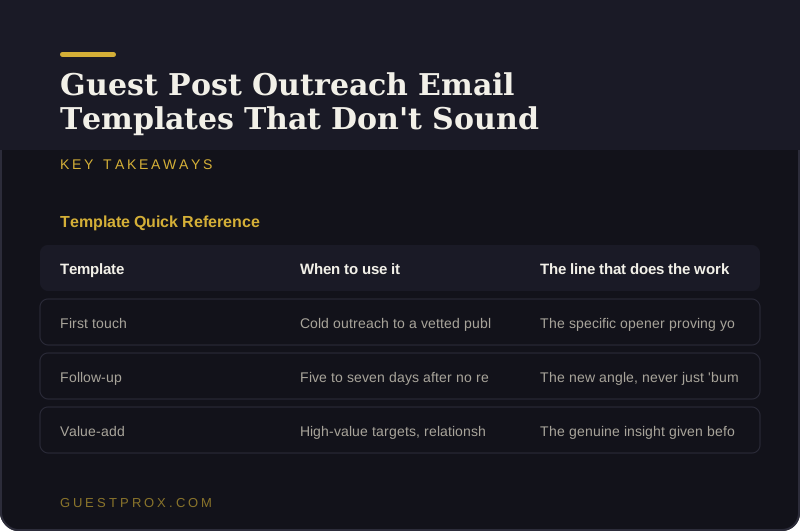
Which template, when, and what carries it.
| Template | When to use it | The line that does the work |
|---|---|---|
| First touch | Cold outreach to a vetted publication | The specific opener proving you read the site |
| Follow-up | Five to seven days after no reply | The new angle, never just 'bumping this up' |
| Value-add | High-value targets, relationship building | The genuine insight given before anything is asked |
The goal is maximum humanity per minute of effort. Here's the efficient frontier.
Eighty percent of the 'human' signal comes from three fields: the specific opener, the tailored topics, and the sender's real identity. Get those right and the rest of the structure can stay consistent. Get those wrong and no amount of clever phrasing saves the email.
If you use merge fields, limit them to facts you actually verified: the editor's name, the specific article you read, the topic gap you found. Merge fields filled by scraping, 'I see you write about {{niche}}', are detectable and worse than no personalization, because they prove you didn't care enough to look.
Test one variable at a time across comparable prospect batches, and measure replies, not opens. But keep expectations modest: subject lines move open rates a few points; the pitch body moves reply rates by multiples. Optimize the email before obsessing over the subject.
'Send me an outline' is the best reply you'll get. Respond within 24 hours with a tight outline: working headline, three to five section summaries, and the takeaway for their readers. Don't send the full draft yet, the outline is a smaller commitment for the editor to approve, and approval on the outline means the draft is 90% accepted.
A reply that starts 'we don't do guest posts' but continues with an alternative deserves a careful read. Sometimes the 'but' is an invitation, sponsored content, expert quotes, or a different format. If the alternative fits your goals, pursue it; if not, thank them and move on. Never try to convert a clear no into a yes, it burns the contact and the publication, and word travels between editors in the same niche.
'What's your budget?' or any rate question needs a straight answer about process, not a number you invent on the spot. If you're doing outreach yourself, know your budget before you pitch; if an agency handles it, loop them in. Vague answers about money kill more deals than the money itself, editors ask because they want to know you're serious, not because they're haggling.
The polite non-reply after a yes, outline approved, then silence, usually means the editor got busy, not that they changed their mind. One brief check-in referencing the approved outline restarts the thread without pressure. Keep every commitment you made in the pitch: same topic, same quality bar, same timeline. Reliability here is what turns one placement into a recurring column, our content outreach team treats the post-yes phase as carefully as the pitch itself.
The best pitch in the world fails from the spam folder. Outreach deliverability is unglamorous infrastructure, and most DIY senders ignore it until their reply rate collapses. The fundamentals: send from a real domain with proper SPF, DKIM, and DMARC records, warm the sending address gradually before any campaign, and keep daily volume conservative, dozens per day per inbox, not hundreds. This infrastructure gap is one reason teams outsource to a dedicated blogger outreach operation.
Never run outreach from your primary business domain. If a receiving server flags your outreach patterns, you don't want your main domain's reputation, the one your customers email, caught in the blast radius. Use a dedicated outreach domain or subdomain, and keep its only job sending pitches. Separation is cheap insurance.
List hygiene matters as much as sending hygiene. Verify every address before sending, bounces hurt sender reputation directly. Remove role-based guess addresses that never engaged, and watch your reply-to: pitches that land in spam often die not because of the content but because the sender's domain has no sending history. A two-week warmup, real emails, real replies, before the first pitch is the minimum.
Finally, measure the right things. Open rates tell you about deliverability and subject lines; reply rates tell you about the pitch. If opens are healthy but replies are dead, the problem is your message, not your infrastructure, go back to the templates above and sharpen the opener and topics. If opens themselves are low, fix deliverability before rewriting a single word, diagnose in order, since fixing the wrong layer wastes weeks.
Templates are tools, strategy decides where to aim them.
Authoritative sources if you want to go deeper on this topic.
Mail merge with genuine per-prospect research fields works; mail merge as disguised mass outreach doesn't. The difference is whether the 'personalized' fields required actual reading. If your merge fields could be filled by scraping, editors will treat the email as scraped. Customize the parts that prove thought.
Under 150 words. Editors triage on phones between meetings. Every sentence must earn its place: opener, topics, credentials, ask. If your email needs scrolling, cut it. Brevity reads as respect for their time, which is itself a credibility signal.
Less than people think. Specific, honest subject lines, 'Guest post pitch: [headline] for [site]', beat clever ones because editors filter by relevance. The subject gets the open; the first two lines get the read. Optimize in that order.
Two total: one value-adding follow-up after five to seven days, one brief final check a week later. Then stop permanently. A third follow-up doesn't convert the hesitant, it annoys the busy and burns a contact you might need next quarter.
No, not uninvited. Unsolicited attachments look like mass outreach and create work for the editor before they've decided they're interested. Offer to send an outline or draft; let them choose. Once they've said yes to a topic, then deliver the draft promptly.
For drafting structure, cautiously, but never send AI output unedited. Editors are developing a sharp eye for synthetic outreach prose, and the whole point of your pitch is proving you're a thoughtful human. Use AI to organize your research, then write the actual email yourself.
Message us on WhatsApp at +1 (213) 582-6001 or send the form below. Our outreach team researches, writes, and follows up, you see the placements.
Global Service Delivery