
For agency owners and freelancers who want to offer link building under their own brand. Learn how the model works, how to vet a provider, and how to keep the margin healthy.
This white label link building guide is for agency owners who want to sell link building without building an outreach team. White label link building means a specialist provider earns the placements through manual outreach, while you sell the service under your own brand, set your own price, and keep the difference.
The workflow is straightforward. Your client signs a link building retainer with you, and you brief the provider on target pages, anchor text, and budget. The provider pitches real editors, secures placements on DR 40-90 sites, and sends you a report carrying your logo. Your client never sees the provider's name.
For pricing, message us on WhatsApp at +1 (213) 582-6001, every project is quoted individually. Done poorly, it is the fastest way to lose a retainer, because a bad link is permanent and visible. This guide covers both sides: choosing a provider you can defend, and running the client relationship so it renews.
Three parties are involved in every white label deal, and each one owns a different job. The client owns the website and the budget. The provider owns outreach, negotiation, and placement, while you own strategy, communication, and the relationship. When everyone stays in their lane, the model runs quietly for years. Write the lanes down in your partner agreement, verbal boundaries blur the first time a client escalates.
Your client brings the site, the target keywords, and the money. They judge you on communication and results, and they should never need to know a partner handled fulfillment. The provider brings the outreach operation: prospect lists, editor relationships, follow-up sequences, and placement negotiation. That is the part most agencies underestimate, because consistent manual outreach is a full-time job, not a task you hand to a junior.
For pricing, message us on WhatsApp at +1 (213) 582-6001, every project is quoted individually. Your price is not fixed, because it reflects the strategy around the links: which pages get them, which anchors, in what order, and how you report progress. The gap between those two numbers is your margin, and it grows as you get better at the strategy layer.
This is why reselling beats hiring: an in-house hire costs you every month whether or not placements land, while a provider costs you only when a link goes live. You convert a fixed salary risk into a variable cost tied to delivered work. Every successful link building reseller we work with treats the provider as a silent factory and themselves as the strategist.
Never outsource the thinking. Anchor text planning, target page selection, and the monthly narrative in your report are the strategy layer, and they are what the client is actually paying for. A provider can suggest anchors, but you should approve every one against the client's existing profile.
Keep client communication entirely on your side. The provider should never email your client, join your calls, or appear in your reports. Invisibility is the product as much as the links are.
Your provider's mistakes become your reputation, so vet them harder than you vet hires: proof of outreach, proof of site quality, proof of reporting standards. A good partner welcomes the interrogation; a bad one gets vague.
Ask exactly how placements are earned. The only acceptable answer is 100% manual outreach to real editors: researched prospects, personalized pitches, follow-ups, and negotiation. Vague answers about partner networks and private inventory mean brokered links or PBNs, and your client's site carries the risk. Outsourced link building only works when the outreach is genuinely manual, because everything downstream depends on real editor relationships.
Ask who writes the pitches and whether you can see a sample thread. Real outreach leaves a paper trail of conversations with editors. Fake outreach leaves excuses.
Ask for the placement criteria in writing. Ours is simple: DR 40-90 sites with verifiable organic traffic, checked before we ever pitch. Traffic verification before pitching matters because DR alone can be inflated; a site with real readers is a site Google already trusts.
Ask to see three live placements from the last month and check them yourself: traffic trend, surrounding content, contextual dofollow link. If a provider will not show recent work, assume it is not worth showing.
Every report you forward should look like it came from your agency: your logo, your colors, your commentary. At minimum the report needs the placement URL, the site's DR and organic traffic, the anchor text, the target page, and the live date.
Also ask how replacements are handled. Links occasionally get removed or pages get deleted; a serious provider replaces them without a debate. Get that policy in writing before the first order.
You cannot promise your client a date your provider cannot hit. Ask for written turnaround times per package, not verbal assurances: honest operations quote something like 15 days TAT on a starter tier and 20 days on a growth tier, because real outreach to real editors takes real time.
Treat impossible speed as a red flag. Anyone promising placements in 48 hours is not doing outreach; they are pulling from inventory, and inventory links are the ones that get sites penalized.
Fulfillment is the provider's job; everything the client experiences is yours. Price the service on value, promise only what the process can deliver, and report like a partner. Agencies that do these three things keep link building retainers for years. The agencies that renew longest are the ones whose clients can explain the strategy back, teach it, do not just report it.
Sell a monthly retainer tied to a placement target and a strategy, not hours worked. Your client is buying movement on the keywords that matter to them and a report that explains what happened. Hourly billing invites the client to audit your time; retainer billing invites them to judge your results. Position it as white label SEO only if you can explain the strategy behind it; otherwise sell it as link building with a clear deliverable.
For pricing, message us on WhatsApp at +1 (213) 582-6001, every project is quoted individually. Discounting trains the client to haggle every month; a clear scope and reporting rhythm is easier to sell than a cheap price.
Tell the client what links do and how long they take before money changes hands: links build authority over months, not days, and no honest provider guarantees rankings. Clients who hear this on day one renew; clients who discover it on day ninety leave.
Put the timeline in writing: outreach in weeks one and two, placements landing through the month, reporting at month end. When the client knows the rhythm, they stop asking for daily updates.
Your monthly report should read as strategy, not a spreadsheet. Lead with what changed: new placements, anchors used, and target pages supported. Then show next month's plan: new prospects, new angles, new content if needed.
Add one line of commentary per placement explaining why that site was chosen. Ten minutes of writing transforms the report from a deliverable into evidence that someone is thinking. That is what renewals are made of.
Agencies fail at white label not on fulfillment but on offer design. A vague link building package invites scope arguments, discount requests, and churn. A structured offer, defined deliverables, written turnaround, clear reporting rhythm, sells itself and defends its margin.
Your offer has four load-bearing walls: the placement target, the quality bar, the timeline, and the reporting format. Define all four in writing before the first sales call, because every undefined element becomes a negotiation you lose.
Sell placements per month against a DR and traffic standard, not vague promises of authority. Example structure: a set number of placements monthly on DR 40+ sites with verified traffic, anchors per your approved plan, reported with live URLs. Precision lets the client compare you against nothing, there is no commodity when the spec is yours.
Put exclusions in the scope document too: no guaranteed rankings, no specific publications promised, no exact-match anchor stuffing. Exclusions prevent the two most common reseller disputes: why the site is not ranking yet, and why a dream publication did not happen. Both are strategy conversations disguised as complaints, and the scope doc turns them into five-minute answers.
Your client-facing SLA must sit comfortably inside your provider's turnaround. If the provider quotes 15 to 20 days per batch, promise the client monthly reporting with placements landing through the month, never a per-link date you do not control. Buffer is professionalism: the client experiences reliability, and you absorb the variance.
Write the SLA into the agreement: outreach cadence, reporting date, replacement policy for removed links. Clients rarely read it until something goes wrong, and then it is the only thing that matters. For context on realistic timelines, how white label link building works explains the fulfillment cycle in detail.
For project pricing, message us on WhatsApp at +1 (213) 582-6001, every engagement is scoped individually. Your retail price should reflect the strategy layer you provide: anchor planning, target page selection, and the monthly narrative. Never itemize your provider's cost inside a client proposal; the client is buying outcomes and accountability, not your supply chain.
Raise prices on results, not on tenure. When a client's target keywords move, that is the moment to propose the next tier, more placements, higher DR targets, broader coverage. Growth sold on evidence renews itself.
Reselling means fielding questions about work you did not personally do. Which sites will we be on? Why did this link take three weeks? Why did rankings dip? You need honest answers that protect the provider's invisibility without misleading the client. Scripts beat improvisation.
The golden rule: answer the strategy question behind the tactical question. Clients ask about sites when they are really asking whether you have standards; they ask about timelines when they are really asking whether anything is happening. Address the anxiety, not just the words.
Say yes, and mean it. Serious white label partnerships run approval workflows: you review the prospect list, the client approves, and only then does outreach begin. This single process eliminates most trust issues before they form.
What you do not share is the provider's internal prospecting method or editor contacts. Those are the factory floor; the client bought the finished product. Our outreach team is a complete and truthful answer, it is your team by contract, even if the hands belong to a partner. See choosing a white-label provider for the approval capabilities to demand before you sign.
This arrives around week six, and the answer must have been given at sale: links build authority over months, and no honest provider guarantees rankings. Your month-one report should restate the timeline the proposal promised, show the placements secured, and preview month two. Clients who understood the timeline at signing renew; clients hearing it for the first time at week six leave.
If rankings genuinely stall after three to four months of good placements, say so plainly and bring a diagnosis: on-page gaps, intent mismatch, or stronger competitors. Honesty about bad news is what separates a partner from a vendor, and partners keep retainers.
Every client asks eventually. The honest answer: we pitch publications that fit the niche and accept contributors; specific top-tier placements cannot be guaranteed by anyone legitimate, and anyone promising them is selling something else. Then redirect to what you can control: the quality bar, the relevance of each placement, and the compounding effect of steady links.
Use the moment to educate. Show the client two recent placements and explain why each site was chosen, traffic, relevance, editorial standard. Clients who understand the strategy stop asking for logos and start asking for results. That shift is the moment a reseller relationship becomes durable.
Most agencies start reselling because building an outreach team is expensive and slow. Some stay resellers forever, happily. Others reach a volume where in-house starts to make sense. Knowing which stage you are in, and what the transition actually costs, keeps you from switching too early or too late.
The math is straightforward but the timing is not. This block lays out the decision honestly, because a provider telling you to stay a reseller forever has an agenda, and one telling you to build in-house immediately has a different one.
In-house outreach starts to pencil out when you are consistently buying forty or more placements a month, enough to keep two full-time outreach specialists busy. Below that, you are paying salaries for idle capacity between campaigns, while a provider spreads that capacity across clients. Do the honest arithmetic on your last six months before deciding.
There is also a middle path: keep fulfillment white-labeled while bringing strategy fully in-house. Many agencies at serious scale run this hybrid permanently, they own anchor planning, prospect approval, and client narrative, and outsource only the sending and negotiating. Our white label versus in-house comparison walks through the trade-offs in detail.
An outreach hire is not one salary, it is recruiting, training, tooling, list building, and six months before the hire produces at full rate. Then there is management: outreach quality decays without review, and review requires someone senior enough to judge a pitch. Budget the manager, not just the hire.
The hidden cost is pipeline risk. A provider with 57+ clients' worth of ongoing outreach has editor relationships and momentum you cannot replicate in a quarter. An in-house team of one starts every relationship from zero. Factor the ramp, not just the run rate.
Here is the uncomfortable truth: most agencies do not want an outreach department. They want the margin without the management. If that describes you, the winning move is not building in-house, it is negotiating better provider terms at volume and investing the saved management time in sales.
Stay a reseller deliberately, not by default. Revisit the decision yearly against real numbers: placements per month, margin per placement, hours spent managing the provider. When the numbers say build, build. Until then, be the best reseller in your market, strategy, reporting, and retention are where the money is anyway. Pair this thinking with white label guest posting if your clients need content-led placements specifically, and read white label link building for agencies for the partnership mechanics.
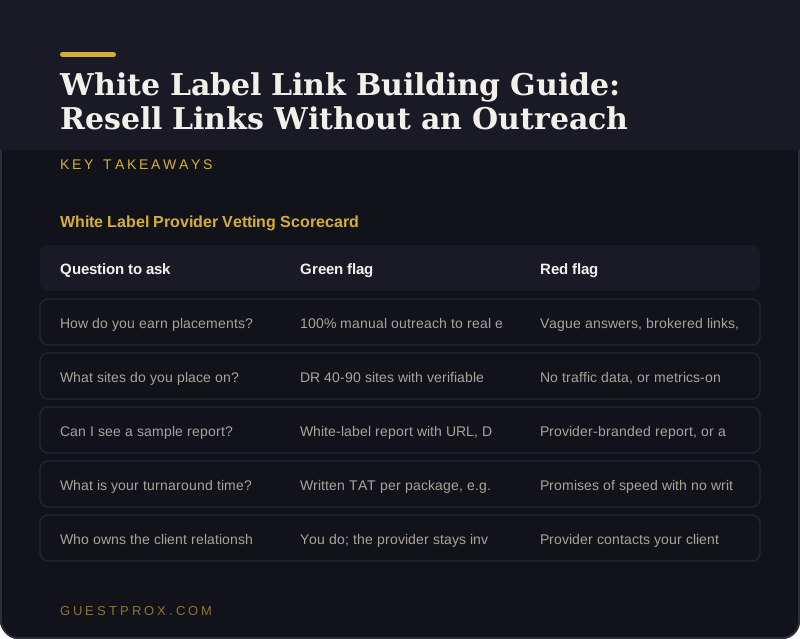
Run every prospective partner through this before you resell a single link.
| Question to ask | Green flag | Red flag |
|---|---|---|
| How do you earn placements? | 100% manual outreach to real editors | Vague answers, brokered links, or PBNs |
| What sites do you place on? | DR 40-90 sites with verifiable organic traffic | No traffic data, or metrics-only proof |
| Can I see a sample report? | White-label report with URL, DR, traffic, anchor | Provider-branded report, or a bare URL list |
| What is your turnaround time? | Written TAT per package, e.g. 15 or 20 days | Promises of speed with no written commitment |
| Who owns the client relationship? | You do; the provider stays invisible | Provider contacts your client directly |
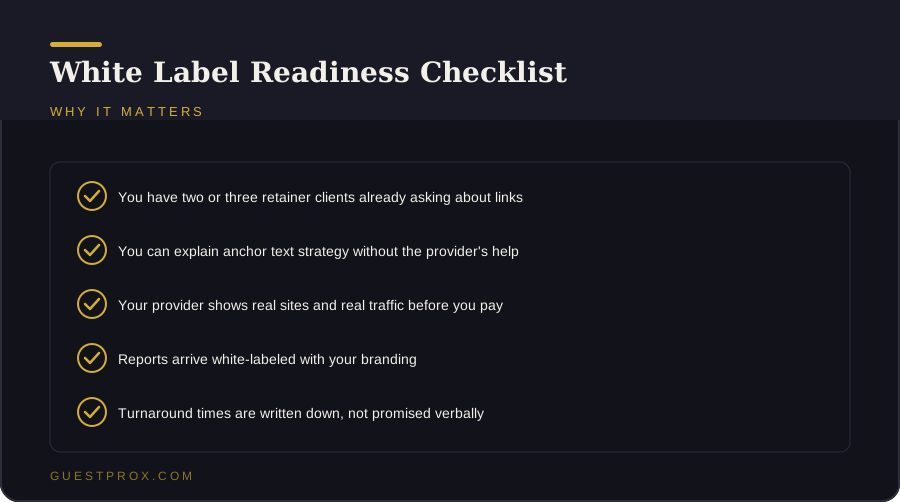
Confirm these before you add link building to your service menu.
Go deeper on the pieces that make white label work.
Authoritative sources if you want to go deeper on this topic.
Buying links usually means paying a broker for placements with no outreach, no vetting, and no accountability. White label link building is a fulfillment partnership: a specialist runs genuine manual outreach to real editors, vets every site for traffic and quality, and reports placements under your brand. The difference shows up in the report.
We don't publish rate cards. Partner pricing is quoted per project based on volume and DR targets, message us on WhatsApp at +1 (213) 582-6001 and we'll put numbers together for your clients.
Not if the partnership is set up correctly: reports arrive white-labeled, the provider never contacts your client, and all communication runs through you. Even large agencies outsource specialist fulfillment. The client pays for your strategy and accountability, and that is what they get.
Outreach and placement run on a monthly cycle, with written turnaround times like 15 days on a starter tier and 20 days on a growth tier. Ranking movement follows over the coming months as search engines recrawl the new links. Set this expectation on day one: clients who understand the timeline renew instead of churning at month two.
Yes. A good provider sends prospects for approval before pitching and confirms anchor text against your plan. You keep the strategy layer: which pages get links, which anchors, in what order. If a partner will not let you approve sites or anchors, find another partner.
Links occasionally disappear: pages get deleted, sites redesign, editors change their minds. A serious provider replaces removed placements at no extra charge. Get the replacement policy in writing before you start, and mirror it in your client agreement.
You need enough to plan anchors, choose target pages, and explain the strategy to a client; you do not need to run outreach yourself. Many successful resellers started as web designers or PPC specialists who added link building as a second service. If you can read a backlink report and explain why each link was chosen, you know enough.
See how our white label link building service works: manual outreach, DR 40-90 placements, and reports with your logo. Message us on WhatsApp +1 (213) 582-6001 or email contact@guestprox.com.
Global Service Delivery