
For agency owners deciding whether to hire an outreach team or outsource. The real numbers behind both options: no pitch, just the framework.
White label vs in house link building is a build-or-buy decision about one of the most labor-intensive parts of SEO. In-house means hiring and managing your own outreach team. White label means a specialist partner fulfills placements your agency sells under its own brand.
Agencies usually frame this as a cost question, but cost is only half of it. The other half is risk: hiring wrong, training slowly, losing your best outreacher to a competitor, and carrying payroll through months when client demand dips. This guide prices both sides honestly so you can decide with open eyes.
Short version: in-house wins when link building is your core differentiator and volume is steady. White label wins when you need flexibility, speed, and expertise without the fixed cost. Most agencies land somewhere in the middle, and the framework below shows you exactly where.
The white label vs in house link building decision is a build-or-buy choice: hire and manage your own outreach team, or partner with a specialist who fulfills placements under your agency's brand.
An outreach hire is not one salary. It is salary, benefits, tools, management time, and the months before a new hire produces. A realistic fully loaded picture for one experienced outreach specialist in the US runs well into six figures a year, and one person is not a team. You need at least two, plus someone writing content, or the pipeline stalls every time one person takes a vacation.
Then comes ramp time. Outreach is a relationship business: editors remember who pitches well and who spams. A new hire needs three to six months to build a contact list, learn which sites convert, and develop the judgment to spot a bad prospect. During those months you pay full cost for partial output.
If link building is your agency's core offer and you sell it at real volume, in-house can be the right call. You control the process end to end, build proprietary publisher relationships, and keep every point of margin. Agencies with twenty or more link-building clients and steady demand often reach the scale where the fixed cost pays for itself.
Control also matters for unusual niches. If your clients sit in heavily regulated or highly technical industries, a dedicated team that learns the niche deeply can outperform a generalist partner.
Outsourcing link building buys three things: expertise you do not have to build, capacity that flexes with demand, and speed. A partner that has delivered 1259+ placements since 2018 has already made the mistakes your new hire is about to make, on someone else's budget.
The flexibility is the underrated part. Client count moves month to month, and a partner absorbs that without hiring or layoffs. You order what you need, when you need it, and your fixed costs stay fixed.
You are adding link building to an existing offer and cannot justify a hire yet. Your demand is lumpy: five clients this quarter, twelve the next. You want to test whether link building even sells before building a department around it. In all three cases, outsourcing gets you to revenue months faster than recruiting.
You give up some control. You cannot walk over to the outreacher's desk, and you depend on the partner's quality standards holding month after month. Mitigate it with trials, sample reports, and contracts, and remember that at very high steady volume, outsourcing can cost more per link than an efficient in-house team. Know your numbers before you scale either way.
Run your agency through these four questions. Your answers point to the right option more reliably than any generic advice.
Many agencies run a small in-house core for strategy and client communication while white labeling fulfillment. You keep control of targets, anchors, and reporting; the partner handles prospecting, pitching, and writing. It is the most common setup we see, and it scales in both directions.
Start white label, build in-house later if the numbers justify it. That sequence de-risks the whole decision: you learn what good fulfillment looks like, build client demand first, and hire only when the revenue is already there. This is why so many agencies treat SEO agency fulfillment as a staged decision, not a one-time bet.
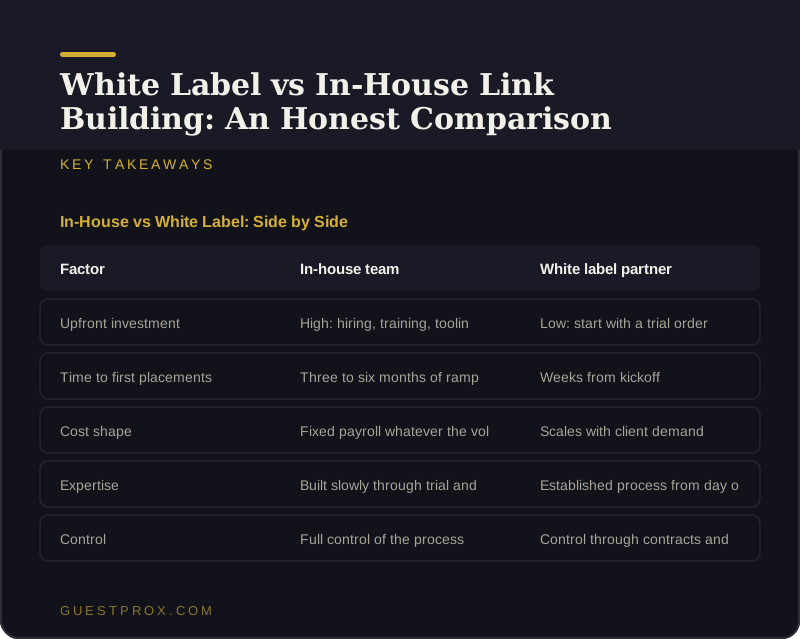
The same six factors, scored for both options.
| Factor | In-house team | White label partner |
|---|---|---|
| Upfront investment | High: hiring, training, tooling | Low: start with a trial order |
| Time to first placements | Three to six months of ramp | Weeks from kickoff |
| Cost shape | Fixed payroll whatever the volume | Scales with client demand |
| Expertise | Built slowly through trial and error | Established process from day one |
| Control | Full control of the process | Control through contracts and reviews |
| Flexibility | Hard to scale down | Scale up or down monthly |
More on the white label model and how to evaluate providers.
Authoritative sources if you want to go deeper on this topic.
Yes, and it is the most common path we see. The white label vs in house link building question is not permanent: start outsourced to build demand and learn what good fulfillment looks like, then hire when steady volume justifies the fixed cost. Your client relationships transfer smoothly because they were always yours.
It varies by market, but budget for a fully loaded annual cost well into six figures in the US once you add benefits, tools, and management time. Then multiply by at least two people, because a one-person outreach team has no redundancy. That math is the whole argument for starting with a partner.
Only if the work is bad. Clients judge the placements and the reporting, not the org chart behind them. A partner delivering real editorial links on real-traffic sites with clean unbranded reports strengthens your reputation, while one cutting corners destroys it. Vet accordingly.
Add up the fully loaded annual cost of the team you would need, then divide by the realistic monthly placements that team could produce. Compare that per-link figure against partner quotes for the same volume and DR band. Below roughly ten placements a month, outsourcing almost always wins; far above it, run the numbers carefully.
Seasonality is one of the strongest arguments for white label. Scale orders up in busy quarters and down in slow ones without hiring or layoffs. An in-house team means paying full payroll through the trough, which is where most small agencies feel the pain.
Yes, as overflow and specialization. Large agencies often keep an in-house team for core clients and white label the overflow, new verticals, or DR bands their team cannot reach. It is a capacity tool, not just a starter option.
Tell us your volume and goals and we will give you an honest read on whether white label fits, even if the answer is hire in-house. Message us on WhatsApp at +1 (213) 582-6001 or email contact@guestprox.com.
Global Service Delivery