
For agency owners evaluating fulfillment partners. Use these questions and red flags to separate real outreach teams from resellers before you sign anything.
Choosing a white label link building provider means hiring a white label team whose work you will put your agency’s name on. The links they build become your reputation, so the evaluation has to be about their process, not their pitch deck.
Most bad partnerships start with the wrong first question. Agencies ask about price and turnaround, then discover six months later that the links sit on resold placements with no traffic. Ask about process first: how they find sites, how they verify traffic, who writes the content, and what happens when a link disappears. Everything else is secondary.
Use this guide with any SEO fulfillment partner you are considering, including us. The questions below are the same ones we would want a prospect to ask.
A white label link building provider is a fulfillment partner that earns backlinks through outreach on your agency's behalf, delivering unbranded placements and reports your clients never trace back to them.

Skip the brochure questions. You want answers that reveal how the work really gets done. A provider running genuine manual outreach will answer these precisely and show evidence; a link building reseller marking up marketplace inventory will change the subject to volume.
Ask every provider the same list so you can compare answers side by side, including whether you even need a provider versus building in-house. Vague or defensive answers are themselves an answer.
When a provider sends a sample report, open the live URLs and check each site's organic traffic in your own SEO tool. Look for twelve months of steady or growing traffic from keywords that fit the niche. A site with strong DR and no traffic is a metric mirage. Links there move nothing.
The article is the product as much as the link is. Read it for original thinking, clean structure, and natural link placement. If the content reads like it was spun or commissioned purely for the link, editors and eventually Google will treat it that way. Ask who wrote it: staff writers with consistent bylines beat anonymous contractor churn.
Some warning signs are negotiable. These are not. If a provider shows any of them, walk away no matter how attractive the pitch sounds. Your clients' sites are the collateral.
Ask directly: is every placement earned through outreach to an independent site's editor? Then spot-check three live URLs from their sample. Sites with thin content, outbound links to unrelated niches, and no real author bios are usually PBN or paid-network properties. One confirmed hit means the whole inventory is suspect.
Inflated metrics are the oldest trick in this industry. A site can show DR 60 while its traffic graph is a cliff and its content is six months stale. Our publisher quality guide shows the full vetting checklist we use. Always pair any authority metric with a traffic trend you verify independently, because no traffic means no link. That rule saves more agencies than any contract clause.
Never move all your link building to a new partner on day one. A one-month, one-client trial reveals everything, it is also how we recommend starting with any white label partner: placement quality, report clarity, communication speed, and how they handle problems. It is the cheapest due diligence an agency can run.
A report you can forward to a client without editing it. Linking site, DR, verified organic traffic, live URL, anchor, target page, and placement date, in a clean unbranded layout. Raw data exports should be available for agencies that build their own dashboards. If you have to reformat the report to hide the partner, the partner is not actually white label.
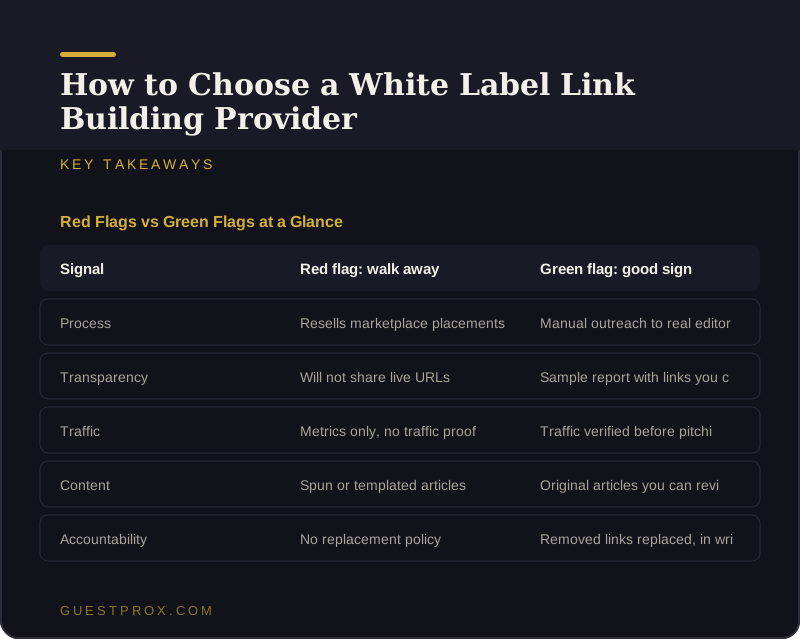
Score every provider you evaluate against the same signals.
| Signal | Red flag: walk away | Green flag: good sign |
|---|---|---|
| Process | Resells marketplace placements | Manual outreach to real editors |
| Transparency | Will not share live URLs | Sample report with links you can open |
| Traffic | Metrics only, no traffic proof | Traffic verified before pitching |
| Content | Spun or templated articles | Original articles you can review first |
| Accountability | No replacement policy | Removed links replaced, in writing |
| Branding | Their logo on your reports | Fully unbranded, client-ready reports |
Before handing over a monthly retainer, run one small paid trial: three to five placements on domains you approve in advance. Give the provider your niche, your minimum traffic bar, and two or three sample targets so they know exactly what good looks like. A confident provider welcomes the test; a weak one pushes for a large upfront commitment instead.
When the trial links land, check each one against the same backlink quality checklist you would use for your own clients: real organic traffic, topical relevance, natural placement inside the article body, and honest anchor text. Then ask for the full report, domains pitched, replies received, and placements secured. If the report is vague or the domains miss your bar, you have your answer before spending real money. For agencies comparing options, our white label vs in-house breakdown helps frame what the trial should cost you in time versus outsourcing it.
More on the white label model, from partnership mechanics to the in-house debate.
Authoritative sources if you want to go deeper on this topic.
One month on one real client is enough to judge placement quality, report clarity, and responsiveness. Anything shorter does not produce enough placements to evaluate. Anything longer, and you are committed before you have decided.
We don't publish prices. Message us on WhatsApp at +1 (213) 582-6001 for a quote scoped to your volume and DR targets. When comparing providers, weigh placement quality and reporting far above headline rates: cheap links on dead sites are the most expensive links you will ever buy.
That is your call, and honest agencies land on both sides. Some describe an in-house fulfillment team; others are open about specialist partners. Either way, you remain accountable for the work, so choose a partner whose placements you can defend in daylight.
A marketplace sells you access to site owners who accept paid posts; you do the vetting, outreach, and quality control yourself. A real provider does all of that for you through manual outreach and hands over finished placements with reports. If a provider's inventory looks identical to a marketplace's, it probably is one.
That risk comes from manipulative tactics: PBNs, paid networks, and spun content at scale. A provider doing 100% manual outreach to real editors on real-traffic sites, with no PBNs, keeps you on the safe side of Google's guidelines. Verify the process, not just the promise.
Yes, and that is the entire point of the trial. Keep your client data, anchors, and reporting in your own systems during the test so switching costs you nothing. A provider worth keeping will make the trial feel effortless; one that is not will show you in the first month.
Send us one client's brief and judge the work on its own merits. Message us on WhatsApp at +1 (213) 582-6001 or email contact@guestprox.com.
Global Service Delivery