
For SEO managers who know placement matters and agencies whose clients check the details, we earn in-content links on real DR 40-90 sites, never bios, sidebars, or footers.
Contextual link building earns backlinks placed inside the body of relevant articles, surrounded by text about your topic. Search engines read the words around a link to decide what the link means. A link inside relevant content passes topical authority. A link in a footer passes almost nothing.
Placement anatomy is where most campaigns quietly fail. Same DR, same niche, but one link sits in the third paragraph of a 2,000-word guide and the other sits in an author bio. The first can move rankings. The second is decoration.
We engineer the context, not just the link. Our team negotiates body placement, checks the surrounding copy for relevance, and plans anchor text across the campaign. Every placement goes through a seven-point QA check before it ships, the same standard behind our guest post placements.
A link is only as good as the hundred words around it.
A contextual link sits inside the article body, surrounded by relevant text, and search engines treat it as a genuine reference, not decoration.

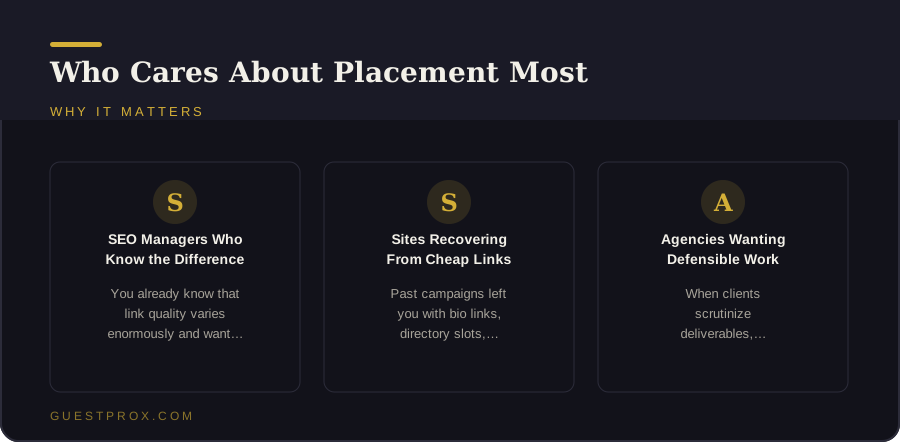
Everyone should. These buyers already do.
You already know that link quality varies enormously and want a partner who sweats the details: surrounding relevance, anchor fit, editorial context. That is literally all we do here.
Past campaigns left you with bio links, directory slots, and footer spam. We rebuild the profile with in-content placements that shift the ratio toward links Google actually respects.
When clients scrutinize deliverables, placement quality is what they check. In-content links on real sites are the easiest line items to defend in any client review.
For money keywords, marginal links do not move the needle. Contextual placements on authoritative, relevant pages deliver the strongest per-link signal you can earn legitimately.
Contextual is a placement standard, not a marketing word. We enforce it like one.
Six stages. The context is engineered; the naturalness is real.
We map each target page to the topics that should surround its links. The surrounding text shapes how Google interprets the link, so this mapping happens before any prospecting begins.
We find publishers covering your topics with genuine traffic and editorial standards. A site can have strong metrics and still be wrong for you if its content never touches your subject matter.
Each prospect is scored on topical fit: does this publication naturally discuss what your page is about? Weak-fit sites are cut no matter how attractive their metrics look.
Personal pitches to editors, proposing article angles where your link belongs organically. Because we pitch relevance first, editors say yes to the topic, the link placement follows from that.
Our writers build the article section around your link so the reference feels inevitable: the right sentence, the right anchor, the right surrounding explanation. Readers should never sense the SEO.
We verify the link sits in the article body, the anchor matches the plan, the page is indexed, and the surrounding text stayed intact. Reports show the placement in context, agencies get them white-labeled.
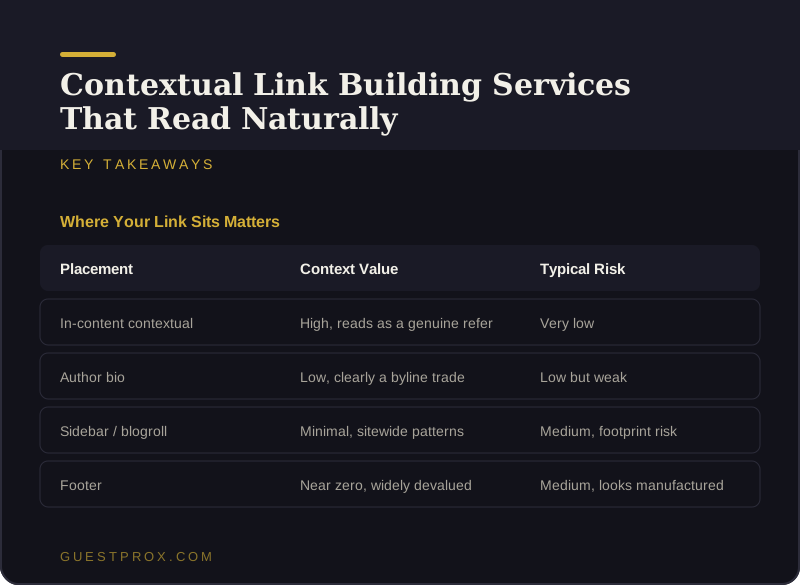
We only sell the first row. The rest exist so you know what to avoid.
| Placement | Context Value | Typical Risk |
|---|---|---|
| In-content contextual | High, reads as a genuine reference | Very low |
| Author bio | Low, clearly a byline trade | Low but weak |
| Sidebar / blogroll | Minimal, sitewide patterns | Medium, footprint risk |
| Footer | Near zero, widely devalued | Medium, looks manufactured |
Before any contextual placement counts in our reporting, it passes seven checks. Here are the three that filter out the most bad placements.
In-content or nothing. Sidebar and footer links are discounted by every modern algorithm, and bio links are marginally better. We negotiate body placement on every order or we do not take the order.
The 100 words around your link should read like they belong on your site. We check topical overlap before approving, because a relevant paragraph multiplies the link's value and an irrelevant one divides it. This is item one on our quality checklist.
A page linking to 40 other sites splits its authority 40 ways. We check how many outbound links share the page and prefer pages where yours is one of few. When an existing article fits perfectly, a niche edit can be the most efficient contextual win available.
Placement quality touches every tactic. These go deepest.
Authoritative sources if you want to go deeper on this topic.
A contextual backlink sits inside the body of an article, surrounded by text relevant to the linked page. Search engines treat it as an editorial reference, the author vouching for the linked content, which is why it carries more weight than bio, sidebar, or footer links.
Because of diminishing returns and footprint risk. Fifty bio links look like a campaign; five contextual links look like recognition. Google discounts patterns, so a smaller number of well-placed links routinely outperforms bulk placements of weaker positions.
We don't publish prices. Every campaign is scoped to your targets and competition, so the fastest way to get an exact number is to message us on WhatsApp at +1 (213) 582-6001.
First placements typically land within weeks, with ranking impact in the usual 4 to 12 week window. Because contextual links carry strong per-link weight, competitive pages often move on fewer placements than buyers expect.
For guest posts, yes, we write the section around your link, so the surrounding text is part of the deliverable. For niche edits into existing articles, we negotiate placement and anchor with the site owner within the article's existing flow.
Yes. Contextual links mimic how natural referencing works, an author linking because the content helps readers, which makes them the hardest placement type to penalize and the most resilient through updates.
Tell us your target pages. We will plan the contexts their links should live in.
Global Service Delivery