
For local businesses, multi-location brands, and the agencies serving them. Learn how to audit, build, and maintain citations that keep your name, address, and phone number accurate across the web.
A local citation building guide teaches you how to get your business name, address, and phone number, your NAP, listed accurately across directories, maps, and review sites. A citation is any mention of that NAP data on a third-party site, with or without a link back to you. Search engines cross-reference these mentions to confirm your business exists and sits where you say it does.
Citations do two jobs at once. They feed the data behind local search results, including the map pack, and they put your details in front of people who browse directories directly. Consistent citations rarely win rankings on their own, but inconsistent NAP data actively drags them down. For multi-location businesses, citation drift between locations is one of the most common local SEO problems we see.
This guide walks through the citation types that matter, which platforms deserve your effort, a repeatable audit workflow, and a cleanup process for duplicates and wrong addresses. It is written for in-house marketers, freelancers, and agencies doing the work by hand.
A citation is any online mention of your business name, address, and phone number. When every mention matches, search engines trust that your business is real and located where you claim.

Structured citations live inside directory fields built for business data: name, address, phone, hours, category. Google Business Profile, Yelp, Bing Places, and Apple Maps are the obvious examples, along with industry directories like Avvo for lawyers or Angi for home services. Because the data sits in labeled fields, search engines read it with high confidence.
Unstructured citations hide inside ordinary prose. A newspaper article that names your street address, a blog post that prints your phone number, an event page that lists your venue. Search engines still extract the NAP facts, but with lower confidence than fielded data. The upside is that unstructured mentions often arrive free alongside local PR, sponsorships, and community involvement.
A handful of data aggregators license business listings to hundreds of smaller directories. Neustar Localeze, Data Axle, Foursquare, and Factual are the names you will see most often in the US. Fix your listing at the aggregator level and the correction ripples downstream without you touching each directory. Skip this step and you will keep finding zombie listings with your old address for years.
Decide one canonical format and never deviate. Same abbreviation for street versus St., same suite formatting, same phone number written the same way every time. Most citation errors are not typos. They are three slightly different correct-looking versions of the same address competing with each other.
Structured NAP citations carry more weight because machines parse them reliably. When time is limited, fill the structured fields first and let unstructured mentions accumulate naturally. A single correct Google Business Profile does more than fifty thin directory submissions.
Audit before you build. Adding new citations on top of a messy footprint just gives search engines more conflicting data to reconcile. Every local citation building guide should start with the audit, not the submission. A proper audit maps every existing mention of your business, flags conflicts, and produces a single source of truth you can work from, because most failed citation projects skip this step and spend months building on a broken foundation.
Write down the exact business name, street address, and phone number you want everywhere. Put it in a shared sheet if a team or agency touches your listings. Every future citation gets copied from this sheet, never typed from memory.
Search your business name, phone number, and street address in Google, each as a separate quoted query. Check the major platforms and aggregators directly. Note every listing, even wrong ones, in one tracker with its URL, the NAP shown, and its status.
Fix aggregators and your Google Business Profile first, since errors there spread. Remove or merge duplicates second, because two listings for one location split your authority. Correct wrong categories and hours third. Leave low-traffic directories with correct data alone.
Most local citations guide advice tells you to submit to every directory on a long list. Work the tiers instead. Core maps and aggregators first, then the industry directories your customers actually use, then local and neighborhood sites. Stop when new listings add no new audience, because thin citations on dead directories are maintenance debt.
Cleanup is where citation building earns its keep. New listings take an afternoon. Untangling years of duplicates, old addresses, and tracking numbers takes a system. Work through the problems below in order and re-audit on a schedule, budgeting more time for cleanup than for building: the mess is always bigger than it looks from the outside.
Duplicate listings split reviews, confuse customers, and dilute signals. On Google Business Profile, report the duplicate and request a merge rather than leaving both live. On directories, claim the listing and request removal or consolidation through their support flow. Never create a third listing to outrank a duplicate.
An old address keeps circulating through aggregators long after you move. Update the aggregators first, then the core platforms, then work down the tiers. Keep the old phone number forwarding for a year if customers still call it, but remove it from every public listing.
Tracking numbers break NAP consistency the moment they appear in citations. If you need call attribution, use dynamic number swapping on your own website and keep one real local number in every external listing. One number everywhere is a rule worth keeping.
Citations decay. Directories merge, scrape each other, and invent listings from old data. Re-audit quarterly for single locations and monthly for multi-location brands. A fifteen-minute check of your top ten listings catches most drift before it costs you.
One location is a checklist. Ten locations is a system, and fifty is a system with governance. Multi-location citation work fails when each location improvises its NAP, so the first deliverable is a master sheet: one row per location, one canonical NAP per row, owned by one person.
New locations get added to the sheet before a single listing is built. Closed locations get marked closed in the sheet first, then closed on every platform. The sheet is the source of truth; every listing is a copy of it. This discipline is the core of professional local citation building for brands with more than a handful of sites.
Franchises add one wrinkle: franchisees who build their own listings with improvised formats. Solve it with a one-page NAP standard and a quarterly audit, not with arguments. The primer on what local citations are is a useful document to share with franchisees who need the why behind the rules.
Citations are table stakes, not a ranking weapon. Consistent NAP data confirms your business exists and sits where you claim, which is a prerequisite for map pack visibility. But once your citations are clean, building more of them does not push you higher. The businesses that outrank you usually win on reviews, proximity, and behavioral signals, not on citation count.
Set expectations accordingly with stakeholders. Citations are infrastructure: invisible when working, damaging when broken. Nobody celebrates the plumbing, but everyone notices the flood. The comparison of citations versus local backlinks draws the line precisely: citations confirm you exist, links prove you matter.
Industry studies consistently rank citation consistency as a foundational factor: necessary, but with diminishing returns past the core platforms. A business with fifty clean citations does not outrank one with two hundred on citations alone. The gap is almost always reviews and review velocity, primary category accuracy, and proximity to the searcher.
That means the effort question has a clear answer: audit and clean first, because dirty data actively hurts, then stop at the tiers that matter. Work spent beyond that buys maintenance debt, not rankings. Pair clean citations with local link building and review generation, which is where the actual movement comes from.
Generic directories get you listed. Industry directories get you customers. A potential client searching within your vertical trusts the industry source more, and search engines read the topical relevance too. Build the vertical sources before the general ones.
Each vertical has its own audit quirks. Healthcare practices battle provider listings that outlive employment; law firms fight bar-directory formatting rules; home service companies inherit listings from previous owners of the phone number. Our legal niche page details the link and citation patterns we see most often for law firms, and the same vertical-first thinking applies everywhere.
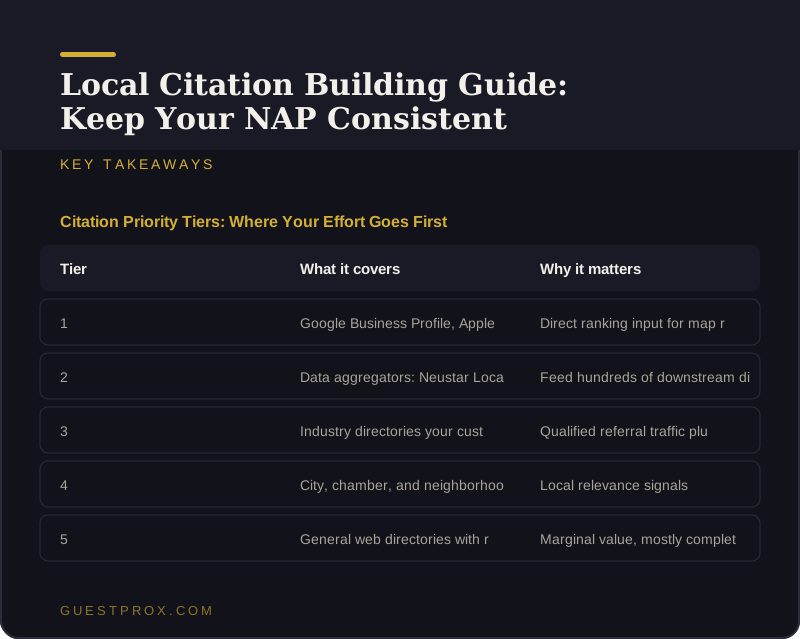
Work top to bottom. Most businesses can stop at tier three.
| Tier | What it covers | Why it matters | Effort |
|---|---|---|---|
| 1 | Google Business Profile, Apple Maps, Bing Places | Direct ranking input for map results | High, one-time setup |
| 2 | Data aggregators: Neustar Localeze, Data Axle, Foursquare, Factual | Feed hundreds of downstream directories | Medium, then mostly maintenance |
| 3 | Industry directories your customers use, e.g. Avvo, Angi, Healthgrades | Qualified referral traffic plus relevance | Medium, ongoing |
| 4 | City, chamber, and neighborhood directories | Local relevance signals | Low to medium |
| 5 | General web directories with real traffic | Marginal value, mostly completeness | Low, and stop here |
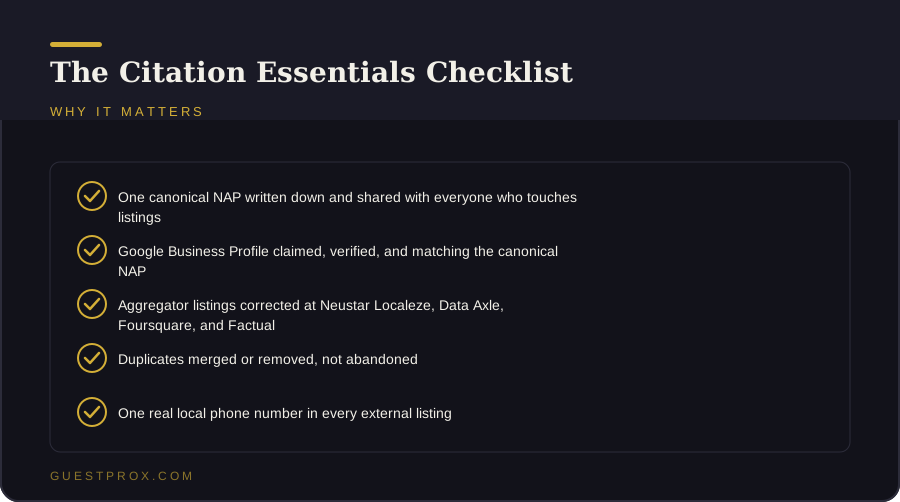
Run through this list before you call any citation profile finished.
More guides and services for local visibility.
Authoritative sources if you want to go deeper on this topic.
There is no magic number, and anyone selling you 500 directory submissions is selling busywork. What matters is complete, consistent coverage across the tiers that count: your core map profiles, the major aggregators, the industry directories your customers use, and reputable local sites. For most single-location businesses, thirty to fifty accurate listings beat three hundred thin ones. Multi-location brands need that same coverage per location.
Yes, but mostly as a trust and consistency layer rather than a ranking lever you can crank. Correct, consistent citations support your map pack visibility, while conflicting NAP data across the web can hold you back. Think of citations as hygiene: their absence or inconsistency hurts you, but piling on more of them has diminishing returns once coverage is complete.
No. A different phone number on different listings breaks the exact NAP match search engines look for. Keep one real local number in every external citation. If you need call attribution, use dynamic number insertion on your own website, which shows tracking numbers to visitors without changing what search engines see in your listings.
A single-location audit and cleanup typically takes two to four weeks, because aggregator corrections and duplicate merges go through review queues you cannot rush. Multi-location cleanups scale with the number of locations and the messiness of the existing footprint. After cleanup, budget a short re-audit each quarter, since directories re-scrape and reintroduce errors over time.
A citation is a mention of your business name, address, and phone number, with or without a link. A backlink is a clickable link from another site to yours. Citations build location trust, while backlinks build page authority. Local businesses need both, which is why citation work and local link building are usually run as parallel tracks.
You can, and for one location the work is straightforward if tedious: lock your NAP, audit, fix, and build in tiers. It becomes worth outsourcing when you have multiple locations, a messy history of duplicates and moves, or no one on staff who will actually do the quarterly re-audits. That is exactly the point where manual, careful work beats a cheap automated blast.
Buying bulk directory submissions usually means automated listings on low-quality directories, inconsistent NAP formatting, and no cleanup of what already exists. Real citation work is manual: auditing what is out there, fixing aggregators, merging duplicates, and submitting to directories with genuine traffic. The first creates maintenance debt. The second creates a stable foundation.
Our local citation building service covers the full audit, aggregator corrections, duplicate cleanup, and ongoing NAP consistency. Tell us about your locations and we will map out the work.
Global Service Delivery