
For local business owners and marketers hearing the word citations for the first time. What they are, why Google cares, and what consistent ones look like.
Local citations are online mentions of your business’s name, address, and phone number, usually called NAP, the foundation our local citation guide builds on. Every time your business appears with those details on Yelp, Google Business Profile, Apple Maps, or an industry directory, that is a citation.
Think of citations as votes of confidence in your business's basic facts. When dozens of trusted sites agree on where you are and how to reach you, Google trusts your location data enough to show you in the map pack. When they disagree, Google hedges, and your competitors take your spot.
Citations come in two flavors. Structured citations are formal listings on directories with dedicated business profiles. Unstructured citations are casual mentions: your business named in a local news article, a blog post, or a chamber of commerce page, with some or all of your NAP details attached.
A local citation is any online mention of a business's name, address, and phone number. The consistent repetition of that information across trusted sites helps Google verify the business is real and located where it claims.
Structured citations live on platforms built for business listings: Google Business Profile, Yelp, Bing Places, Apple Maps, Facebook, and industry directories like Avvo for lawyers or Healthgrades for clinics. Each one gives you fields for name, address, phone, hours, categories, and photos. These carry the most weight because their entire purpose is accurate business data.
Unstructured citations appear in the wild: a newspaper article about your grand opening, a blog's best-of roundup for your city, a sponsorship listing on a little league site. They rarely include your full NAP, but they reinforce your local presence with context Google can read.
Structured first, always. They are the citations Google explicitly checks when verifying your location, and you control them directly, which is why local citation building starts with structured listings. Unstructured citations are a valuable bonus layer, but no substitute for a clean set of core listings.
NAP consistency means your name, address, and phone number appear identically everywhere. Not nearly identically: identically. 123 Main St on one site and 123 Main Street on another is a discrepancy, and so is a tracked call number that differs from your real one.
Google cross-references your citations the way a bank cross-references your ID. Every mismatch is a small reason to doubt the data, and map pack rankings run on trust in that data. Businesses with clean, consistent NAP citations routinely outrank competitors with stronger reviews but messier listings.
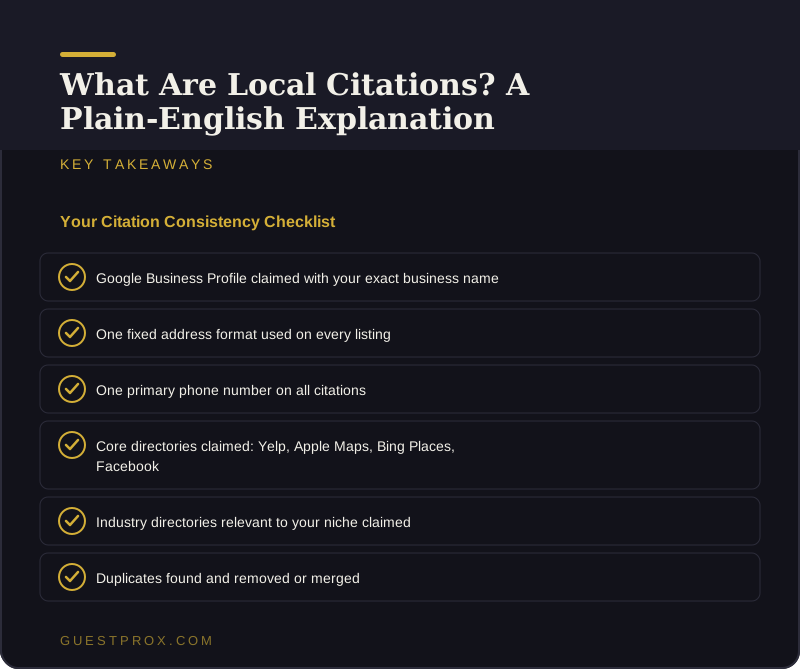
Pick one exact business name and use it everywhere, with no keyword stuffing and no location modifiers that are not part of your legal name. Write your address in one fixed format, including suite numbers and abbreviations. Use one primary phone number across all listings; call tracking numbers belong on your website and ads, not your citations.
A dental clinic lists itself as Bright Smile Dental on Google, Bright Smile Dental LLC on Yelp, and BrightSmile Dental on Facebook, with two different phone numbers across the three. To Google, those look like three semi-related businesses, and the listing authority splits three ways. One name, one format, one number. That is the whole game.
Citations are one leg of the local SEO stool, alongside your Google Business Profile, reviews, and local links. They rarely win rankings alone, but they are the foundation the rest stands on. Without consistent citations, your profile optimization, review velocity, and local content all work harder for less.
The good news is that citation work is finite. Unlike content or links, you can reach a state of done: a clean, consistent footprint across the directories that matter, maintained with occasional audits. For most local businesses, that baseline takes weeks, not months. That is why citation building is usually the first local SEO task worth finishing completely.
A backlink is a link from another site to yours that passes authority. A citation is a mention of your business details that may or may not include a link, the full comparison is in citations vs backlinks. Many citations include links, but Google values citations for data consistency, not link equity. You need both, and they do different jobs.
Run any business through these six checks in under an hour.
From explanation to execution: building and cleaning up citations.
Authoritative sources if you want to go deeper on this topic.
Yes. They are a foundational trust signal, not a ranking trick. Google uses citation consistency to verify your business is real and located where it claims, which is a prerequisite for map pack visibility. They will not single-handedly outrank a competitor, but inconsistent citations will absolutely hold you back.
Quality beats quantity. Forty to fifty consistent citations across core platforms and industry directories outperform two hundred sloppy ones. Cover tier-one platforms first, then your industry directories, then general directories. After that, each additional citation has diminishing returns.
A backlink is a hyperlink from another site to yours that passes ranking authority. A citation is a mention of your business's name, address, and phone number, with or without a link. Citations prove where you are; backlinks prove you are worth trusting. Local SEO needs both.
We don't publish prices. Message us on WhatsApp at +1 (213) 582-6001 for a quote based on how many locations you have and the state of your current listings. Cleanup-heavy projects scope differently from fresh builds, so an audit comes first.
Yes, if you have the time and discipline. Claim the core directories, follow the consistency rules in this guide, and log everything in a spreadsheet. Most owners start strong and stall at listing twenty. If that sounds like you, handing the repetitive work to a specialist is the pragmatic move.
Then you have a cleanup project, not just a building project. Old addresses and numbers live on in aggregator databases for years, feeding fresh duplicates. Update the big four aggregators first, then work through your listing spreadsheet correcting each one. This is the single most common source of citation messes we see.
We audit, clean up, and build consistent citations across the directories that matter. Message us on WhatsApp at +1 (213) 582-6001 or email contact@guestprox.com.
Global Service Delivery