
A clear-headed comparison for business owners and SEOs: what citations and backlinks each do, when one is enough, and where the confusion comes from.
A citation is a mention of your business name, address, and phone number on another website. A backlink is a clickable link from another website to yours. Citations prove you exist; backlinks prove you are worth ranking.
The confusion exists because both live under local SEO and both appear in every audit checklist. But they do different jobs. Citations feed Google's knowledge graph and confirm consistency. Backlinks feed authority algorithms and move rankings. Mixing them up leads businesses to buy five hundred directory listings and wonder why the map pack never budged.
This guide breaks down exactly what each one is, what it does for rankings, when citations alone are enough, and when you need to start earning links. If you remember nothing else: clean your citations once, then spend your ongoing effort on links.
A citation is a mention of your business name, address, and phone number; a backlink is a clickable link from another site to yours. Citations prove you exist, backlinks prove you are worth ranking.
Every citation repeats your name, address, and phone number, the NAP. Google cross-references these mentions across the web to confirm your business is real and located where you claim. Consistent NAP builds confidence in your listing; inconsistent NAP, an old suite number here, a tracking phone number there, quietly erodes it.
This is entity confirmation, not authority building. A citation does not pass meaningful link equity in most cases. It tells Google you are who you say you are, which is necessary but not sufficient for ranking.
Most guides call these local SEO citations, and the job is the same everywhere: keep the data identical.
Citations live on directories like Yelp and Yellow Pages, data aggregators that feed hundreds of smaller directories, and industry-specific listing sites. Some are structured, with dedicated fields for NAP. Others are unstructured, a mention inside a blog post or news article that names your business without linking.
The aggregators matter most because they distribute your data downstream. Fix your information at the aggregator level and dozens of downstream listings correct themselves. Fix them one by one and you will be auditing forever.
A backlink passes authority from the linking site to yours, and when the linking site is local, it passes geographic relevance too. A link from your city’s newspaper tells Google two things at once: this business is trusted, and it is trusted here. That combination is exactly what the local algorithm rewards.
This is why one link from a respected local publication can outweigh a hundred directory citations. Citations confirm; links persuade.
In low-competition categories, clean citations and a complete Google Business Profile can be enough to rank. But the moment real competitors enter, the map pack sorts by authority, and authority comes from links. Study any competitive local SERP and the pattern holds: the top three map listings almost always have the strongest local link profiles.
Links are also harder to fake at scale, which is why Google trusts them. Anyone can submit to directories. Earning a link from a local journalist or chamber takes a real business doing real things.
A brand-new business in a low-competition town can rank on citations and a solid Google Business Profile alone. If nobody in your category is actively building links, consistency plus relevance wins by default. The same applies to hyper-niche services where search volume barely supports one page of results.
The moment you are stuck on page two of local results with clean citations, or competitors with worse reviews outrank you, the gap is links. Competitive categories like plumbing, legal, and dental are link contests wearing a local costume.
That is where structured local link building comes in: chambers, sponsorships, local press, and supplier links earned month after month. Citations got you in the game; links decide whether you win it.
You do not need software to get a working read on both halves. This quick audit tells you whether citations or links are your bottleneck before you spend anything.
Search your exact business name plus your city and open the first two pages of results. Every directory, aggregator, and profile that appears should show identical name, address, and phone details. Note every mismatch in a simple sheet: wrong suite numbers, old phone numbers, and duplicate listings are the usual offenders. If you find more than a handful of errors, citations are leaking trust and fixing them is your first job.
Now search your main service plus your city and open the three competitors ranking above you. You cannot see their full link profiles without tools, but you can spot the pattern: check their sites for press mentions, sponsor pages, and partner logos, then compare against your own. If competitors show local press and community links you lack, links are your bottleneck and citations alone will never close it. That twenty-minute comparison is the same triage we run before scoping any local campaign.
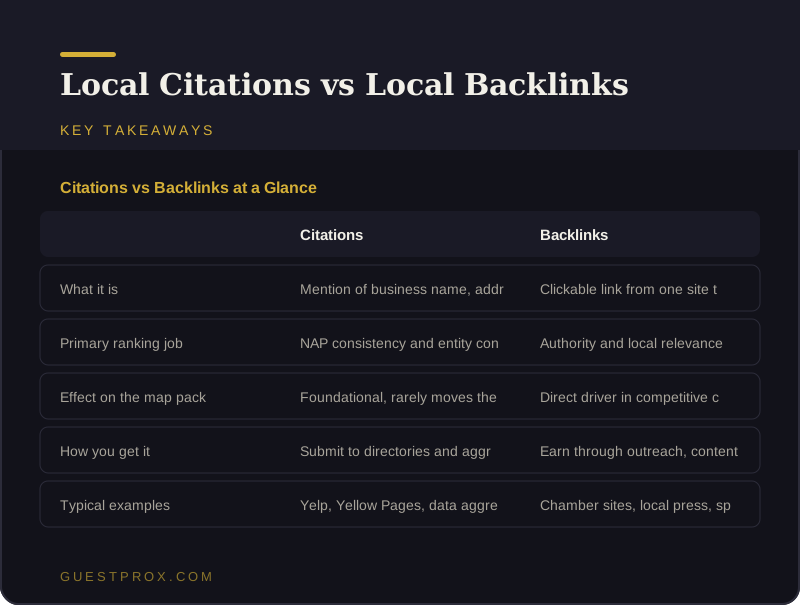
The full comparison in one view: purpose, ranking effect, and how you earn each.
| Citations | Backlinks | |
|---|---|---|
| What it is | Mention of business name, address, phone | Clickable link from one site to yours |
| Primary ranking job | NAP consistency and entity confirmation | Authority and local relevance |
| Effect on the map pack | Foundational, rarely moves the needle alone | Direct driver in competitive categories |
| How you get it | Submit to directories and aggregators | Earn through outreach, content, relationships |
| Typical examples | Yelp, Yellow Pages, data aggregators | Chamber sites, local press, sponsor pages |
| Ongoing effort | Audit twice a year | Steady monthly outreach |
The companion pieces on citations and local links.
Authoritative sources if you want to go deeper on this topic.
Yes, as a foundation. Consistent citations remain how Google confirms your business details, and messy NAP data still suppresses visibility. But citations are table stakes now, not a differentiator. Nobody wins a competitive local market on citations alone anymore.
Citations are low-risk by nature: submitting accurate business information to real directories is standard practice. Links are where risk lives. Paying for placements on link farms or private blog networks can trigger penalties. Manual outreach to real local sites, which is all GuestProx does, carries none of that risk because the links are editorial and earned.
They will help less than they should. Inconsistent citations create entity confusion that drags down everything else, including the value of new links. Fix NAP consistency first, it is an afternoon of work, then every link you earn lands on a clean foundation.
Yes, and this is a common source of confusion. A Yelp profile is a citation because it lists your NAP; if that profile also links to your website, it is simultaneously a backlink, usually nofollowed and weak. The citation value is the consistency, the link value is minor. Real link building targets links from pages that exist to publish content, not directories.
We don't publish prices. Message us on WhatsApp at +1 (213) 582-6001 for a quote.
Audit in order. First check NAP consistency across the major directories and aggregators; if it is messy, you need citation work. If citations are clean and you are still stuck behind competitors, pull their backlink profiles. When they have real local links and you do not, that gap is your answer.
From citation cleanup to manual local outreach on real sites, we cover the full local picture. Message us on WhatsApp at +1 (213) 582-6001 or use the contact form and we will map out a plan.
Global Service Delivery