
Every site accumulates links it never asked for. Here is how to review yours systematically, judge what is helping or hurting, and turn the findings into a plan.
A backlink audit is a systematic review of every link pointing to your site, judging each one for quality, relevance, and risk. It answers a simple question with a not-so-simple process: which of these links are helping, which are dead weight, and which might be hurting.
Most sites accumulate links they never asked for. Old directory submissions, scraper sites, forum signatures from a decade ago, a previous agency's shortcuts. Individually they are noise. In aggregate they shape how Google reads your site's trustworthiness, and they quietly distort every new campaign you run.
An audit gives you a clean baseline. This post walks through pulling your link data, judging quality link by link, deciding what to do about the bad ones, and turning the findings into a forward plan.
A backlink audit is a systematic review of every link pointing to your site, judging each one for quality, relevance, and risk.
You cannot judge what you cannot see. Start by assembling the full picture.
Pull backlinks from Google Search Console, which is free and authoritative but limited, plus at least one dedicated tool like Ahrefs or Semrush for depth. Each source misses things the others catch. Merge them, deduplicate by linking domain and page, and you have your working set.
Sort linking domains by organic traffic first, then by authority metrics. High-traffic referrers deserve individual review. Long-tail domains with no traffic and no relevance can be judged in bulk. This triage keeps a 10,000-link audit from becoming a month of busywork.
Keep a simple log: domain, target page, anchor, traffic, relevance, verdict. Future you will thank present you. An audit you cannot revisit is a one-time exercise instead of a living baseline for every future campaign.
Four checks separate links worth keeping from links worth acting on.
Does the linking site operate in your world? A plumbing supplier linking to a plumber is relevance. A casino blog linking to a plumber is a question mark. Irrelevant links are not automatically toxic, but they contribute nothing and dilute the topical clarity of your profile.
Does the linking domain get real organic visitors? Traffic is the hardest metric to fake and the strongest single indicator of a legitimate site. Links from zero-traffic domains deserve skepticism, especially in batches with similar patterns.
Where does the link sit? Editorial links inside relevant content are the gold standard. Footer links, sidebar links, author-bio-only links, and links on pages with hundreds of outbound links carry less weight and sometimes signal low-quality schemes.
Look at groups, not just individuals. Dozens of links with identical anchors, from sites with similar templates, appearing in the same week, point to manufactured link building. Patterns are what you act on; single odd links are usually just noise.
Finding bad links is only half the audit. The other half is responding proportionally.
Most low-quality links can be ignored. Google is good at discounting obvious junk without your help, and overreacting to every odd link wastes effort better spent building good ones. Act on clear patterns, not isolated curiosities.
For links you control or can influence, contact the site owner and ask for removal or a nofollow attribute. It works more often than people expect for directory and partnership links. Document the attempts; the paper trail matters if issues escalate.
The disavow tool tells Google to ignore specific links. Reserve it for clear manufactured patterns or the aftermath of a penalty: large-scale spam, hacked links, or a previous provider's PBN work. It is a scalpel, not a routine maintenance tool, and careless disavows can discard links that were actually helping.
An audit that ends in a spreadsheet is a missed opportunity. The findings should directly shape what you build next.
Compare your profile against two or three sites outranking you. The domains linking to them but not you are your highest-probability outreach targets. An audit plus a gap analysis is the closest thing link building has to a roadmap.
Audits almost always reveal anchor skew: too much exact match from an old campaign, or a branded base that never grew. Feed the findings into your anchor plan so the next batch of links corrects the profile instead of amplifying its flaws.
Write down what a keep-worthy link looks like for your site: relevance, traffic thresholds, placement standards. Every future placement gets judged against it. That single habit prevents most of the junk a future audit would find.
An audit decays the moment it is finished. Set a reminder for six to twelve months out, and re-run the core checks quarterly on your highest-value pages. Profiles drift as new links arrive, and regular check-ins keep small problems small.
If an agency or freelancer builds your links, share the audit baseline and the quality bar with them before work starts. Aligned expectations prevent most disputes about what counts as a good link, and the audit gives both sides a common language for the campaign.
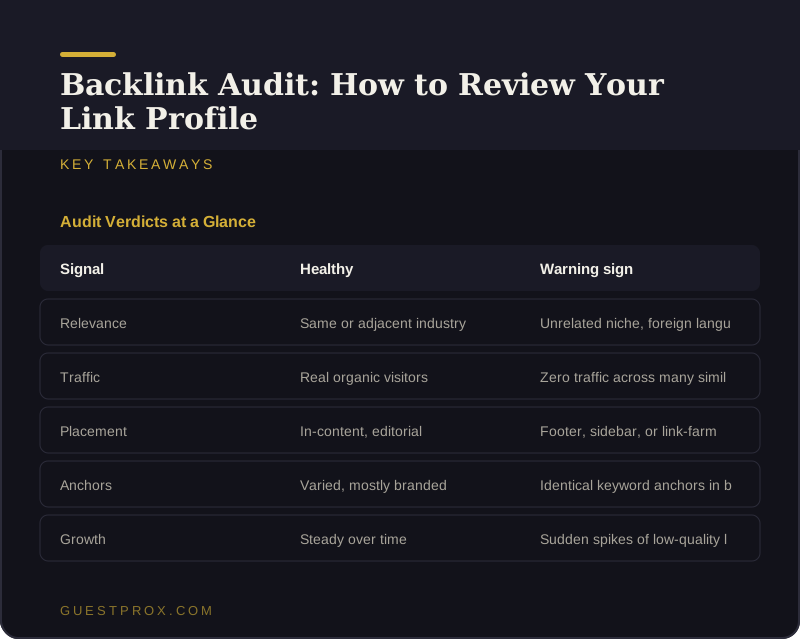
How to read each signal when judging a link.
| Signal | Healthy | Warning sign |
|---|---|---|
| Relevance | Same or adjacent industry | Unrelated niche, foreign language spam |
| Traffic | Real organic visitors | Zero traffic across many similar domains |
| Placement | In-content, editorial | Footer, sidebar, or link-farm pages |
| Anchors | Varied, mostly branded | Identical keyword anchors in bulk |
| Growth | Steady over time | Sudden spikes of low-quality links |
More on evaluating and planning links.
Authoritative sources if you want to go deeper on this topic.
A systematic review of all links pointing to your site, judging each for quality, relevance, and risk. The output is a clean baseline: which links help, which are neutral, and which patterns need action, plus a plan for what to build next.
At least once a year, and before any serious new link building campaign. Also audit after switching providers, after a traffic drop you cannot otherwise explain, or when inheriting a site with unknown history. Regular audits catch manufactured patterns before they compound.
Links from irrelevant, zero-traffic domains, especially in bulk with identical anchors or templates. Hacked or injected links. Large-scale directory and footer link schemes. Single odd links are usually noise; it is the patterns that warrant action.
It tells Google to ignore specific links when assessing your site. It is a last resort for clear manufactured patterns or penalty recovery, not routine maintenance. Most low-quality links are simply discounted by Google on their own and do not need disavowing.
Start with Search Console plus one dedicated tool like Ahrefs or Semrush, since each misses links the others catch. Merge, deduplicate by domain, sort by referring traffic, and judge the high-impact domains individually while triaging the long tail in bulk.
We do not publish prices. Message us on WhatsApp at +1 (213) 582-6001 for a quote based on your site's size and history.
We start every engagement by understanding your current profile. Message us on WhatsApp at +1 (213) 582-6001 or send a message through the form.
Global Service Delivery