
Your competitors already did the prospecting. Here is how to map their link profiles, find the gaps, and turn them into outreach targets.
Competitor backlink analysis is the process of mapping who links to the sites outranking you, so you can find link opportunities you are missing. Instead of guessing where to get links, you study the link profiles that are already winning your target SERPs and work backward.
This is the highest-impact research in link building. Your competitors have already done the prospecting: every domain linking to them is a site that links out in your niche, to content like yours, for reasons you can understand and replicate. The gap between their referring domains and yours is essentially your opportunity list.
This post covers picking the right competitors, finding the gaps worth closing, and turning those gaps into outreach targets that actually convert.
Competitor backlink analysis is the process of mapping who links to the sites outranking you, so you can find link opportunities you are missing.
The analysis is only as good as the competitors you choose. Pick wrong and you chase irrelevant targets.
Analyze the sites actually outranking you for your target keywords, not the brands you admire or fear. A site can be a business competitor without being a search competitor. Pull the top five to ten results for your priority terms and start there.
Include one or two dominant sites to see what the ceiling looks like, but weight your effort toward competitors within reach. A site with ten times your referring domains has links you cannot replicate yet; a site slightly ahead of you has links you can earn now.
Depth beats breadth. Two competitors analyzed thoroughly, domain by domain, beats ten skimmed for headline numbers. You are looking for specific linkable domains, not aggregate statistics.
A backlink gap is simply the set of domains linking to competitors but not to you. The work is in filtering it.
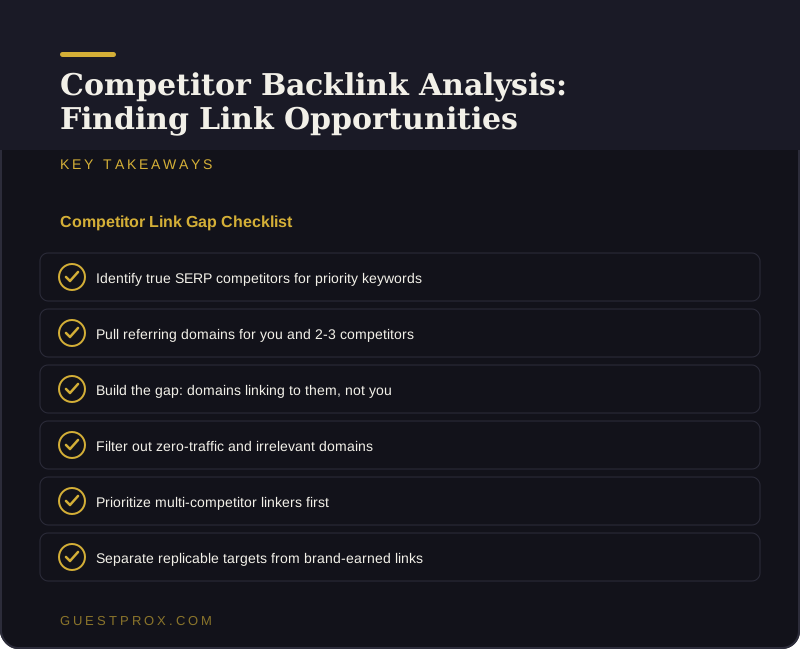
Use a link gap analysis to list domains linking to competitors but not you. This raw list is always too long and too noisy. Treat it as raw material, not a prospect list. Export referring domains rather than individual links; you want the list of sites, not an inflated count of URLs.
Remove zero-traffic domains, irrelevant niches, and obvious link farms. What remains should be real sites with real audiences in your world. A gap of two hundred domains usually compresses to thirty worth contacting, and that is fine. Thirty good targets beat two hundred bad ones.
Rank remaining targets by a simple question: which links would move the needle most for the least outreach effort? Sites that linked to multiple competitors are warm by definition. Niche-relevant publications with engaged audiences come next. Everything else is a later phase.
A gap list becomes a campaign when each target gets an angle.
Some competitor links are replicable: directories, resource pages, podcasts, contributor columns. Others were earned through brand strength you do not have yet. Pursue the first category now and let the second inform your longer-term content and PR work.
Never pitch a gap target with a generic template. Reference why they linked to the competitor and offer something better or different: fresher data, a contrarian take, a more useful resource. The gap tells you they link out; your angle tells them why to link to you.
Record which gap sources convert best. Over time you learn which competitor links are actually replicable in your niche, and your prospecting gets sharper with every campaign. The analysis compounds, especially when you feed the results back into a backlink audit each quarter.
Keep the gap analysis, the filters you applied, and the final target list in one document per campaign. When results come in, you can trace wins back to specific gap sources, which sharpens the next round of analysis. Institutional memory beats starting from scratch every quarter.
The right tooling speeds up the mechanical parts so you can spend time on judgment.
Link intersect features in tools like Ahrefs and Semrush automate the raw gap computation across multiple competitors. They save hours of manual comparison but produce noisy lists. The filtering step is where the value gets added, not the export.
No tool judges relevance or editorial quality for you. The final pass, opening the actual domains and deciding whether each is worth contacting, is manual work. Budget time for it. Skipping it is how campaigns end up pitching link farms.
Competitor profiles change monthly. Re-run gap analysis quarterly rather than treating it as a one-time project. New gaps appear as competitors earn new links, and each refresh surfaces targets your last campaign missed.
Run this sequence before every outreach campaign.
More on research-driven link building.
Authoritative sources if you want to go deeper on this topic.
The process of mapping who links to the sites outranking you, then identifying the domains linking to them but not to you. That gap is your opportunity list: sites already proven to link out in your niche, to content like yours.
The sites ranking above you for your target keywords, not necessarily your business rivals. Pull the top results for priority terms and analyze two or three thoroughly. Depth on a few true SERP competitors beats skimming many loosely related sites.
A backlink gap is the set of referring domains linking to your competitors but not to you. It matters because every domain in it has already demonstrated willingness to link in your niche, which makes them far warmer prospects than cold lists built from scratch.
Filter ruthlessly for traffic and relevance first. Then prioritize domains linking to multiple competitors, since they are proven serial linkers. Separate replicable targets like resource pages and podcasts from links earned through brand strength you cannot yet replicate.
Yes, with one caveat: copy the opportunity, not the tactic. If a competitor earned links through original research, the lesson is that research earns links in your niche, not that you should mimic their exact pages. Use gaps for prospecting and angles, not imitation.
We do not publish prices. Message us on WhatsApp at +1 (213) 582-6001 for a quote on gap analysis and the outreach campaign built on it.
We run competitor gap analysis before every campaign so outreach targets proven linkers. Message us on WhatsApp at +1 (213) 582-6001 or send a message through the form.
Global Service Delivery