
There is no magic number, but there is a method. Here is how to scope link building from the competitor gap instead of guessing.
If you are asking how many backlinks do I need, you are asking the wrong-shaped question. The useful version is: how many quality referring domains separate your pages from the ones outranking them? A local business facing competitors with 40 referring domains needs a fundamentally different campaign than a SaaS brand fighting pages with 400.
Raw counts mislead in both directions. Ten links from real, trafficked publications in your niche can outweigh a hundred directory and forum links. And matching a competitor's total is rarely the goal, you need enough quality referring domains to make your page the credible answer, which is often fewer than the raw gap suggests.
The honest method is competitor gap analysis: measure what ranks, filter for links that actually count, and build a plan to close the quality-adjusted gap. The steps below are the same process we run at the start of GuestProx campaigns.
You don't need a number, you need the gap. Scope link building from competitors' quality referring domains, not from a quota.

Link count became the industry's favorite vanity stat because it is easy to sell. But Google has never counted links like beans in a jar. One editorial link from a trafficked publication in your niche carries more weight than dozens of low-quality mentions, and experienced SEOs stopped chasing raw backlink quantity years ago.
When you export competitor backlinks, a large share turns out to be noise: scrapers, directories, forum signatures, dead pages. The number that matters is quality referring domains, real sites with real traffic and topical relevance. A competitor showing 800 referring domains might have 120 that actually do work.
A keyword where page one averages 30 quality referring domains is a different project than one averaging 300. New sites should start with keywords where the gap is closable in months rather than years, then reinvest new traffic and authority into harder targets. Ambition is good; sequencing is what wins.
Three steps, a few hours with the right tools, and a scope you can defend to any stakeholder.
Pick three to five target keywords and note the domains holding page one. You are analyzing specific pages, not whole sites, authority concentrates at the page level, and that's where the fight happens.
Export referring domains for each competing page, then strip the noise: nofollowed blog comments, directories, obvious PBNs, dead domains. What remains is the quality baseline, usually twenty to forty percent of the raw count.
If the filtered baseline is 60 quality referring domains and you have 15, your gap is roughly 45, but you rarely need all of it. Target the highest-impact third first: the most authoritative, most relevant placements. Rankings often shift well before the gap fully closes because quality compounds.
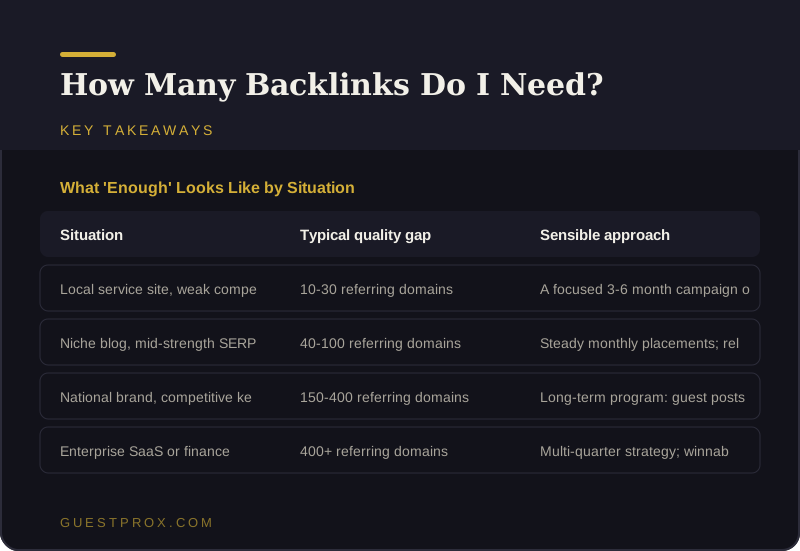
To make this concrete, here are typical situations and what scoping looks like in each. Your numbers will differ, but the logic is identical.
Most oversized link budgets come from two errors, and both are fixable in an afternoon with the right export.
If you scope from raw referring-domain totals, you are budgeting against scrapers, directories, and dead pages, links you would never want anyway. Always filter first, then scope. In our experience the quality baseline lands at twenty to forty percent of the raw count, which cuts most we-need-500-links panics down to a sane program.
Teams fixate on the head term with a 400-domain gap while ignoring ten related keywords with 20-domain gaps. Those clusters are where new authority compounds fastest: each win funds the next with traffic, rankings, and referring domains of its own. Sequence the easy wins first and the big number shrinks on its own.
Link profiles rot. Competitors lose referring domains every month to dead pages, removed links, and site closures, often five to ten percent a year. Your gap is a moving target, which is another reason steady monthly building beats one heroic push: you outpace their decay while closing the gap.
Once you know your gap, the next question is pacing: how many quality placements should you aim for each month? There is no universal number, but the planning ranges below reflect what sustainable campaigns look like at different stages. Treat them as starting points to adjust against your own SERP, not as promises.
Four to eight quality referring domains a month is a solid cadence when you are starting from near zero. It is fast enough to move the needle within two quarters on winnable keywords, and slow enough that every placement can be vetted properly. The priority at this stage is relevance over volume: links from sites your buyers actually read.
Ten to twenty quality placements a month is common where the SERP demands it, provided the content and prospecting operation can sustain that pace without cutting corners. If your team cannot vet twenty sites properly in a month, do ten well instead. A smaller number of clean placements always beats a larger number of questionable ones, because questionable links are the ones that decay or get discounted.
Illustrative ranges, your SERP sets the real numbers.
| Situation | Typical quality gap | Sensible approach |
|---|---|---|
| Local service site, weak competitors | 10-30 referring domains | A focused 3-6 month campaign on local and niche publications |
| Niche blog, mid-strength SERP | 40-100 referring domains | Steady monthly placements; relevance over raw authority |
| National brand, competitive keywords | 150-400 referring domains | Long-term program: guest posts, digital PR, content outreach |
| Enterprise SaaS or finance | 400+ referring domains | Multi-quarter strategy; winnable clusters first, head terms later |
Tools and methods for scoping your campaign.
Authoritative sources if you want to go deeper on this topic.
It depends entirely on your SERP. Against weak local competitors, 100 quality referring domains might be overkill; against national brands, it might be a tenth of the gap. Scope from competitors, not from round numbers.
No. Beyond a point, additional low-quality links add risk without reward, while a few authoritative, relevant placements keep moving the needle. Chase the quality-adjusted gap, then stop and measure before scaling further.
Honestly, months, and anyone promising an exact date is guessing. What we can say: steady monthly placements from real publications compound, and most campaigns see movement within a few months. We report every placement so you can watch the gap shrink.
Don't match it, beat it on quality. If their 200 links include 150 directory listings, you don't need 200 links; you need 60 better ones. Filtering for quality before scoping changes the entire plan.
Then don't fight them head-on yet. Win keyword clusters where the gap is closable, build authority there, and expand upward. Trying to out-link an entrenched domain on its strongest terms first is how budgets die.
Count alone doesn't hurt, patterns do. Thousands of links appearing overnight from thin sites looks manufactured; the same number earned steadily from real publications looks like success. Pace and source quality matter more than totals.
We'll analyze your competitors' real link profiles and map the quality gap. Message us on WhatsApp at +1 (213) 582-6001.
Global Service Delivery