
The shortcuts are dead. What works in 2026 is editorial links from real, relevant sites, earned through a repeatable framework. Here it is.
Building quality backlinks in 2026 means earning editorial links from real, trafficked, topically relevant websites through manual outreach. The tactics that worked five years ago, directory blasts, forum signatures, exact-match anchors everywhere, now waste time at best and create risk at worst.
What changed is not the goal but the filter. Search engines and their spam systems got better at judging whether a link represents genuine editorial choice. The link building strategy below is built for that reality: every step assumes your links will be scrutinized, and designs them to pass scrutiny.
A quality backlink in 2026 is an editorial, contextual, dofollow link from a real site your industry actually reads.
Six stages, in order. Skip one and the later stages leak value.
Outreach without an asset is begging. Before prospecting, make sure you have pages worth linking to: a genuinely useful guide, original data, a free tool, or the best resource on a narrow topic. Editors link to resources their readers will thank them for.
Audit your existing content first. Most sites already have two or three pages with link potential buried under weak titles or outdated information. Fixing those is cheaper than building new.
Pull the backlink profiles of the three sites outranking you for your priority keywords. You are looking for patterns: which domains link to all of them but not you, which content formats attract their links, and where their anchors cluster.
The gap between their profile and yours is your campaign plan. It tells you how many links, of what type, from what caliber of site, you actually need, replacing guesswork with a target.
Build your target list the way an editor would: sites your audience reads, publications that shape opinion in your niche, resources journalists cite. Then vet every prospect for real traffic, content quality, and relevance before it earns a pitch.
This is the step most campaigns rush, and it is where most campaigns fail. A vetted list of 100 real prospects outperforms a scraped list of 5,000 every time. That is the standard our editorial link building starts from on every campaign.
Editors receive dozens of pitches weekly. Most are deleted in seconds. The ones that survive share specific traits.
Mentioning the editor's name is not personalization. Referencing a specific article they published, explaining why your piece fits their audience, and proposing two or three concrete topic angles, that is personalization. It proves you read the publication, which is rarer than it should be.
Keep pitches short. Editors skim. One paragraph of context, three topic ideas with one-line descriptions, one line about you. Anything longer gets deferred, which means deleted.
One polite follow-up after a week is professional; four is spam. If there is no answer after two touches, move on, the prospect list should be deep enough that no single site matters.
Track everything: who was pitched, when, what was offered, what was answered. Campaigns that do not track outreach cannot learn from it.
Link counts are a vanity metric. Measure what the links are supposed to change.
Track keyword movements for target pages, organic traffic to those pages, and referral traffic from placements. A campaign that built 20 links and moved three money pages is succeeding; a campaign that built 60 links and moved nothing has a quality problem.
Give it time. Links need to be discovered, indexed, and then weighted, 4 to 12 weeks is the normal window before judging.
If verified, relevant placements are not moving rankings after three months, the constraint is usually elsewhere: the target page does not deserve to rank, the keyword difficulty was underestimated, or technical issues are blocking progress. More links will not fix a content problem. Diagnose before doubling down.
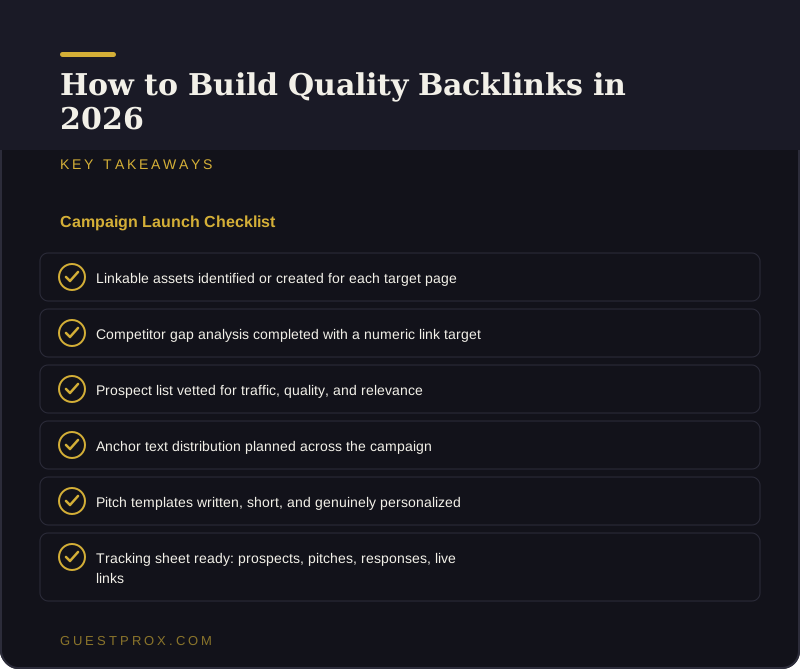
Run through this before your first pitch goes out.
Competitor gap mining remains the highest-signal source: domains linking to two or more of your competitors but not you are pre-qualified, they already link to sites like yours. Export the intersection, filter for traffic and relevance, and you have a pitch list with a built-in reason to say yes. Our competitor backlink analysis guide walks through the exact process.
SERP mining is the second source. Sites ranking for your target topics are, by definition, topically relevant and currently trusted by Google. Not all accept contributions, but the ones that do are often better placements than anything a prospecting tool surfaces, because their relevance is proven in the actual search results.
Follow the bylines. Contributors who write across multiple publications in your niche are warm paths to several placements each, and editors who accept guest contributions tend to do so repeatedly. A spreadsheet of active contributors in your niche is a prospecting asset that appreciates, most teams never build one.
Finally, listen where your niche talks: industry Slack groups, subreddits, newsletters, and forums surface rising publications months before they appear in SEO tools. Early relationships with growing publications pay off for years. This kind of ground-level prospecting is what our blogger outreach service does daily, across every campaign we run.
Treat your prospect list as a living asset. Every pitch outcome, accepted, rejected, ignored, is data: which publication types convert, which topics editors want, which niches are saturated. Log it all. After six months you'll have a private database of what works in your niche, which is a competitive advantage no tool sells.
AI-generated content at scale is the year’s most common rejection trigger. Editors spot it instantly now, several publications auto-screen for it, and one flagged submission can burn a relationship permanently. The fix is unglamorous: write like a human, with specific examples and a point of view, or don’t pitch at all.
Anchor over-optimization has not gone away, it is just better hidden. Exact-match anchors on every placement still create the most manufactured-looking pattern in link building. The fix is a written distribution plan before the first pitch, tracked per placement. Our anchor text guide covers the ratios that look natural.
Marketplace buying disguised as outreach is the vendor-side failure: if a ‘prospect list’ arrives within an hour with prices attached, it wasn’t prospected, it was shopped. Real outreach takes days of research, pitching, and follow-up. Ask vendors how their lists are built; the honest ones will show you.
Quitting at week six is the timeline failure. Links need discovery, indexation, and weighting, four to twelve weeks before judging, so campaigns evaluated at week six always look like failures. Set the expectation before spending a cent: month one builds, month two compounds, month three is when you judge.
Tactics, quality factors, and the fundamentals.
Authoritative sources if you want to go deeper on this topic.
Manual outreach for guest posts and niche edits on vetted, relevant sites remains the most reliable. Digital PR wins on peak authority but not on predictability. For most sites, a foundation of outreach-built links with occasional digital PR spikes is the winning mix.
There is no universal safe number, velocity should look natural for your site's size and history. A new site gaining 50 links in a month looks manipulated; an established brand earning 50 through a PR hit looks normal. Build steadily, diversify sources, and avoid sudden spikes from low-quality sources.
Some, branded anchors to the homepage look natural and build domain-level authority. But most link equity should flow to the pages you want to rank: service pages, key guides, tools. Deep links to specific pages move specific rankings.
They help enormously with prospecting, gap analysis, and verification, but they are not strictly required to start. Free alternatives and manual checks can cover the basics. What you cannot skip is the vetting judgment, tools surface candidates, humans make decisions.
AI Overviews and LLM answers cite sources, which makes being a cited, linked authority more valuable, not less. The same editorial links that build rankings also build the entity authority that gets your brand mentioned by AI systems. The tactics converge: be genuinely authoritative and well-referenced.
When outreach consistently loses to your other priorities. The process is simple but time-intensive, most in-house attempts fail on consistency, not knowledge. If you have gone three months without steady output, outsourcing is cheaper than the rankings you are not gaining.
This framework is what we run every day. Message us on WhatsApp at +1 (213) 582-6001 and we'll map it to your site.
Global Service Delivery