
For link builders and agency teams who run outreach themselves. The full process from prospect list to published link, with the details that lift reply rates.
A blogger outreach guide is a manual for getting real website owners and editors to say yes, to your pitch, your article, and your link. It covers list building, personalization, follow-up sequences, and negotiation, all done by hand.
Outreach fails most often because it is treated as a numbers game. Ten thousand templated emails will always lose to two hundred researched ones. Editors reply to relevance and respect for their time; everything in this guide optimizes for those two things.
We run 100% manual outreach at GuestProx, no automation blasts, no mass templates, and it has produced 1259+ placements since 2018. This blogger outreach guide documents the process our team actually follows, from first search to live link.
Blogger outreach is the practice of contacting website editors personally to propose content collaborations, guest posts, link insertions, or expert contributions, that earn contextual backlinks.

The list is the campaign. Great emails cannot save bad prospects, but a great prospect list forgives average emails. Spend half your total campaign time on prospecting and qualification before writing a single pitch.
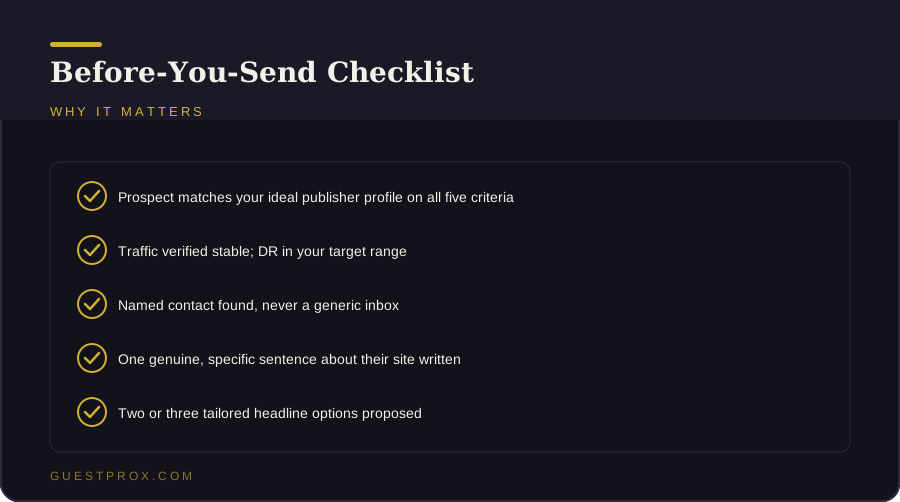
Define your ideal publisher profile first: niche relevance, DR 40-90, verified organic traffic, real authorship, and a history of publishing contributor content. Every prospect gets scored against the profile; anything below the bar never gets an email.
Search operators surface sites Google already associates with your topics: try keyword plus write-for-us, contribute, or guest post guideline queries. These find sites openly accepting contributors.
Competitor backlinks find the rest. Export where rivals earn guest posts and pitch the same publications with a better angle, if they accepted a competitor, the door is open.
Manual browsing fills the gaps. Read roundups, resource pages, and niche communities in your space; the best prospects are often sites that have never appeared on anyone's list.
Check traffic, relevance, and editorial standards for every prospect before it enters the outreach queue. A bloated list of unqualified sites wastes the scarcest resource in outreach: sender reputation.
Find the right contact, the editor, not info@. About pages, author bylines, and LinkedIn get you a name; a named email outperforms a generic inbox by multiples.
Track every prospect's stage: to contact, pitched, followed up, negotiating, writing, published. Outreach without a tracker leaks opportunities, most yeses arrive after the second or third touch.
Set reminders, not just sends. A disciplined outreach process beats a brilliant one-off email every time.
A pitch has one job: earn a reply. Keep it under 150 words, lead with the value to their readers, and propose two or three specific headlines. Long emails about your company get deleted; short emails about their audience get answered. If you cannot state the reader benefit in one sentence, the pitch is not ready, rewrite it until you can.
Follow up twice, spaced five to seven days apart. The first follow-up doubles response rates; the second adds another meaningful lift. After three touches with no reply, move on, the hardest discipline in any blogger outreach guide, and the one that protects your reputation.
Subject lines under eight words, specific to the site: a topic reference beats a generic guest post subject every time. Open with something true about their recent content, it proves the email was written for them.
Close with a low-friction ask, such as which of your three headlines would work for their audience. A yes-or-no question outperforms an open-ended one.
Confirm the essentials before writing: dofollow status, contextual in-content placement, permanence, and timeline. If the site charges an editorial fee, decide upfront whether the placement is worth it, legitimate publications sometimes do.
Get agreements in the email thread, not verbally. When a link goes missing six months later, the thread is your use for a polite restoration request.
Submit clean, original work formatted to the site's style, on the agreed date. Editors remember reliable contributors, reliability is a competitive advantage in outreach because it is so rare.
After publication, share the piece and thank the editor by name. That single habit turns one-off placements into ongoing relationships, and relationships are where the best links come from.
Small mechanics separate campaigns that get replies from campaigns that get spam complaints. None of these tips are glamorous; all of them move the numbers. The unglamorous mechanics compound: small edges in list quality and follow-up discipline produce most of the replies.
Treat every tip below as a default, then measure. Reply rate, positive reply rate, and placement rate per hundred prospects are the only metrics that matter, optimize those and everything downstream improves.
One genuine, specific sentence about their site outperforms five merge tags. Reference an actual article, a stance they took, or a gap in their coverage your piece would fill.
If you cannot write one true sentence about the site, the prospect does not belong on your list. That filter alone will raise your reply rate.
Warm up new sending domains for two to three weeks before real outreach. Keep daily volume conservative, authenticate with SPF, DKIM, and DMARC, and never buy lists.
Watch bounce and complaint rates closely. One burned domain poisons every future campaign sent from it, reputation is the infrastructure outreach runs on.
After a successful placement, pitch the editor again in sixty to ninety days with something even better. Second placements close faster, negotiate easier, and often come with warmer terms.
Introduce editors to each other when it helps them. Generosity in a small industry compounds, the outreach world is smaller than it looks.
Everyone claims their outreach is personalized. Almost no one's is. Real personalization is not a mail-merge tag with the editor's first name, it is evidence, in one or two sentences, that a human read the site this week. This block gives you the audit: run every template through it before it sends.
The test is brutal and simple. Cover the prospect's name and site title in your draft. If the email could be sent to any site in your niche, it is not personalized. Personalization that survives the redaction test gets replies; everything else gets archived.
Bad: a generic compliment about a recent article on the site's core topic. That line could be sent to ten thousand sites, and editors know it. It is worse than no personalization because it announces that you are faking it.
Good: one true, specific sentence, a stance the author took, a gap in their coverage your piece would fill, a data point from their own article you can extend. It proves reading happened, it flatters accurately rather than generically, and it sets up the pitch that follows. If you cannot write one true sentence about a site, it does not belong on your list, that filter alone will lift reply rates.
Bad: a vague offer to write a guest post, with generic topic ideas that could fit any blog in the niche. Generic topics signal generic effort, and the editor correctly predicts a generic article.
Good: three headlines that could only fit this publication, each with a one-line angle tied to something they recently published. Specificity is respect: it shows you valued the editor's time enough to think. Our outreach email templates that don't sound automated show this structure applied across common scenarios.
Templates decay. Phrases that felt personal in January read as formulaic by June once every sender copies them. Once a month, read your own template as an editor would and cut anything that has become a cliché, including, eventually, the personalization tricks in this very section.
Track which personalization elements correlate with replies. Over time you will find your own patterns: for most teams, referencing a specific article outperforms referencing the site's mission, and proposing a contrarian angle outperforms proposing a better version. Measure, then double down.
Manual outreach scales further than most people think, and then it hits a wall called sender reputation. The wall is real: mailbox providers track how many cold emails a domain sends, how recipients respond, and whether anyone complains. Push past the limits and every future campaign from that domain suffers.
Scaling safely means treating reputation as inventory that depletes and replenishes. Every send spends a little; positive replies and low complaint rates rebuild it. The mechanics below keep you in the safe zone while volume grows.
Warm any new sending domain for two to three weeks before real outreach, starting with a handful of emails daily to engaged contacts. Ramp gradually; there is no shortcut that mailbox providers cannot see through. A common ceiling for sustained cold outreach is a few dozen sends per domain per day, beyond that, split across domains and senders.
Never let a single domain carry the whole program. Distribute volume across two or three authenticated sending domains so no one domain absorbs all the risk. If one domain's reputation dips, the program continues while it recovers.
The fastest way to burn a domain is emailing bad lists: purchased contacts, scraped addresses, role-based inboxes that never opted into anything. Bounces and complaints are the two signals that kill reputation fastest, and both come from list quality, not copywriting.
Verify every address before sending, remove role-based emails from cold sequences, and suppress anyone who bounced once, never mail them again from any domain. This discipline is what separates outreach that gets editors to say yes from outreach that gets domains blacklisted.
When multiple people send, centralize the suppression list and the per-domain volume caps. One teammate blasting from a shared domain undoes everyone's careful pacing. Assign prospects to owners so no editor gets two pitches from your team in the same month, that particular embarrassment is entirely preventable.
Review reply and complaint rates weekly per sender. A sudden dip means something changed: a template went stale, a list went bad, or a domain needs rest. Catch it in the weekly review and it is a blip; catch it in the quarterly review and it is a burned asset.
Some legitimate publications charge editorial or processing fees for contributor content. This confuses buyers, because paying a site sounds like buying a link. The distinction matters enormously: an editorial fee paid to a real publication with real standards is a cost of access; a fee paid to a site that publishes anything is a link purchase wearing a receipt.
The difference is not the money changing hands, it is what the money buys. One buys review by an editor who can still say no. The other buys guaranteed publication. Learn to tell them apart before you pay anyone.
Before paying any fee, ask: does the site have real traffic from real readers? Would the publication reject a bad article even after payment? Is the fee disclosed as an editorial or processing charge rather than priced per link? Is your link one of few outbound links, not one of dozens? Would you be proud to show this placement to a client? Five yeses means a legitimate cost of doing business; any no means walk away.
Fees are often negotiable, especially for strong contributors: ask about contributor rates versus one-off rates, multi-article commitments, or fee waivers for genuinely original research. What you must never negotiate away are the placement terms, dofollow, contextual, permanent, confirmed in the email thread before you pay.
Get the invoice or receipt in writing. Legitimate publications operate like businesses: they invoice, they have terms, they answer emails. A site that wants payment through an anonymous link with no paperwork is not a publication; it is a marketplace. Treat it accordingly.
Budget editorial fees as a line item, not a surprise: decide in advance what a placement on a given tier of site is worth to you, and stop paying when the fee exceeds the value. Some of the best publications charge nothing and some charge fairly, price and quality correlate weakly, so judge each site on the traffic and standards tests, not the invoice.
And keep the ratio sane. A campaign where every placement is paid looks different from one where most placements were earned on merit. Earned placements remain the backbone; fees are how you access the publications worth paying for. The same judgment applies inside a guest posting strategy: merit first, paid access where it is genuinely worth it. For teams that would rather not manage any of this, content outreach run by a specialist team removes the negotiation entirely.
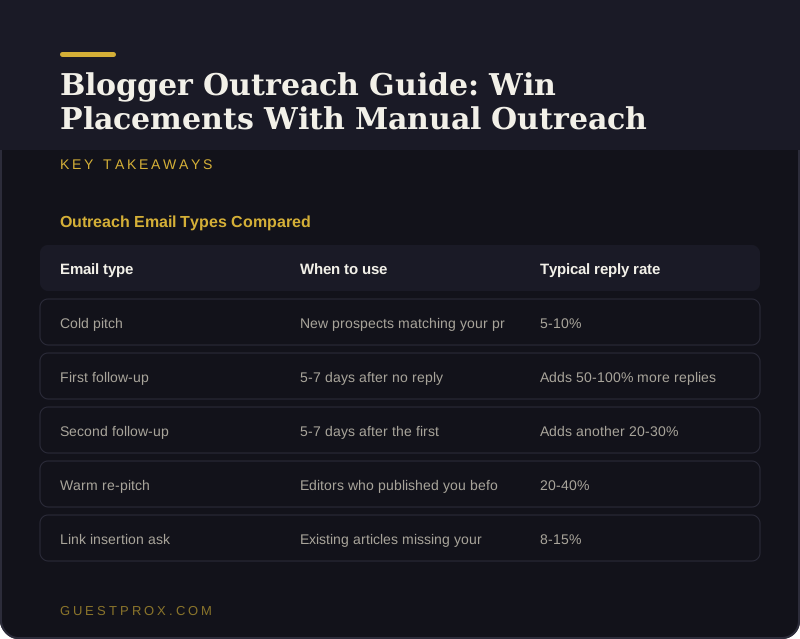
What to send, when, and the reply rates to expect.
| Email type | When to use | Typical reply rate | Notes |
|---|---|---|---|
| Cold pitch | New prospects matching your profile | 5-10% | Relevance and personalization drive the variance |
| First follow-up | 5-7 days after no reply | Adds 50-100% more replies | Short, polite, one new angle |
| Second follow-up | 5-7 days after the first | Adds another 20-30% | Last touch, then move on |
| Warm re-pitch | Editors who published you before | 20-40% | Relationships outperform cold outreach by multiples |
| Link insertion ask | Existing articles missing your resource | 8-15% | Works when your page genuinely improves the article |
Seven checks between you and the send button.
Sharpen every stage of your outreach operation.
Authoritative sources if you want to go deeper on this topic.
For cold outreach, five to ten percent is healthy; follow-ups roughly double it. Warm re-pitches to editors who published you before can hit twenty to forty percent. If your cold reply rate sits below three percent, the problem is almost always list quality, not copywriting.
We don't publish prices. Every campaign is scoped to your targets and competition, so the fastest way to get an exact number is to message us on WhatsApp at +1 (213) 582-6001.
Only if you do it badly: high volume from cold domains, purchased lists, and deceptive subject lines trigger spam filters and complaints. Manual, low-volume, relevant outreach from an authenticated domain is just email. We protect sender reputation as carefully as we protect link quality.
Buying links pays site owners for placement with no editorial bar, fast, but it leaves footprints and the sites are often built to sell. Outreach earns placement from real editors who chose your content for their readers. The first is a transaction Google can detect; the second is how the web is supposed to work.
Two, spaced five to seven days apart. The first follow-up typically doubles your total replies; the second adds a smaller but real lift. Beyond that, response rates flatline and annoyance climbs, archive the prospect and move on.
Automate the tracking, never the sending. Tools are excellent for managing pipelines and reminders; blasting templated emails at scale is what gets domains burned and reply rates crushed. Every email we send at GuestProx is written by a human, for a human, that is the entire differentiator.
From list building to published links, plan six to ten weeks for a first campaign: two for prospecting, three to four for pitching and follow-ups, two to four for editorial calendars. Repeat campaigns run faster because relationships and templates already exist. Our Growth package runs on a 20-day turnaround per batch once the campaign is rolling.
GuestProx handles list building, pitching, and placement with 100% manual outreach. See our blogger outreach service for packages.
Global Service Delivery