
Twenty factors, grouped in four layers, that separate links which move rankings from links which just exist. Use this to judge any backlink, yours or a vendor's.
A quality backlink is a dofollow, contextual link from a real, trafficked page on a topically relevant site with a clean link profile. Everything below is how you verify each part of that sentence.
These backlink quality factors are grouped in four layers: the domain, the page, the link itself, and risk signals. Work through them in order, a failure at the domain layer disqualifies the link before the other layers matter.
Judge the domain first, the page second, the link third, and check risk signals throughout.
If the domain fails here, stop. Nothing downstream rescues a bad domain.
The domain passed. Now check the specific page carrying your link, domain authority does not automatically transfer to every page.
The domain and page check out. Now examine the link itself.
The final layer: signals that the link could hurt rather than help.
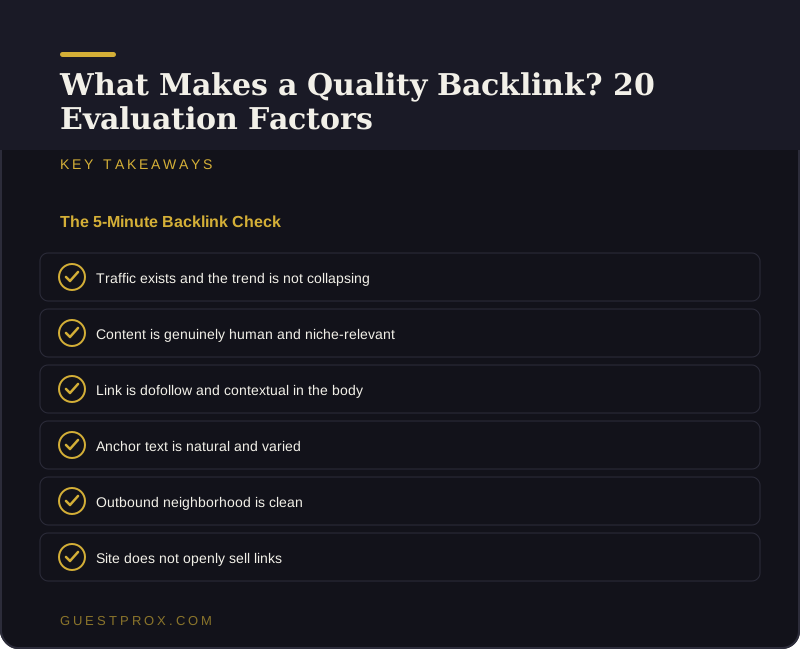
Twenty factors are a lot to hold in your head during prospecting. In practice, run them as three passes. First pass, sixty seconds: traffic trend, content skim, outbound link glance, this eliminates most bad prospects. Second pass, five minutes: the domain and page factors on your shortlist.
Third pass, only for placements that matter: the full twenty, documented. That is how you scale rigor without slowing outreach to a crawl. It is also the workflow our guest posting team runs on every campaign.
Take a DR 58 marketing blog with steady traffic that covers SaaS weekly. Domain factors pass. The specific page ranks for its topic and the content is genuinely useful, page factors pass. Your link would sit contextually in the body with a natural anchor to your most relevant page, link factors pass. The site has no advertise page and its outbound links go to legitimate sources, risk factors pass.
That is a placement worth pursuing. Now change one variable: same site, but the page linking to you is a generic roundup with 150 outbound links. Page factor ten fails, and the link's value drops sharply. Same domain, different decision, which is why you evaluate the page, not just the domain. Same domain, different decision, which is why you evaluate backlink relevance at the page level, not just the domain.
When you cannot run all twenty, these seven catch most problems.
The most overweighted factor is the authority score. A single number is comforting, it sorts neatly in a spreadsheet, but it says nothing about traffic, relevance, or whether the page will even be indexed. Buyers who filter on DR alone end up purchasing impressive spreadsheets attached to hollow links.
The most underweighted: outbound link count. A page linking to one hundred fifty commercial sites dilutes every link on it, yet buyers routinely approve placements without ever counting. Page-level traffic is the other miss, domain authority does not automatically transfer to every page, and a link on a page nobody visits inherits the page’s obscurity, not the domain’s reputation.
Then the maintenance factors: link stability and documentation. Unmonitored links quietly vanish during redesigns; unindexed pages pass nothing no matter how good the domain. These feel like administrative details until you audit a two-year-old campaign and find a third of the value gone.
The pattern: buyers overweight what is easy to sort and underweight what requires opening the page. Open the page, read the article, and count the outbound links, the five minutes it takes is the difference between evaluating a backlink and evaluating a number. Related reading: why topical fit matters at the page level.
Ask any prospective vendor for five recent placements with live URLs, then score each against the twenty factors, pass or fail per factor, no vibes. A vendor averaging sixteen or better is running a serious operation. Below twelve, you are looking at a reseller with a spreadsheet.
Set red lines in advance: any fail on the risk factors, paid-link footprints, dirty outbound neighborhoods, is an instant veto, not a discussion. Pattern fails matter too: if all five links sit in author bios, that is a process problem, not bad luck, and it will repeat on your campaign.
Put the scorecard in the agreement: dofollow, contextual body placement, indexed within weeks, replacements for removed links. Verbal promises evaporate when placements go wrong; written standards do not. This is the operating standard behind our editorial link building, and the backlink quality checklist is the same reference our team works from.
Run the scorecard on yourself, too. Score your five most recent placements, whether you built them or a vendor did, and see where your own process leaks. Most teams discover they're stricter with vendors than with their own work. The scorecard only works if it cuts both ways.
Metrics, vetting, and campaign strategy.
Authoritative sources if you want to go deeper on this topic.
Treat the domain-level five as non-negotiable, a failure there disqualifies the link. Page and link factors allow occasional tradeoffs: a slightly off-topic page on a superb domain can still be worthwhile. Risk factors are binary: any hit on 16 or 17 is a veto.
Usually yes. A single editorial link from a top-tier relevant publication can move a competitive keyword; ten mediocre directory-style links often move nothing. This is the central math of modern link building: quality compounds, quantity without quality just costs money.
Partially. Traffic, relevance, and content quality still determine a nofollow link's value for visitors and brand building. Attribute-dependent factors like link equity obviously do not apply. Judge nofollow placements as media buys with SEO side benefits.
Quarterly for your most important placements, annually for the full profile. Sites decline, get sold, or change editorial direction. A link that passed all twenty factors last year can fail half of them today, usually through no fault of yours.
Yes, when it points to the wrong page or arrives in the wrong context. A superb link to a thin, outdated page wastes its equity, and a great link with an irrelevant anchor confuses the signal. Quality of the link and quality of the target are separate requirements.
Open the page, confirm the link is present with sensible attributes, skim the surrounding content for relevance, and check the domain's traffic trend. That two-minute pass catches the majority of bad links. Run the full twenty when the placement matters or the vendor is new.
This is the framework behind every placement we deliver. Message us on WhatsApp at +1 (213) 582-6001 to discuss your campaign.
Global Service Delivery