
Link building is how sites earn the backlinks that search engines count as votes of confidence. This guide covers what it is, why it matters, and how it's done right.
Link building is the practice of earning hyperlinks from other websites to your own. Search engines treat those links as votes of confidence: a page with strong, relevant backlinks tends to outrank an otherwise identical page without them.
It is called building rather than buying or waiting because good links rarely happen by accident. Someone has to create something worth linking to, find the right sites, and persuade their editors, or run the kind of brand and content operation that attracts links naturally. Both paths count as link building.
This SEO link building guide covers why links matter, the main ways they get built, what to avoid, and how to tell whether your efforts are working. Start with our link building guide for the complete playbook in order.
Link building is earning hyperlinks from other websites so search engines trust your pages more.
Every major search engine uses links as a core ranking signal. Content tells Google what your page is about; links tell Google whether anyone trusts it. You need both.
The original insight, from Google's PageRank, still holds: a link is an endorsement. But modern systems read far more than the link's existence, they weigh the linking site's authority, its topical relevance to you, the context around the link, and the anchor text.
That is why one editorial link from a respected industry publication can outweigh a hundred directory links. Search engines got good at telling the difference years ago.
Think of it as three legs. Content earns the right to rank, technical SEO removes the obstacles, and links supply the authority that decides close contests. Most sites that stall on page two have a content problem or a link problem, and link problems are more common than people admit.
You can verify this yourself: compare the backlink profiles of page-one results for any competitive keyword against pages stuck on page two. The gap is usually obvious.
Every legitimate tactic falls into one of three buckets. Understanding the buckets matters more than memorizing tactic names.
Create something worth citing, original research, a useful tool, definitive data, and promote it to people who link to such things. This is the highest-impact approach when it works, because the links come from genuine editorial choice.
The catch is the when. Great content with no promotion often earns nothing. Earning still requires outreach; it just leads with the asset instead of the ask.
Find relevant publications, pitch useful contributions, and earn contextual links inside real articles. Guest posting and niche edits live here. It is the most controllable form of link building: you choose the targets, shape the content, and know what each placement should deliver.
Our agency has delivered 1259+ placements this way since 2018. The work is unglamorous, prospecting, pitching, writing, follow-up, but it compounds into a link profile you can actually plan around.
Build newsworthy assets or genuine expertise, pitch journalists, and earn coverage links from press and industry media. Less controllable than outreach, but capable of landing the highest-authority links available, the kind competitors cannot easily replicate.
Google's guidelines are clear about what counts as manipulation. The short version: if the link exists only because money or automation put it there, and it is designed to mislead search engines, it is a risk.
Private blog networks, bulk marketplace links, automated comment spam, and link farms share one trait: the sites exist to sell links, not to serve readers. Google's spam systems target exactly this footprint, and they have gotten dramatically better at it.
The tell is always the same: sites with metrics but no audience, content nobody would read voluntarily, and outbound links to unrelated commercial pages.
Most sites do not get a dramatic manual penalty. They get something quieter: links that simply stop counting. Rankings stall, new links do nothing, and the money keeps going out. Algorithmic discounting is the common outcome of scheme-built profiles, invisible, gradual, and expensive to unwind.
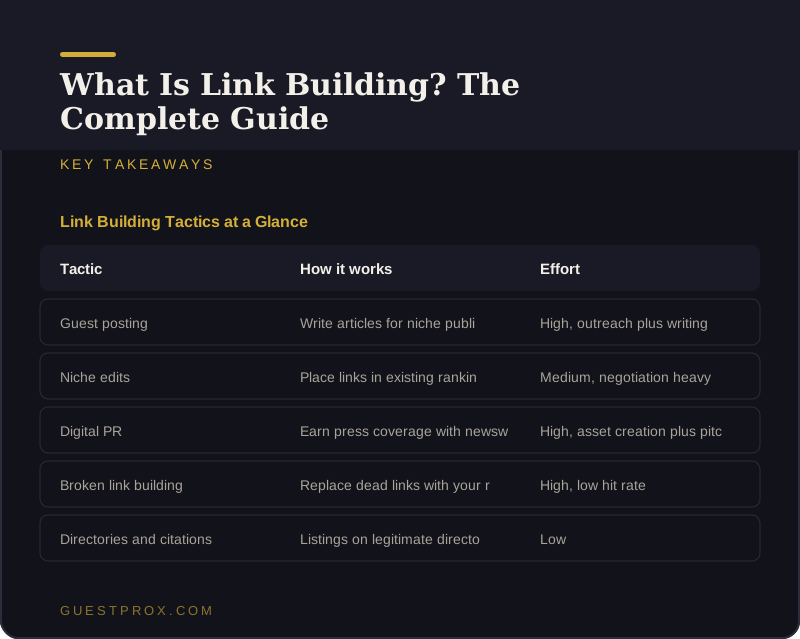
The main tactics, honestly assessed.
| Tactic | How it works | Effort | Risk |
|---|---|---|---|
| Guest posting | Write articles for niche publications; earn contextual links | High, outreach plus writing | Low, when sites are vetted |
| Niche edits | Place links in existing ranking articles | Medium, negotiation heavy | Low, when editorial and relevant |
| Digital PR | Earn press coverage with newsworthy assets | High, asset creation plus pitching | Low |
| Broken link building | Replace dead links with your resource | High, low hit rate | Low |
| Directories and citations | Listings on legitimate directories | Low | Low, but limited value |
| Buying bulk links / PBNs | Pay for placements on link-selling sites | Low | High, the classic penalty footprint |
Sequence matters. Technical SEO comes first, if Google cannot crawl or index your pages, links point at locked doors, and content comes second, because target pages need to deserve rankings with genuinely useful, intent-matched material. Links come third, supplying the authority that decides close contests. Building links before fixing the first two is pouring water into a leaking bucket.
New sites should start link building early but modestly: genuine outreach to niche publications, a few truly editorial placements, foundational citations if local. Keep velocity natural for the site’s age, a three-month-old domain gaining fifty links in a month looks manufactured. Let the content library and the link profile grow together.
For established sites that stalled, links are usually the missing leg, but verify before spending. Compare your backlink profile against the sites outranking you; if their content is similar and their links are stronger, you have found the constraint. If their content is simply better, links will not save you. Diagnose first, build second.
This sequencing is why link building works best as part of an off-page SEO strategy rather than a standalone purchase, authority, brand mentions, and outreach compound when they are coordinated instead of bought in isolation.
Revisit the sequence annually, not just at launch. Sites evolve: content libraries grow, technical debt accumulates, competitors move. An annual constraints audit, technical health, content competitiveness, link gap versus page-one rivals, tells you which leg of the stool needs work this year before you spend on the wrong one.
Diversity is the headline trait. No single tactic should dominate, guest posts, editorial mentions, PR hits, citations, a scattering of nofollow, because natural profiles are messy. If one tactic exceeds seventy percent of your profile, diversify before adding more of the same. Review the main backlink types and check your mix against them.
Depth matters too. Most link equity should flow to the pages you want to rank, service pages, key guides, tools, with branded anchors to the homepage for naturalness. A profile of five hundred homepage links and zero deep links looks like a brand campaign, not an authority profile, and it moves no specific rankings.
Velocity should look human. Steady month-over-month growth beats spikes; new sites grow slowly while established brands can absorb the occasional PR-driven burst. The pattern that gets discounted is sudden volume from low-quality sources, exactly what bulk sellers provide.
And profiles need maintenance. Sites decline, get sold, or change direction; links quietly lose value. Quarterly rechecks on important placements, disavow only for clear manipulation, and keep building, standing still means falling behind. That is the ongoing work our link building service handles for clients who would rather not manage it themselves.
Go deeper on tactics and measurement.
Authoritative sources if you want to go deeper on this topic.
Yes. They remain one of the strongest ranking signals across every major search engine. What changed is the bar: manipulative links get discounted or penalized, while editorial links from real, relevant sites carry more weight than ever. The signal did not die; the shortcuts did.
Expect 4 to 12 weeks from when links go live and get indexed before seeing ranking movement. Competitive keywords take longer. Link building compounds, month six of consistent effort looks very different from month one.
Yes, if you have the time. The process is straightforward: create link-worthy content, prospect relevant sites, pitch editors, and follow through. What agencies sell is mostly labor and relationships, the hours of outreach most teams cannot spare. Many businesses start DIY and outsource once the time cost becomes clear.
There is no magic number. Compare your backlink profile to the sites currently outranking you for your target keywords, that gap is your answer. Ten excellent relevant links can beat a hundred mediocre ones, so count quality first.
Earning editorial links through outreach and great content is not against the guidelines. What violates them is manipulation: buying links to pass PageRank, participating in link schemes, and using automation to create links at scale. The line is intent and deception, not outreach itself.
Start with digital PR-style assets and genuine outreach to niche publications, plus foundational citations if you are local. Avoid anything that promises fast bulk links. New sites benefit most from a small number of truly editorial, relevant links while the content library grows.
We build editorial links through manual outreach, no schemes, no spam. Message us on WhatsApp at +1 (213) 582-6001 to talk strategy.
Global Service Delivery