
The clickable words in your backlinks shape how Google reads them. Here is how to plan anchor text deliberately, without tripping spam filters.
An anchor text strategy is the plan behind which clickable words carry your backlinks, so your link profile reads as earned rather than engineered. Every link you build makes a choice for you, whether you planned it or not: the words inside the link tell Google what the target page is about and how hard you are pushing it.
Most site owners never think about anchors until something looks wrong. A backlink profile where forty links all say the exact same keyword phrase is a pattern, and patterns are what spam detection is built to find. The fix is not complicated, but it has to be deliberate: vary anchors across branded, partial-match, generic, and natural phrases, and match each anchor to the context of the linking page.
This guide covers the anchor types that matter, what a believable distribution looks like, and the mistakes we see most often when auditing profiles. Everything here comes from placing 1259+ guest posts by hand and watching which patterns hold up over time.
An anchor text strategy is the plan behind which clickable words carry your backlinks, so your link profile reads as earned rather than engineered.
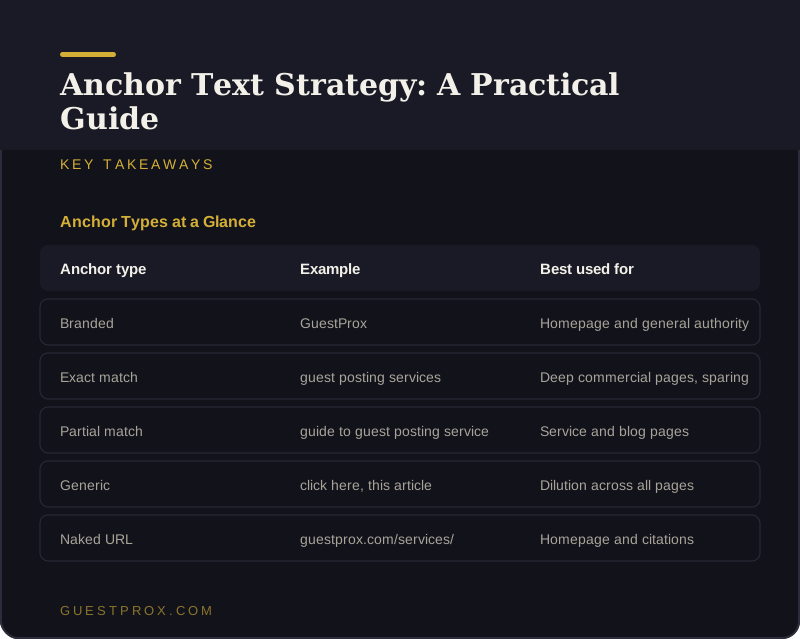
Anchors fall into a few families. You do not need exotic taxonomy, just a working sense of what each type signals and where it belongs.
Your company or site name as the link text. These are the safest anchors you own, because real-world linking produces them constantly: people reference brands by name. A healthy profile leans heavily on branded anchors, especially toward the homepage.
The precise keyword you want to rank for, used as the link text. These carry the most direct ranking signal and the most risk. A handful pointed at deep pages is normal; dozens aimed at one page is the classic footprint of manufactured link building.
Variations that include the keyword alongside other words. These give you topical signal with far less pattern risk, and they read naturally inside editorial content, which is exactly what editors prefer to publish.
Phrases like click here or read more, or the raw URL itself. They look like zero-effort linking, which is precisely why they show up in natural profiles all the time. A steady sprinkle of them keeps your distribution believable.
Distribution is where strategy lives. The individual anchor matters less than the shape of the whole profile.
Think about how people link when nobody is paying them. They use brand names, page titles, and lazy phrases like here. Keyword-stuffed anchors are rare in the wild. Your strategy should imitate that reality, then tilt it slightly toward the pages you most want to rank.
Decide the anchor mix per target URL in advance, not link by link in the moment. Homepages can absorb mostly branded and URL anchors. Commercial pages need a careful blend: some partial match for signal, plenty of branded and generic for cover. Informational content can carry more descriptive anchors because those links naturally do.
You will find charts prescribing exact percentages. Treat them as rough guardrails. What matters more is the absence of spikes: no single anchor phrase dominating, no sudden bursts of keyword-rich anchors, and a branded base that keeps growing with every campaign.
Most anchor problems are self-inflicted and entirely avoidable once you know what to watch for.
The most common self-inflicted wound. Ten guest posts all linking the same keyword phrase to the same URL is a billboard, not a strategy. Spread keyword anchors across related pages and dilute them with branded and generic anchors.
Even a safe anchor becomes a pattern when it is the only one you use. If every link says your brand name plus one keyword, that is still a manufactured signature. Rotate through genuine variations that fit each article's context.
Not every link is yours to control. Directory listings, press mentions, and forum links arrive with whatever anchor the linker felt like using. Audit the full profile, our backlink audit process covers exactly how, not just the links you built, before deciding what your next anchors should be.
Theory is simple. The discipline is in applying it consistently across every link you build.
Before planning new anchors, export your current profile and group links by anchor text. Note which phrases dominate and which pages carry the most keyword anchors. Your plan should correct imbalances, not just add more links. A profile heavy on exact match needs a branded-heavy campaign next; a profile with no keyword signal at all can afford to be more deliberate on commercial pages.
Keep a simple sheet listing each target URL, its approved anchor variations, and anchors already used. Share it with everyone who builds links, in-house or outsourced. Without documentation, anchor discipline collapses within weeks as different people make different choices link by link.
Anchor distributions drift as campaigns run. Re-export quarterly, compare against the plan, and adjust the next campaign's mix. This fifteen-minute habit prevents the slow accumulation of patterns. And when you are ready to compare notes, our breakdown of branded vs exact match anchors shows where most profiles go wrong.
A quick reference for planning which anchor goes where.
| Anchor type | Example | Best used for | Overuse risk |
|---|---|---|---|
| Branded | GuestProx | Homepage and general authority | Low, the safest anchor |
| Exact match | guest posting services | Deep commercial pages, sparingly | High, classic spam signal |
| Partial match | guide to guest posting services | Service and blog pages | Medium, safe in rotation |
| Generic | click here, this article | Dilution across all pages | None, adds naturalness |
| Naked URL | guestprox.com/services/ | Homepage and citations | None, very common naturally |
More on anchors, link building, and measuring results.
Authoritative sources if you want to go deeper on this topic.
It is the deliberate plan for which clickable words carry your backlinks. Instead of letting every link default to the same keyword, you distribute branded, partial-match, generic, and exact-match anchors across your target pages so the profile looks earned and supports the right rankings.
A mix dominated by branded and natural anchors, with URL anchors steady and keyword-rich anchors a minority pointed at specific pages. There is no universal percentage. The key signal is the absence of spikes, where one phrase repeats far more than real-world linking would produce.
There is no fixed number, but concentration is the issue. Many exact-match links to a single page in a short window is the classic footprint of manufactured link building. Spread keyword anchors across related pages, keep them a small share of new links, and surround them with branded and generic anchors.
No. That is one of the fastest ways to make a profile look manufactured. Most of your links should use branded, generic, or URL anchors. Keyword anchors work best as a minority, placed where the surrounding content genuinely supports the phrase.
In a sense, yes. Google reads the image alt text as the anchor, so branded or descriptive alt text on linked images behaves like a normal anchor and the same variety principles apply. Keyword-stuffed alt text on every linked logo is just as visible a pattern as text anchors.
Yes. Every outreach campaign we run includes anchor mapping per target URL before a single pitch goes out. Message us on WhatsApp at +1 (213) 582-6001 and we will talk through your current profile and targets.
We plan anchor text for every placement before outreach begins. Message us on WhatsApp at +1 (213) 582-6001 or send a message through the form.
Global Service Delivery