
A practical playbook for small business owners: what local links are, which tactics pay off first, and what to do with five hours a month.
Local link building is the process of earning backlinks from websites rooted in the same city or region as your business. Each link acts as a local vote of confidence: a chamber of commerce listing you, a neighborhood blog covering your event, or a supplier naming you as a dealer all signal that your business is a trusted part of the local ecosystem.
Those signals feed directly into the map pack and local organic results, where most small-business customers come from. National-style guest posting builds domain authority; local SEO links build geographic relevance. The businesses that win locally usually do both, but the local layer is what puts you on the map, literally.
The confusion most owners hit is citations versus links. A citation is a mention of your business name, address, and phone number on directories like Yelp or Yellow Pages, useful for consistency but weak as a ranking signal. A backlink is a clickable link from one site to yours, and it carries far more weight. Get citations cleaned up first; then links do the heavy lifting.
This playbook assumes you have five hours a month, not fifty. Every tactic below is ranked by effort and impact so you can start with what pays off fastest and ignore the rest until you have help.
Earning backlinks from websites rooted in your city or service area tells Google your business belongs in local results.
Citations keep your business name, address, and phone number consistent across the web. Google cross-checks them to confirm your business is real and located where you say it is. Inconsistent citations, an old address on one directory or a wrong phone number on another, create doubt and quietly suppress your local visibility.
Treat citations as hygiene, not strategy. Claim and correct your Google Business Profile, then the major data aggregators and core local directories. One thorough pass, reviewed twice a year, covers it for most small businesses.
Backlinks pass authority and relevance. A link from your city's newspaper or a respected neighborhood blog carries more local ranking power than a dozen directory listings combined. Google's local algorithm weighs link signals heavily for map-pack placement, especially in competitive categories.
The catch is that backlinks are earned, not submitted. There is no form to fill and no listing to claim. Every link worth having requires outreach, a relationship, or something worth linking to.
Fix citations first. It takes an afternoon and removes a silent penalty. Then build links steadily, one or two a month. A small business with clean citations and twelve strong local links will outrank a competitor with five hundred citations and zero links almost every time.
Chamber sites almost always link to member businesses from a directory page. The link itself is solid, but the real value is institutional trust: it is exactly the kind of local link Google expects a legitimate business to have.
Join the chamber in your city, not a national directory farm. Ask whether your listing includes a followed link to your website, and complete the profile fully. A bare name with no link wastes the membership.
Youth sports teams, school fundraisers, and community festivals usually publish sponsor pages with links. A modest sponsorship often buys a link from a community or education-adjacent site that no competitor can replicate.
Pick sponsorships whose websites actually publish and maintain sponsor lists, and check before you write the check. One link-bearing sponsorship beats five that never make it online.
Local reporters and neighborhood bloggers constantly need stories: a grand opening, a charity drive, a milestone anniversary. A short, genuine pitch to the right person can land press coverage with a link from the most authoritative domain in your city.
Build the relationship before you need it. Follow the reporter's work, share it, and when you pitch, lead with what is newsworthy for their readers, not what you want promoted.
A thorough guide to your service in your city becomes a resource that local blogs and community groups link to on their own. The key is making it genuinely useful: pricing factors, local regulations, seasonal advice. A sales page wearing a guide's title earns nothing.
Surveys, price comparisons, and annual roundups of local data are link magnets because journalists and bloggers need citable sources. A home services company publishing average project costs for its city gives every local writer a reason to link.
You do not need a research firm. Aggregate your own job data, strip anything identifying, and publish the averages with a simple chart. Real numbers beat polished guesses.
Consistency beats intensity. Three thoughtful pitches a month for six months will outperform a frantic week of link begging every time.
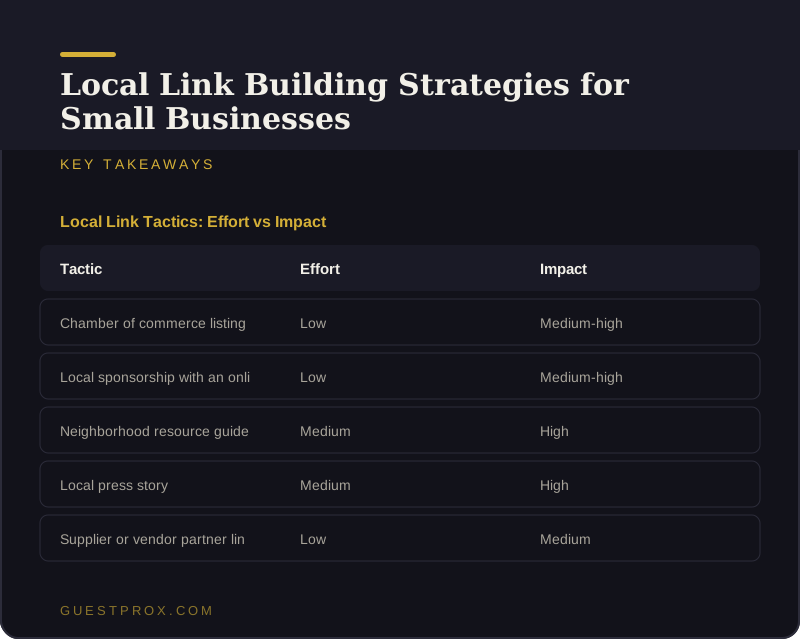
Rank every tactic by what it costs you in time and what it returns in rankings.
| Tactic | Effort | Impact |
|---|---|---|
| Chamber of commerce listing | Low | Medium-high |
| Local sponsorship with an online sponsor page | Low | Medium-high |
| Neighborhood resource guide | Medium | High |
| Local press story | Medium | High |
| Supplier or vendor partner link | Low | Medium |
| Community event hosting | High | High |
Go deeper on the pieces that make local links work.
Authoritative sources if you want to go deeper on this topic.
Expect the first movement in 8 to 12 weeks in a low-competition category, and longer in competitive markets like legal or home services. Google has to recrawl the linking pages and recalculate your local authority. Anyone promising local rankings in days is selling something risky.
Citations get you eligible; links get you ranked. Clean citations confirm you exist, but in any category with real competition, the businesses in the map pack almost always have stronger local link profiles. If you are stuck with clean citations and flat rankings, links are the missing piece.
Buying links means paying for placements on sites chosen for price, not relevance, often link farms that Google eventually penalizes. Manual outreach earns links from real local sites through relationships, sponsorships, and content worth linking to. The first is a transaction Google penalizes; the second is how the web is supposed to work.
We don't publish prices. Message us on WhatsApp at +1 (213) 582-6001 for a quote.
Yes, and this guide is your starting point. The chamber, sponsorship, and local press tactics above are all doable by an owner. Where owners stall is consistency: outreach dies the week business gets busy. That is the point where handing it to a team that does it daily usually pays for itself.
There is no magic number. In most local categories, 10 to 20 strong local links put you ahead of the majority of competitors. Audit who ranks in your map pack, count their quality local links, and aim to beat that, not to hit an arbitrary total.
We run 100% manual local outreach for small businesses: real editors, real local sites, monthly reporting. Message us on WhatsApp at +1 (213) 582-6001 or send a note through the contact form.
Global Service Delivery