
For marketers and SEOs doing the work themselves. The full process: audit your footprint, clean up the mess, build in priority order, and track it.
This local citation building guide is a practitioner's walkthrough of the full process: auditing your existing citations, cleaning up inconsistencies, building new listings in priority order, and tracking the footprint over time. It assumes you already know what citations are and want the how-to.
Order matters. Building new citations on top of a messy footprint multiplies the mess, because Google ends up with more conflicting data, not less. Audit first, clean second, build third. Every experienced local SEO learns this sequence the expensive way; this guide lets you skip that tuition.
The process below works for a single-location business and scales to multi-location with a spreadsheet and discipline. Budget a few focused weeks for the initial pass, then about an hour a quarter for maintenance, or hand the recurring work to a local SEO partner.
Local citation building is the systematic process of auditing, correcting, and creating online business listings so that your name, address, and phone number stay consistent everywhere Google checks.

Before you build anything, find out what already exists. Search your business name, phone number, and address variants in Google, because each query surfaces different listings. Run the same searches with old phone numbers and old addresses if the business ever moved; stale data from years ago still counts against you.
Log everything in a spreadsheet: directory name, listing URL, the name, address, and phone as shown, and status. Pair this with local link building and the footprint starts compounding. This sheet becomes your cleanup hit list and your build tracker. Most businesses discover twenty to forty existing listings they forgot about, plus a handful of duplicates.
Data aggregators feed thousands of smaller directories, so check your listings on the major aggregators first. Fixing data at the source propagates downstream and saves you from editing hundreds of sites one by one. Also search your phone number in quotes: old tracked numbers and former addresses surface listings that no business-name search will ever find.
Cleanup means correcting inaccurate listings and eliminating duplicates. Claim every listing you can, because unclaimed listings get edited by anyone, including competitors and well-meaning customers. Where you cannot claim, use each directory's suggest-an-edit or support flow.
Duplicates are the silent killer. The same business listed twice on one platform splits authority and confuses customers. Merge or remove duplicates before building anything new; most directories have a report-duplicate flow for exactly this. Citation cleanup is unglamorous work, and it is where most failed citation projects actually failed.
If more than a third of your existing listings are wrong or duplicated, spend your first week purely on cleanup. Building on a broken foundation just hands Google more conflicting signals. A useful rule: audit in week one, clean in week two, build from week three.
Lock one canonical format now. Business name exactly as registered, with no added keywords or city names. Address in a single fixed style: pick St or Street and never deviate, and write suite numbers identically everywhere. Use one primary phone number in one consistent format, then put these three lines at the top of your tracking sheet and never improvise.
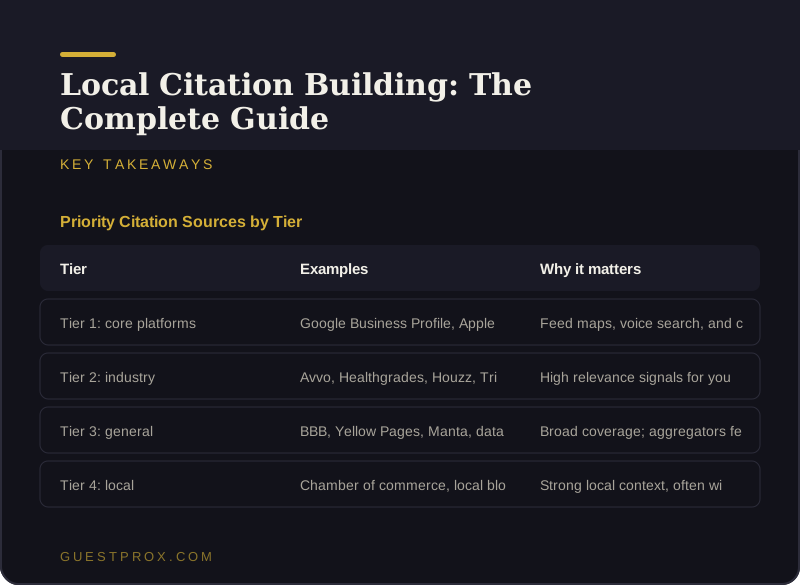
Not all directories are equal. Build in tiers: the platforms Google checks first, then your industry directories, then general directories, then local and niche opportunities. Fifty right local citations beat two hundred random ones, the same quality-first rule behind our local citation standards.
Tier one is non-negotiable: Google Business Profile, Apple Maps, Bing Places, Yelp, and Facebook. These feed maps, voice assistants, and car navigation directly. Get them perfect before touching anything else.
A finished footprint means every tier-one and tier-two listing claimed, accurate, and consistent, with no unresolved duplicates and a current tracking sheet. For most single-location businesses that is forty to sixty listings. After that, maintenance is a quarterly audit pass, because aggregators resync and new duplicates appear. Catching them early keeps the footprint clean.
Keep the audit spreadsheet alive as your source of truth: one row per listing, a last-checked date, and a status column. Re-check tier-one listings quarterly and the full sheet twice a year. When the business moves, changes numbers, or rebrands, the sheet tells you exactly which listings to update, which is precisely when most businesses create their mess.
Build top-down. Each tier assumes the one above it is finished.
| Tier | Examples | Why it matters |
|---|---|---|
| Tier 1: core platforms | Google Business Profile, Apple Maps, Bing Places, Yelp, Facebook | Feed maps, voice search, and car navigation directly |
| Tier 2: industry | Avvo, Healthgrades, Houzz, TripAdvisor, niche directories | High relevance signals for your specific vertical |
| Tier 3: general | BBB, Yellow Pages, Manta, data aggregators | Broad coverage; aggregators feed hundreds of smaller sites |
| Tier 4: local | Chamber of commerce, local blogs, sponsorships | Strong local context, often with unstructured mentions |
From citation basics to the local links that come next.
Authoritative sources if you want to go deeper on this topic.
Clean first, always. New citations built on top of conflicting old ones give Google more contradictions to resolve, not fewer. Work through your audit spreadsheet correcting and deduplicating before you create a single new listing. The only exception is a brand-new business with no footprint at all.
The initial pass takes a few focused weeks for a single location: one for audit, one for cleanup, one or two for building. Maintenance after that is about an hour a quarter. Multi-location businesses multiply the build time but follow the identical process per location.
Not the same list, but the comparison is useful. Pull the citation profiles of the top three map pack competitors and note which directories appear repeatedly that you are missing. Those gaps are your highest-value builds, because they are citations Google already associates with ranking businesses in your market.
We don't publish prices. Message us on WhatsApp at +1 (213) 582-6001 for a quote. Cleanup-heavy projects scope differently from fresh builds, so we start with an audit of your current footprint before quoting anything.
The process stays the same; the bookkeeping multiplies. Keep one tracking sheet per location with its own canonical NAP format, and never copy one location's listings as a template for another. Shared phone numbers or addresses across locations are the fastest way to create duplicates at scale.
Yes, through trust dilution rather than penalties. Google will not punish you for a wrong phone number on a directory, but every inconsistency is a reason to doubt your location data. Enough doubt and a competitor with cleaner data takes your map pack spot, even with weaker reviews. That is the quiet cost of a messy footprint.
We handle audit, cleanup, and building end to end, with a tracking sheet you keep. Message us on WhatsApp at +1 (213) 582-6001 or email contact@guestprox.com.
Global Service Delivery