
Editors don't reject guest posts for being too optimized. They reject them for being boring, thin, or obviously written for a link. Write for the reader and the link takes care of itself.
Learning how to write a guest post editors accept starts from the publication's readers, not your keyword. Research what the site has already covered, find the angle-shaped hole, then write the article you'd want to read if you were their audience. Our guest post quality checklist covers link placement and the rest of the pre-submission bar in one page.
Most rejected guest posts fail the same test: they were written for the link, and it shows. Thin content, generic advice the site has published before, awkward keyword-stuffed anchors, editors see dozens weekly. The posts that sail through read like they came from a regular contributor who happens to have a relevant resource to link.
A publishable guest post serves the publication's readers first, original angle, real depth, natural link placement, and earns its backlink as a byproduct.
Every editorial decision answers one question: will our readers be glad we published this? Write to that question.
Before writing, read the publication. Note the audience's level, beginners need foundations, practitioners need depth, and match it. A post pitched at the wrong level gets rejected no matter how well written, because the editor can picture their readers bouncing.
Check the comments and social shares on similar topics. The questions readers ask there are your outline, handed to you free. That is the real curriculum for how to write a guest post: study the readers, then serve them.
Editors have seen every generic version of your topic. What they haven't seen is your specific experience: the campaign data, the mistake you made, the counterintuitive result. Lead with what's yours. A post built on first-hand specifics is nearly rejection-proof; a post built on rewrites of existing articles is nearly acceptance-proof, in the wrong direction.
This is also where AI-written drafts fail hardest. They produce competent averages of existing content, which is exactly what editors already have.
Thin doesn't just mean short, it means low information density. Five hundred words of genuine insight beats two thousand words of padded generalities. Editors skim for substance: specific examples, concrete steps, honest caveats. If a section could appear in any article on the topic, cut it or make it specific.
Strong guest posts follow a shape editors recognize as professional.
Open with the reader's problem or a surprising specific, not a dictionary definition, not 'in today's world.' Two to three sentences that make the target reader think 'this is for me.' If the opening could open any article on the topic, rewrite it.
Use descriptive subheadings that tell a skimmer the story. Each section should deliver something the reader can use, a step, a framework, a decision rule. Vary the texture: a short punchy paragraph after a dense explanatory one keeps momentum. End sections with the implication, not just the information.
Place your link where a reader would genuinely want it, as a citation for a claim, a deeper resource on a subtopic, a tool that solves the problem you just described. Contextual, mid-article placement in a relevant section. Never force it into the intro, never stuff three links where one belongs, and keep anchor text natural.
Summarize the decision or action, not the article. Readers remember endings, give them the one-line takeaway and, where appropriate, a next step. Keep author bio lines factual and brief; editors trim hype.
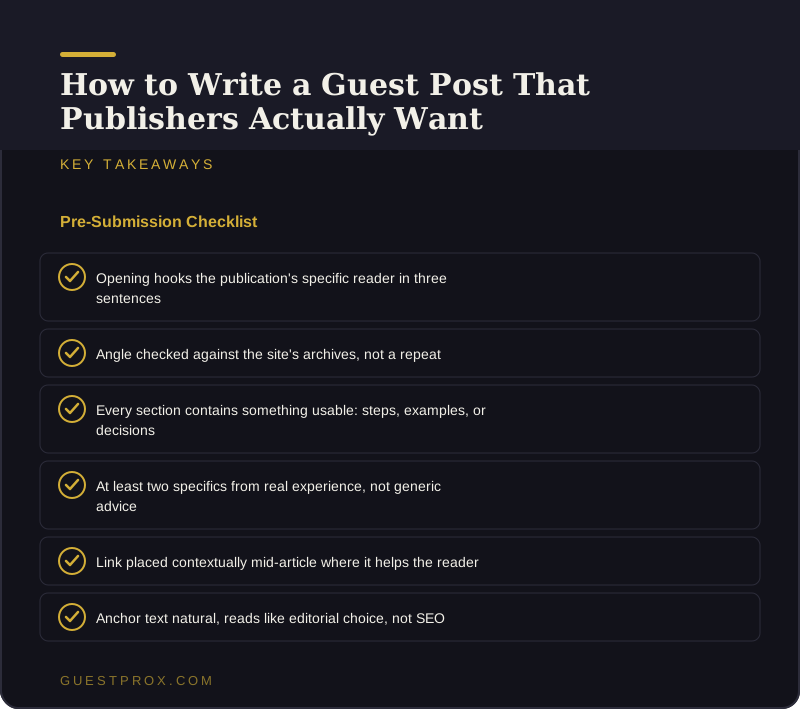
Run every draft through this before it goes to the editor.
Acceptance is often the start of a short collaboration, not the end of the process.
Editor feedback is a map of what their audience wants. 'Can you make this more actionable?' means their readers are practitioners. 'This overlaps with our recent piece' means your research missed something, apologize, adjust, move on. Take every note seriously; editors rarely give second chances to defensive writers.
Rarely, and gently. If a requested change would break the article's accuracy or strip your link's context unfairly, explain the concern once, briefly, and offer an alternative. Most of the time, though, the editor knows their audience better than you do, default to trusting them.
Return revisions quickly, within days, not weeks, with a short note on what changed. Speed signals professionalism and keeps your article in the editor's mental queue. A fast, gracious revision round is also how one-off contributors become regular ones.
Editors can tell within two paragraphs whether a draft belongs on their site. Voice mismatch, a casual post on a formal publication, or jargon-heavy writing on a beginner blog, is a silent rejection trigger. The fix is a focused read-through before you write: open three recent articles and note sentence length, jargon density, how they open, and how they close.
Build a quick voice profile: is the tone 'we' or 'you', do headlines promise outcomes or ask questions, are paragraphs two sentences or six, do they use named-company or hypothetical examples? Ten minutes of this beats an hour of rewriting later, because you're calibrating before the words exist rather than fixing after.
Then write to the profile, not to your habits. If their posts open with a reader's problem, open with a reader's problem, even if you usually open with data. If they close with a clear next step, close with one. Mimicry isn't the goal; belonging is, the draft should feel like it could have come from their staff, which is exactly the standard our SEO content writing team writes to for every placement.
One warning: voice matching is not topic matching. Writing in their voice about a subject they've covered three times still gets rejected. Voice gets you past the skim; originality gets you the yes. You need both, in that order.
The link itself is a few words; the paragraph around it is what makes it editorial. Write the 150 to 200 words surrounding your link as if the link weren't there, a genuinely useful passage that earns its place in the article. Then place the link where a reader would naturally want to go deeper. If the paragraph collapses without the link, it was written for the link, and editors can feel it.
The best link paragraphs do one of three jobs: they cite evidence for a claim you just made, they point to a deeper resource on a subtopic you're summarizing, or they name the tool or method that solves the problem you described. Each job gives the reader a reason to click that has nothing to do with your SEO. Write the reason first; the link follows.
Anchor text should read like the author's choice, not a keyword insertion. If the sentence sounds natural with the anchor replaced by 'this guide' or 'their research,' you're fine. If removing the exact-match phrase breaks the sentence, rewrite the sentence, the anchor was driving the writing instead of the writing driving the anchor. For the full discipline behind this, see our anchor text guide.
Write it well, then place it well.
Authoritative sources if you want to go deeper on this topic.
As long as the topic needs, usually 1,000 to 2,000 words for substantive SEO topics. Length follows depth: cover the subject properly and stop. Editors reject padded 2,500-word posts as fast as thin 400-word ones. Match the publication's typical article length as your guide.
One self-serving link is the norm; two at most if both genuinely help the reader. Everything else should link out naturally to sources and references like any good article would. Posts built around smuggling multiple commercial links get rejected, and the ones that slip through sit on sites with no standards.
Editors are rejecting AI-generated submissions at increasing rates, they recognize the patterns, and the content is usually a competent average of what's already published. We write every guest post manually. Use AI for outlining or research if you like, but the draft that goes to an editor should be human-written.
Original images, screenshots, or diagrams strengthen a pitch and a post, they signal effort and improve the reader experience. Stock photos add little. If you have real data visualizations or process screenshots, include them; editors notice.
In our experience: topics the site already covered, content clearly written for the link rather than the reader, and drafts that ignore the publication's guidelines. All three are avoidable with twenty minutes of research before writing. Rejection is usually about fit and effort, not writing talent.
Typically the publication, once published, that's the trade. You get the link and exposure; they get the content asset. Keep a copy for your portfolio, but don't republish it elsewhere verbatim. Some agreements differ, so check the publication's contributor terms if ownership matters to you.
Message us on WhatsApp at +1 (213) 582-6001 or send the form below. Our writers produce every guest post manually to editorial standard.
Global Service Delivery