
Guest posting is simple in concept and easy to get wrong in practice. Here is what it actually is, how the process works, and what separates a placement that moves rankings from one that wastes money.
Guest posting is the practice of writing and publishing an article on someone else's website in exchange for a backlink to your own site. The article lives on their domain, the link points to yours, and both sides get something: the publisher gets free content for their readers, and you get authority, referral traffic, and a vote of confidence in Google's eyes. If you've been wondering what is guest posting in practical terms, not the textbook definition, this guide covers exactly that.
It matters because backlinks remain one of the strongest ranking signals in search. Not all links are equal, though. A contextual link inside a genuine article on a real, trafficked website carries weight. A link on a site nobody visits, built only to sell links, carries almost none, and can cause problems.
The difference between those two outcomes is the entire craft of guest posting. It is not about publishing anywhere that will take your article. It is about earning placement on legitimate publications through real outreach, with content their editors would accept even if you weren't a link builder.
Guest posting is publishing an article on another website to earn a contextual backlink, referral traffic, and topical authority for your own site.

Strip away the jargon and the process has four moving parts. Understanding each one helps you judge any guest posting offer, including ours, with clear eyes.
You (or your agency) identify a website in your niche with real readers. You pitch the editor a topic their audience would genuinely want to read. If they accept, you write the article, they publish it, and somewhere natural in the text sits a link back to a relevant page on your site.
That link is the asset. Everything else, the research, the pitch, the writing, exists to make that link legitimate in the eyes of both the editor and Google.
A real campaign starts with prospecting: finding sites with verified organic traffic in your industry, not just impressive-looking metrics. Then comes vetting, where each candidate is checked for content quality, link patterns, and signs it exists to sell links. Only then does outreach begin, a personal pitch to an actual editor, not a blast to a thousand inboxes.
After a topic is approved, the article is written to the publication's editorial standard, submitted, sometimes revised, and published with your link placed contextually in the body. Finally, you get a report with the live URL. From first research to live link, our Starter campaigns typically complete in about 15 days.
In a done-for-you service like ours, we handle prospecting, vetting, outreach, writing, and reporting. You approve the strategy up front, which pages to promote, what anchor text to use, and you see every live placement. What you should never have to do is wonder where your links actually live.
Honest expectations matter more than hype. Here is where guest posting earns its keep, and where it doesn't.
Guest posting builds referring domains from real editorial sites, which is exactly the link profile Google rewards. Anyone asking what is guest posting's real advantage over other tactics usually lands here: control plus editorial legitimacy in one package. It lets you control anchor text and target pages precisely, unlike digital PR where you take what coverage gives you. And it compounds: each placement adds a permanent, relevant citation to your site's authority.
It also drives referral traffic when the publication has a real audience, people who click through because the article was worth reading.
Links can't rescue a site with thin content, technical problems, or no clear reason to rank. If your pages don't satisfy search intent, authority just gets you a higher position on a page nobody clicks. Fix the on-page foundation first, then build links to pages that deserve them.
It also won't outrun a manual penalty caused by past spammy link building. That needs cleanup before new links help.
Most clients notice ranking and traffic movement within 4 to 12 weeks of placements going live. Google needs time to crawl the new links, re-evaluate your pages, and adjust. Anyone promising overnight jumps from a handful of guest posts is selling something else.
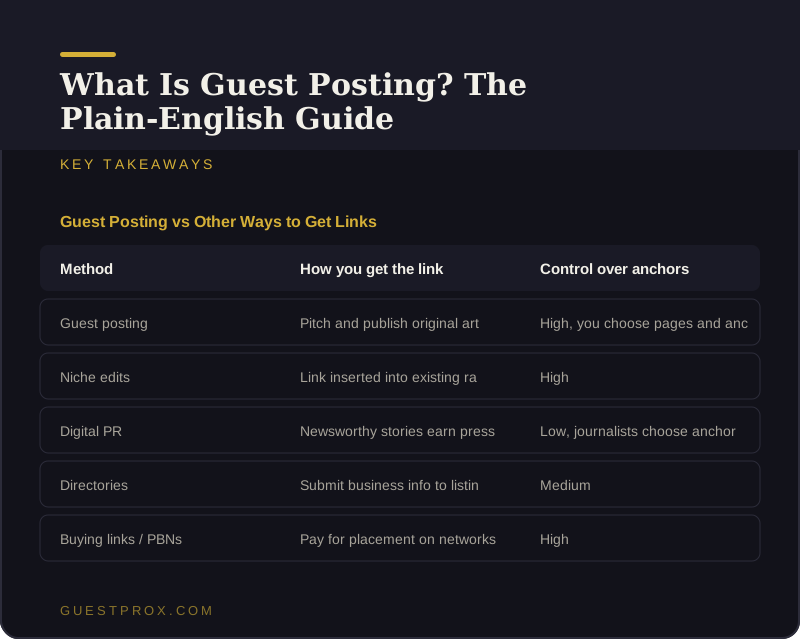
Every link tactic has a tradeoff. Here is how guest posting stacks up.
| Method | How you get the link | Control over anchors | Typical risk |
|---|---|---|---|
| Guest posting | Pitch and publish original articles on real sites | High, you choose pages and anchors | Low when done with manual outreach on real sites |
| Niche edits | Link inserted into existing ranking articles | High | Low with proper vetting; faster impact |
| Digital PR | Newsworthy stories earn press coverage | Low, journalists choose anchors | Low, but unpredictable volume |
| Directories | Submit business info to listing sites | Medium | Low value; fine for local citations |
| Buying links / PBNs | Pay for placement on networks built to sell links | High | High, violates Google's spam policies |
The tactic is old; the standards are new. What worked five years ago, decent article, decent site, done, now competes with sharper editorial filters and smarter spam detection. The core idea still holds, but the execution bar moved.
Google's spam policies target scaled, manipulative link building: large article campaigns with keyword-rich anchors, links from sites built to sell them, automation at every step. What they don't target is genuine editorial publishing, real sites, real audiences, real content standards.
The confusion comes from lumping all guest posting together. A thoughtful article on a respected industry publication and a spun post on a link farm share a name and nothing else. Judge the practice by its execution, not its label.
As AI made content cheap, editors got pickier, they've seen every generic version of every topic. Publications that survive now filter harder, which is good for serious link builders: stricter editors mean less competition from low-effort pitches and more durable links when you get through.
This is also why relationships compound. An editor who accepted your work once opens your next email faster. Reputation is the moat in modern outreach.
Manual outreach to vetted publications. Original angles backed by real experience. Natural anchor text planned across a campaign, not stuffed into every post. Transparent reporting with live URLs. None of this is new, it's just that the shortcuts around it finally stopped working, leaving the fundamentals as the only game left.
Guest posting pays off fastest for sites competing in SERPs where links decide the winner: national keywords, competitive local markets, SaaS categories dominated by review sites. If your pages already satisfy search intent and convert, each relevant placement adds authority that turns into visible movement, which is why placements should follow a documented guest posting strategy, not ad-hoc orders.
It is a weaker fit for brand-new sites with no content depth yet. A new domain with five thin pages and fifty guest post links looks engineered, because it is. Build the content foundation first, real pages worth linking to, then layer in placements at a pace that matches genuine growth.
It is also the wrong first move when a site carries a penalty from past spammy link building. New editorial links can't outvote a manual action; cleanup and reconsideration come first. An honest provider tells you this before taking your money, it is one of the fastest ways to separate real operators from order-takers.
For everyone in between, established sites, growing blogs, local businesses in competitive markets, agencies fulfilling for clients, it is the most controllable link tactic available. You choose the publications, the topics, the anchors, and the pace. That control is why our guest posting guide treats strategy before tactics: the who and why decide whether the how works.
DIY guest posting is entirely possible and teaches you the craft fast. The hidden costs are time and tools: prospecting software, backlink analysis, a warmed sending domain, and roughly five to ten hours per placement when you count research, pitching, writing, and follow-up. Most in-house attempts stall at the outreach stage, not from lack of skill, but because editors respond to senders they recognize.
Agencies compress that timeline with relationship capital. Since 2018 we have built publisher relationships across 20+ niches, so our prospecting starts warm while DIY starts cold. You are not just buying labor; you are buying the reply rates that come from editors who have accepted our writers' work before.
The middle path works for many teams: run strategy and target-page selection in-house, outsource prospecting, outreach, and writing. You keep control of anchors and priorities; the agency supplies the pipeline. Our guest posting service is built for exactly this split, you approve the plan, we run the machine, every placement is reported with a live URL.
Whichever route you take, judge it on the same outputs: placements on real trafficked sites, natural anchor distribution, and ranking movement within the 4-to-12-week window. If a provider can't show you live URLs you can click, the DIY route with full transparency beats the agency route with none. Verifiability is the whole game.
Go deeper on the guest posting process and the publishers we target.
Authoritative sources if you want to go deeper on this topic.
Yes, when done properly. Google's spam policies target manipulative link schemes, scaled, low-quality guest posting with keyword-stuffed anchors. Editorial guest posts on real publications with genuine audiences remain one of the most reliable ways to build authority. The tactic didn't stop working; the shortcuts around it did.
Not inherently. Google penalizes large-scale article campaigns with keyword-rich anchor text designed to manipulate rankings. A manual, selective approach, real sites, real traffic, relevant topics, natural anchors, sits comfortably within the guidelines. That is the honest version of what is guest posting under Google's rules: intent and execution decide. Transparency helps: we never hide that placements are earned through outreach.
There is no universal number. It depends on your niche's competitiveness, your current authority, and which keywords you're chasing. A local business might move with a handful of strong placements; a SaaS company fighting for national keywords needs sustained campaigns. We scope this from competitor analysis, not guesswork.
We do. Our writers produce the guest post to the publication's editorial standard, and you approve the topic direction up front. If you prefer to write it yourself, that works too, we'll handle the outreach and placement around your draft.
Yes. Every placement we deliver is a contextual, dofollow link inside the article body. We verify this at publication and again in QA before reporting. If a publisher only offers nofollow, we tell you before proceeding rather than after.
We don't publish prices. Every campaign is scoped around your niche, target metrics, and volume, so a flat rate would be dishonest. Message us on WhatsApp at +1 (213) 582-6001 for a quote.
Message us on WhatsApp at +1 (213) 582-6001 or send the form below. We'll show you the kind of publishers we work with before you commit to anything.
Global Service Delivery