
Random guest posts produce random results. Here is the strategic framework behind campaigns that actually move rankings, the same one we run for our clients.
A guest posting strategy is a plan that connects every placement to a business goal: which pages you're promoting, what anchor text you're using, what caliber of sites you're targeting, how fast you're publishing, and how you'll know it's working. Without it, you're just collecting links and hoping.
Strategy matters because links interact. Ten placements with the same exact-match anchor look manipulative; ten with a natural mix look editorial. Five links to your homepage and none to your money pages wastes authority where it can't convert. The framework below is how we plan every campaign before a single pitch goes out.
In one line: it plans which pages to promote, with what anchors, on what caliber of sites, at what pace, before any outreach begins.
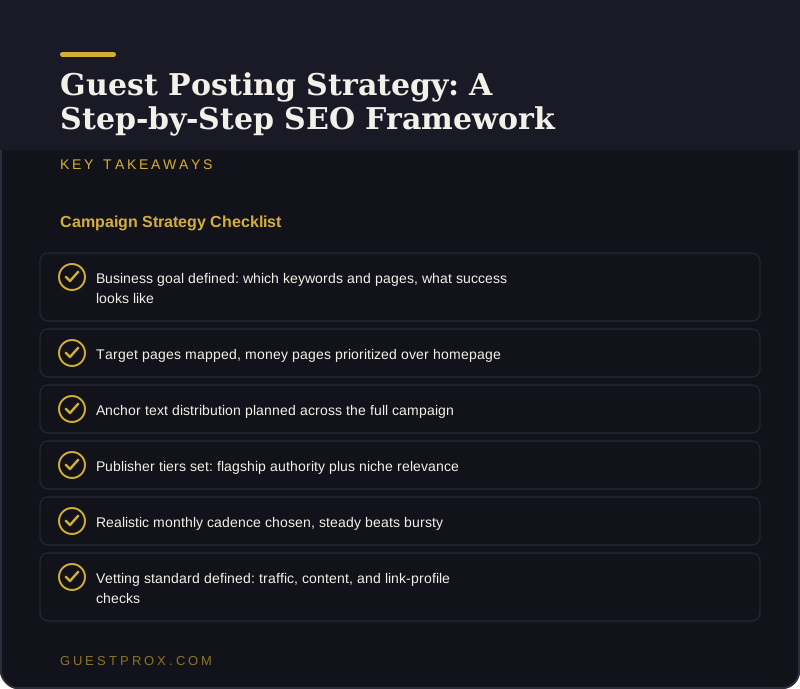
Get these five right and the tactics nearly take care of themselves.
Start with the business outcome: which keywords, which pages, what movement would count as success. Then map placements to pages deliberately, priority money pages get the strongest, most relevant links; supporting content gets the rest. Links pointed at pages that can't convert are authority spent poorly.
A common mistake is pointing everything at the homepage. Homepages usually rank on brand strength already. Your commercial and content pages are where targeted links change outcomes.
Plan your anchor mix before you start, not after ten identical anchors are live. A natural profile blends branded anchors, naked URLs, generic phrases, and exact or partial-match keywords, with commercial anchors as the minority, not the majority.
We map anchors per target page in advance and track the running distribution across the campaign. This is unglamorous spreadsheet work, and it's what keeps a campaign safe as it scales.
Not every placement needs to be a top-tier publication. A smart strategy mixes high-authority flagships that build trust with mid-tier niche sites that deliver relevance and volume. We typically work across DR 40 to 90, weighting the mix toward your goals: authority plays get flagships, relevance plays get niche depth.
Tiering also manages risk. If one placement underperforms, the campaign doesn't depend on it.
Publishing rhythm should look like a real content marketing effort, not a link blast. Steady, consistent placements over months beat fifty links in a week followed by silence, both for safety and because Google's evaluation of your profile happens continuously.
For most businesses, a sustainable monthly cadence tied to content output works better than sprint-and-stop bursts. Agencies white-labeling with us usually run always-on campaigns for exactly this reason.
A strategy without measurement is a wish. Here's what to actually watch.
Early signals that the campaign is on track: placements going live on vetted sites, referral traffic from published articles, new referring domains appearing in your profile, and target pages getting crawled more frequently. These show up within weeks and confirm execution quality.
The outcomes that matter: keyword movement for targeted terms, organic traffic growth to promoted pages, and ultimately conversions. Most clients see meaningful movement within 4 to 12 weeks of placements going live. Judge a campaign on these, but give it the full window before declaring verdicts.
If leading indicators are strong but rankings don't move after three months, the problem is usually on-page, intent mismatch, thin content, or technical issues, not the links. If placements stall, revisit prospecting breadth. Strategy is a loop: measure, diagnose, adjust, repeat.
Run through this before launching any campaign.
We've reviewed enough campaigns to see the same errors repeat. All are avoidable.
Strategies built around 'get X links at DR Y' optimize for the report, not the business. Start from the outcome, which keywords, which pages, what movement, and let the metrics serve that. A campaign that hits its link quota and moves nothing failed, no matter how good the spreadsheet looks.
Link building isn't a project with an end date; it's a capability. Competitors keep building, algorithms keep evolving, content keeps aging. The best-performing clients run steady, always-on campaigns and review strategy quarterly, not one-off blasts followed by a year of silence.
Links amplify pages; they don't fix them. Before scaling outreach, make sure target pages deserve to rank: intent match, depth, speed, internal linking. We've seen campaigns double their effectiveness just by fixing the landing pages first. Audit the destination before buying the fuel.
Strategy turns into a calendar. For a new campaign, we think in three 30-day phases with different jobs. Days 1–30 are foundation: intake, anchor audit, competitor benchmarking, prospecting, and the first pitches. Expect few live links this month, the output is a vetted pipeline and approved topics, not a report full of URLs.
Days 31–60 are acceleration. Outreach compounds as early replies land, writing runs in parallel with pitching, and the first placements go live. This is also when anchor discipline matters most: the temptation is to point every early link at the money page with commercial anchors. Resist it, the first links set the pattern Google learns, so they should look the most natural.
Days 61–90 are review and rebalance. With placements live for several weeks, leading indicators start arriving: referral traffic, new referring domains, crawl frequency on target pages. Compare reality against the success criteria written at intake. If prospecting underperformed, widen the list; if anchors skewed commercial, correct the mix; if target pages didn't move, audit the pages before blaming the links, then set the next quarter's plan from data, not hope.
One caution: the 90-day frame is for the campaign's rhythm, not a promise of rankings. Google's evaluation window runs 4 to 12 weeks from when links go live, and competitive niches need sustained effort beyond one quarter. Anyone selling you a 90-day guarantee is selling the calendar, not the outcome. For pacing specifics, our post on link velocity covers how fast is too fast.
The framework is the same; the constraints differ. In-house teams own the strategy but usually lack the outreach infrastructure, no warmed domains, no publisher relationships, no dedicated prospectors. Their best play is focus: fewer target pages, tighter anchor plans, and a short list of dream publications pursued persistently. Depth beats breadth when bandwidth is limited.
Agencies face the opposite problem: plenty of pipeline, complicated reporting. When you're fulfilling for clients, strategy has to survive translation, the client's goals become your brief, your placements become their report. White-label delivery adds another layer: reports must read as the agency's work, metrics must be client-ready, and communication runs through the agency, never around it. Our white-label link building is structured around exactly these constraints.
The hybrid model, in-house strategy, outsourced execution, is where most serious operations land. You keep the decisions that need business context: which pages matter, what success looks like, how aggressive to be. The agency supplies the machine: prospecting, outreach, writing, QA, reporting. Strategy stays yours; labor scales without headcount.
Whichever structure you run, keep one non-negotiable: strategy gets reviewed on a schedule, not when something breaks. Quarterly reviews, anchors, publisher mix, target pages, leading indicators, take an hour and prevent the slow drift that turns good campaigns mediocre. Set-and-forget is how strategies die; scheduled review is how they compound.
Strategy in practice.
Authoritative sources if you want to go deeper on this topic.
It depends on your niche's competitiveness and your goals. A local business might run a handful monthly; a SaaS company in a competitive SERP needs sustained volume. The right number comes from competitor analysis, look at the link velocity of sites outranking you and plan to match it with better quality, not just match it.
Most campaigns show ranking and traffic movement within 4 to 12 weeks of placements going live. Strategy doesn't shorten Google's evaluation window, but it makes sure that when the window closes, the links point at the right pages with the right anchors, which is what turns movement into meaningful gains.
No. Homepages usually rank on existing brand authority. Your commercial pages, category pages, and key content pieces are where targeted, relevant links change outcomes. A good strategy distributes placements across the pages that need authority most, with the homepage getting only its natural share.
You should. Guest posting gives you control and relevance; digital PR gives you authority spikes and brand mentions; niche edits give you speed on existing ranking pages. The strongest campaigns layer tactics deliberately rather than betting everything on one. We build mixed-tactic strategies for clients who need them.
Connect placements to outcomes in stages: execution metrics first (live placements on vetted sites), then leading indicators (referral traffic, referring domain growth), then business outcomes (keyword movement, organic traffic, conversions). Report on a 4/8/12-week cadence so stakeholders see progress before the final results land.
We don't publish prices, every campaign is scoped around niche, target site caliber, and volume. Message us on WhatsApp at +1 (213) 582-6001 and we'll quote your strategy directly.
Message us on WhatsApp at +1 (213) 582-6001 or send the form below. We'll analyze your niche and map a placement plan around your actual goals.
Global Service Delivery